Artwork
Madonna and Child
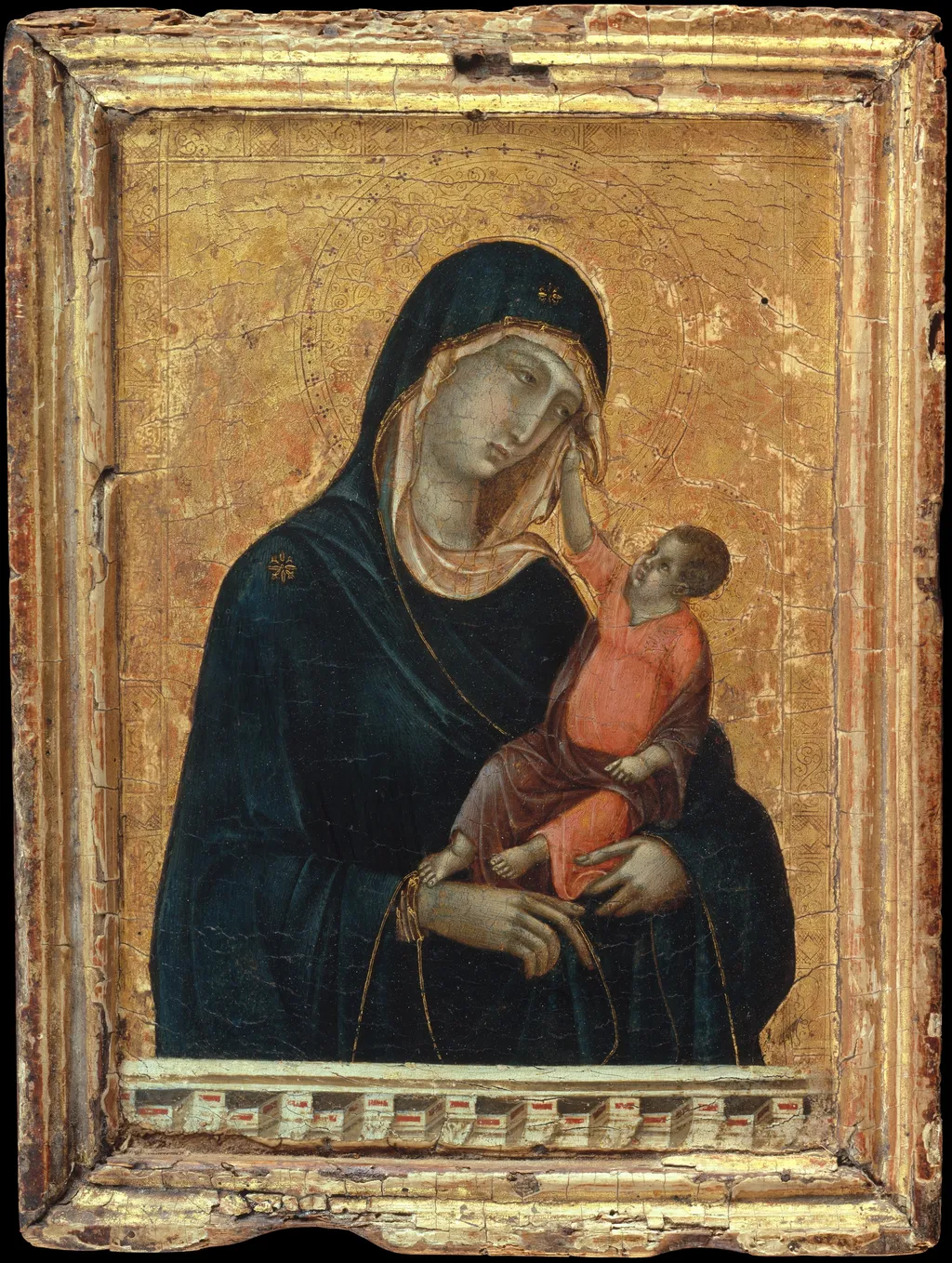
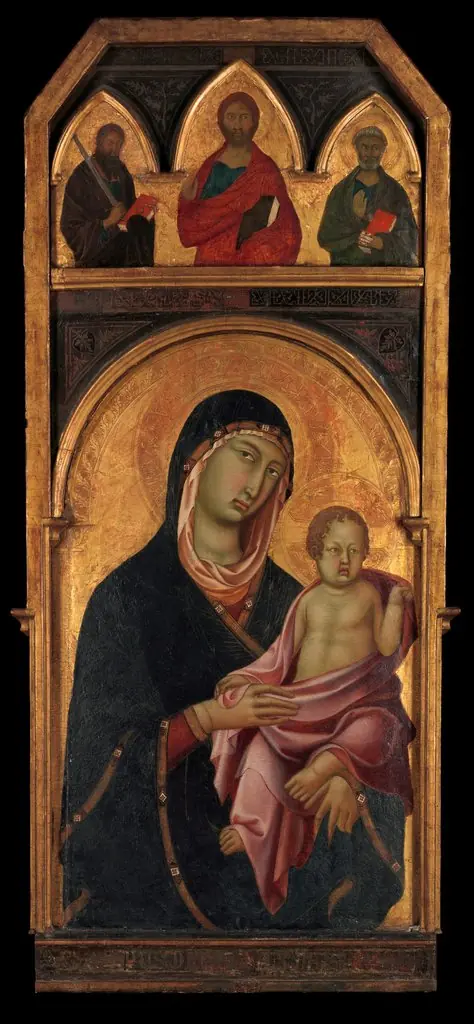
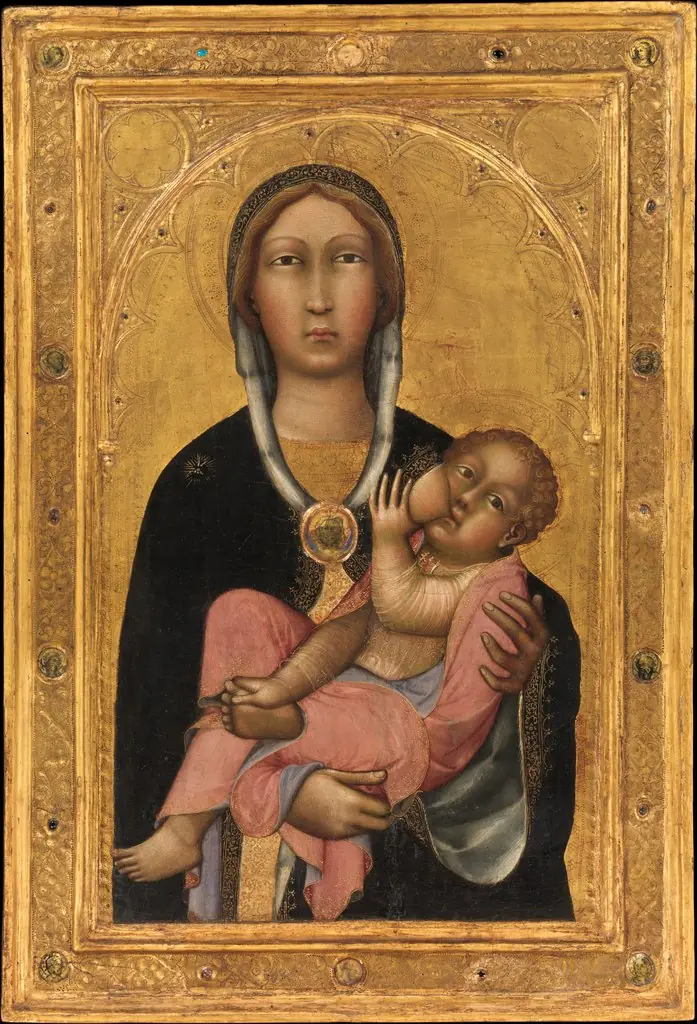
Madonna and Child is an unspecified painting by Duccio di Buoninsegna. It is held in the collection of the Metropolitan Museum of Art.
About this work
Subject & Meaning
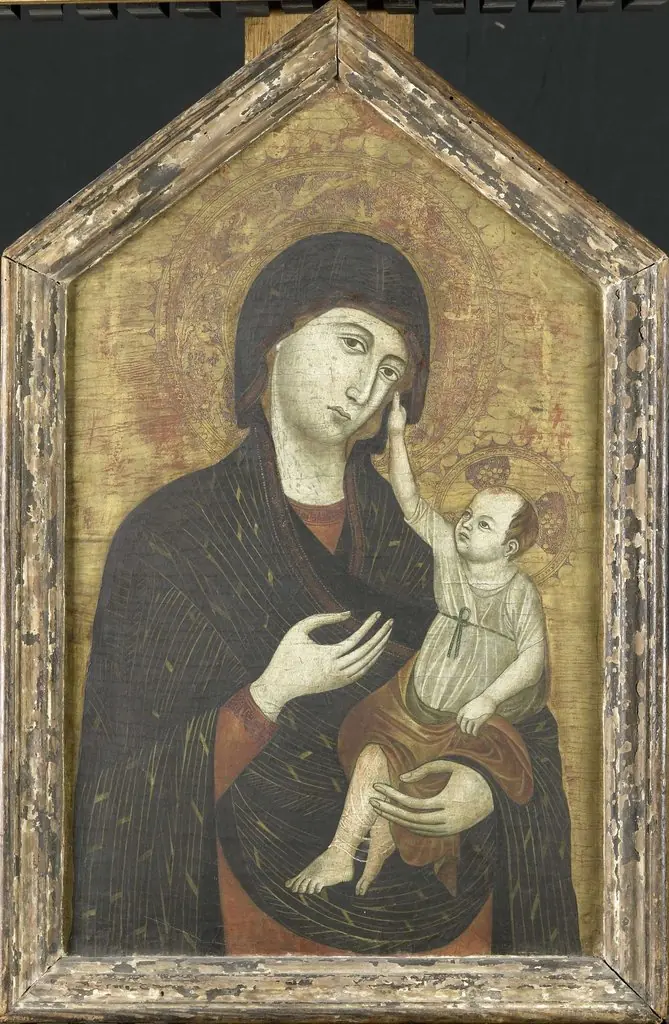
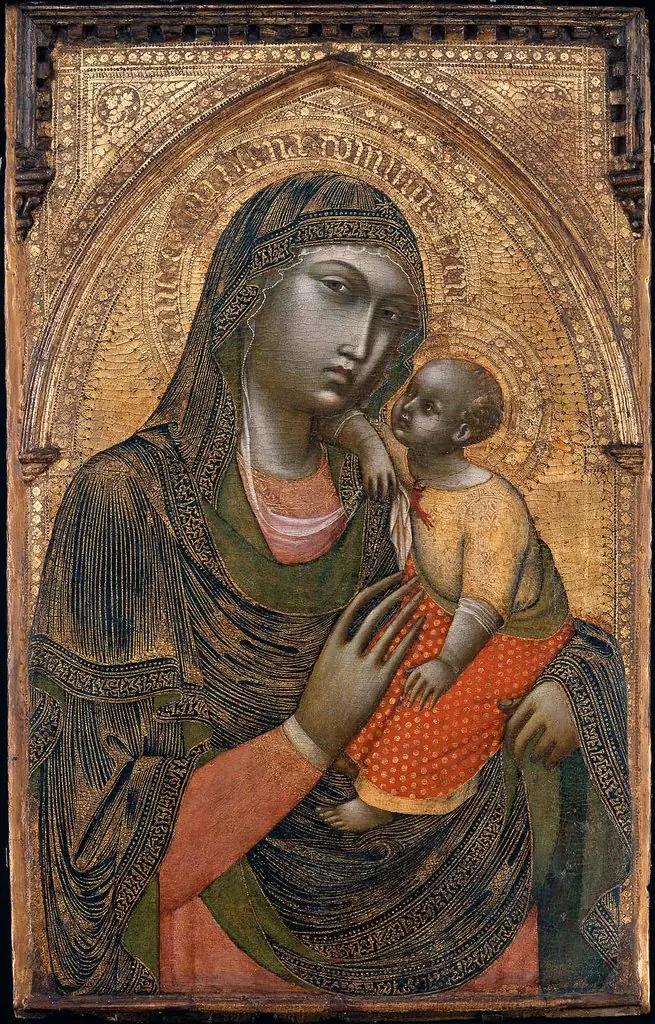
Duccio renders Mary in a simple maphorion replaced by a thin veil, while the Christ Child reaches toward her face, a gesture that alludes to his future Passion.
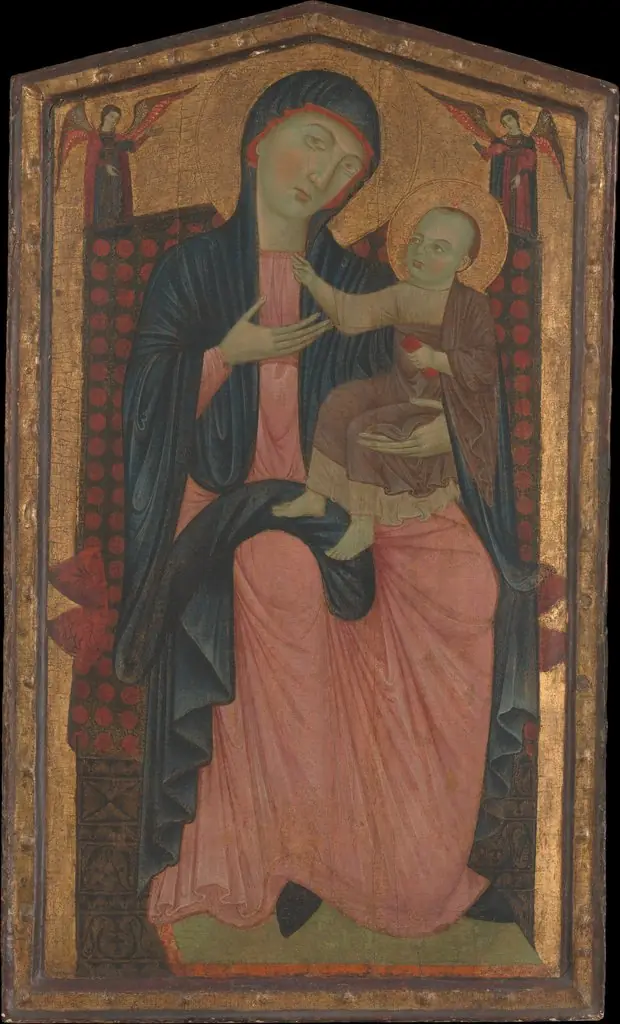
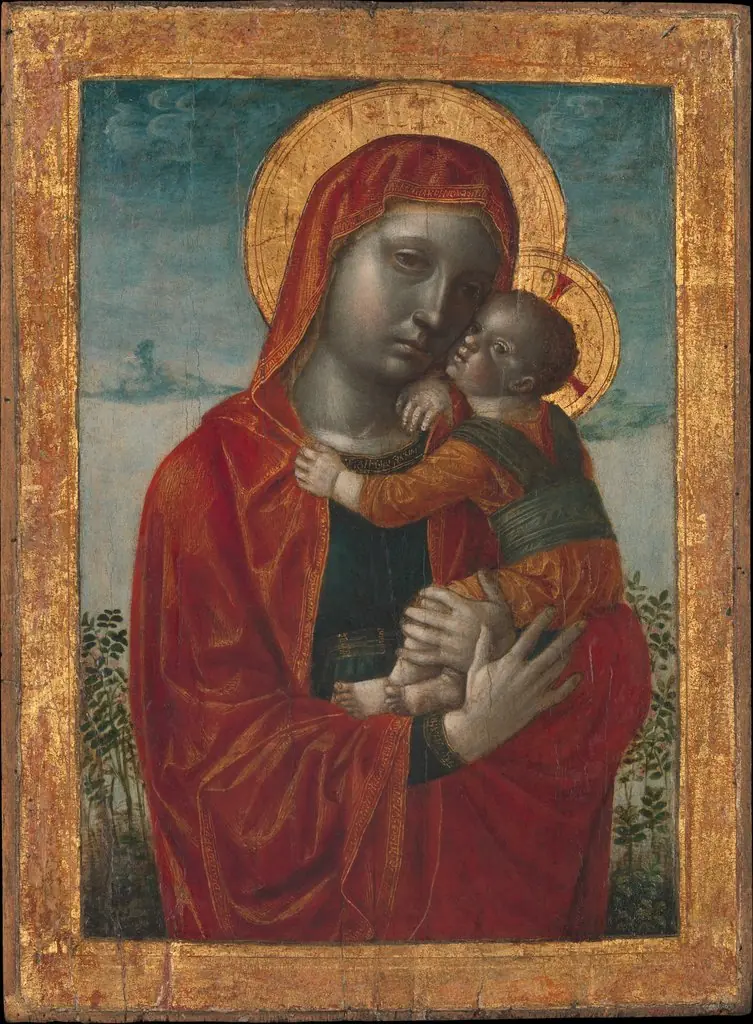
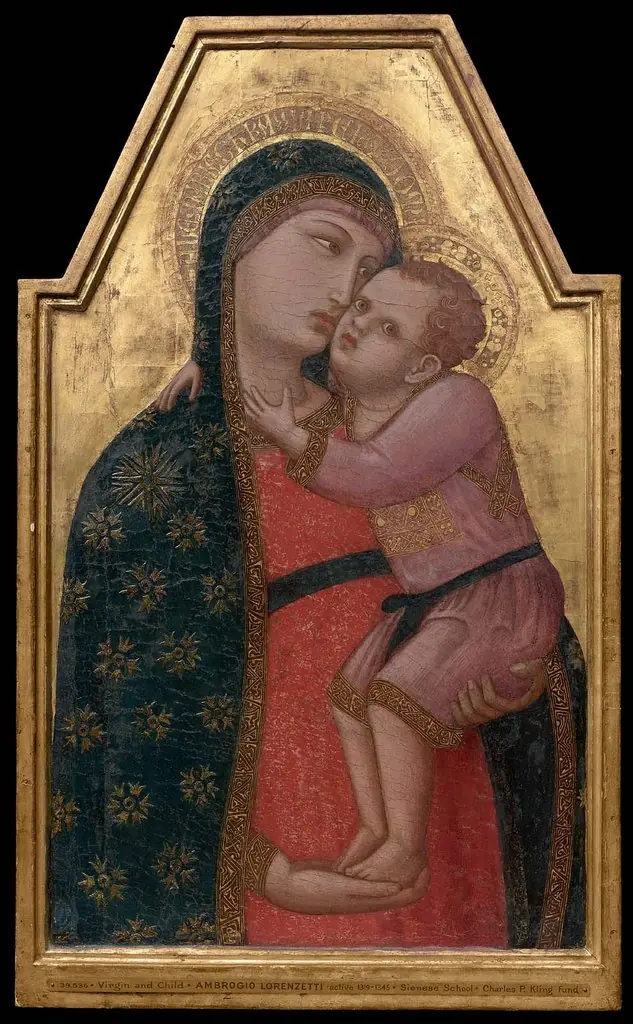
The work portrays the Virgin Mary holding the infant Christ, a traditional icon of the Madonna and Child. Duccio renders Mary in a simple maphorion replaced by a thin veil, while the Christ Child reaches toward her face, a gesture that alludes to his future Passion. A marble parapet at the lower edge creates a shallow space that both invites the viewer into the intimate scene and functions as a symbolic barrier between the earthly and the sacred.
The luminous colors, delicate fabric folds, and finely tooled gold ground reflect an emerging humanist naturalism that bridges Byzantine tradition and early Renaissance realism. These visual choices convey a devotional focus on personal connection and foreshadow later Sienese developments.
Technique & Style
Executed circa 1300, this compact devotional panel measures approximately 24 by 16 centimeters and is painted in tempera on a wood support. The work retains its original engaged frame, which exhibits burnt edges at the bottom, likely resulting from proximity to lit candles during private worship. Stylistically, the painting synthesizes Byzantine traditions with emerging humanist realism; while the Virgin's oval face and the Christ Child's miniature proportions reflect earlier conventions, the handling of light and fabric demonstrates significant innovation.
Duccio employed luminous colors and rendered the Virgin's veil with fine, translucent folds, replacing the heavy Byzantine maphorion with a softer, more naturalistic drape. A marble parapet featuring tooled acanthus consoles spans the foreground, utilizing trompe-l'œil to create spatial depth while simultaneously acting as a symbolic barrier. The gold background is embellished with minute, hand-inscribed punched designs forming halos and borders, showcasing the artist's meticulous attention to surface detail.
History & Provenance
The provenance of this panel prior to the mid-19th century remains unknown. The earliest documented owner was the Russian Count Gregori Stroganoff, who acquired the unattributed work from a dealer and exhibited it in Siena in 1904. Following Stroganoff's death in 1910, the painting entered the collection of Adolphe Stoclet, becoming known as the Stoclet Madonna.
It remained with the Stoclet family until the Metropolitan Museum of Art acquired it in autumn 2004 for an estimated $45 million. While traditionally dated to circa 1300, the chronology is debated due to a twenty-year gap in Duccio's recorded output and lingering Byzantine stylistic elements. Although scholar James Beck controversially argued in 2007 that the work was a 19th-century forgery based on stylistic anachronisms, museum curators maintain its authenticity, citing technical analysis of the wood panel and pigments that support the early 14th-century attribution.
The Madonna and Child by Duccio di Buoninsegna is held by the Metropolitan Museum of Art in New York. It entered the museum’s collection following its purchase in autumn 2004 for approximately $45 million, becoming known as the Stoclet Madonna. Prior to this, the work was owned by Count Gregory Stroganoff, who displayed it at the 1904 Mostra d’Arte Antica Senese in Siena, and later by Adolphe Stoclet, who exhibited it in 1930 and 1935 and showed it to select visitors at his residence.
The painting has thus been shown in several public exhibitions from the early 20th century through its acquisition by the Met.
Context
Duccio di Buoninsegna's Madonna and Child (c. 1300) is recognized as a pivotal work in the transition from the Italo-Byzantine canon to early Italian realism. Scholars note its stylistic innovations, such as the marble parapet, which creates a tangible spatial connection between the viewer and the sacred figures while simultaneously acting as a barrier between the vernacular and the divine. These humanistic qualities, including the delicate drapery and the Christ Child's gesture toward Mary's veil, are credited with shaping the subsequent sensibility of Sienese painting.
The work's significance was highlighted by Mary Logan Berenson, who labeled it one of Duccio's "most perfect" pieces upon its 1904 exhibition. However, its chronology remains debated; while the Metropolitan Museum of Art dates it to c. 1300, James Beck argued it was a 19th-century forgery due to perceived Renaissance features. Conversely, Keith Christiansen defends the attribution based on technical analysis of the panel and pigments, affirming its place among only thirteen known works by the master.
Legacy
The Madonna and Child’s humanistic innovations, its luminous colors, delicate drapery, the Christ Child’s reaching hand, and the marble parapet that invites the viewer into the sacred space, shaped the sensibility of later Sienese painting and secured Duccio’s work enduring credibility in art history. Praised as one of Duccio’s “most perfect” pieces after its 1904 Siena exhibition, the painting inspired awe among viewers and was subsequently shown in the Stoclet collection and at exhibitions in 1930 and 1935. Its 2004 acquisition by the Metropolitan Museum of Art for an estimated 45 million USD, a record for the museum, underscored its rarity as one of only thirteen known Duccio panels and cemented its legacy as a touchstone of early‑fourteenth‑century devotional art.
Overview
Duccio di Buoninsegna's Madonna and Child is a significant painting from the late 13th or early 14th century. This work exemplifies the artist's pivotal role in the development of early Italian art. It is recognized for its innovative approach to portraying sacred figures, moving towards a more naturalistic representation that influenced subsequent generations of painters. The artwork depicts the Virgin Mary cradling the infant Jesus.
Own this work as a print
Artist & collection