Artwork
The Nativity with the Prophets Isaiah and Ezekiel
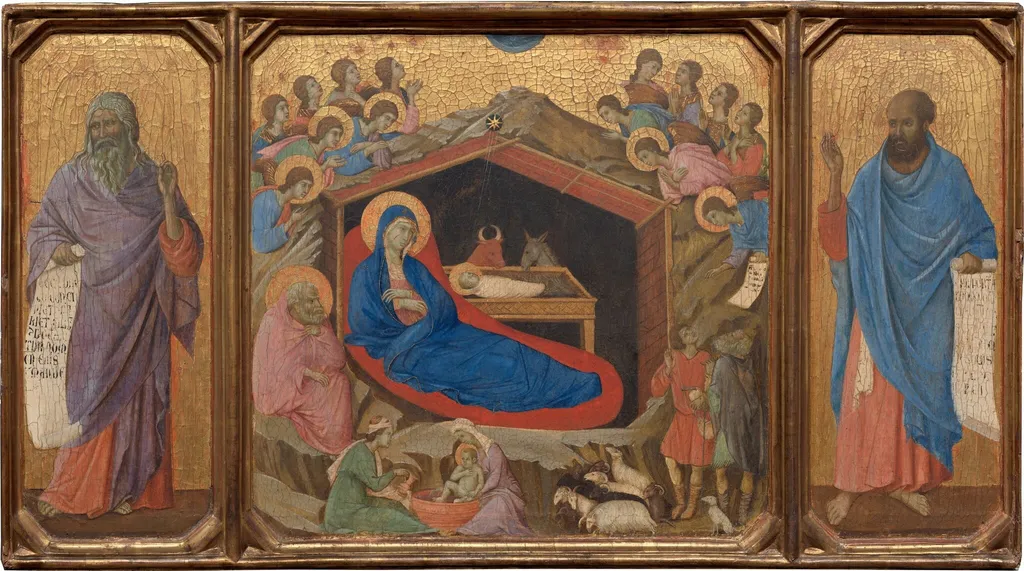
The Nativity with the Prophets Isaiah and Ezekiel is a tempera painting by the Byzantine icon painting artist Duccio di Buoninsegna. It dates from 1310 and is held in the collection of the National Gallery of Art.
- Inscription
- Inscribed:left section, on the scroll of Isaiah: ECCE VIR / GO CONCI / PIET [et] PA / RIET FILIU[M] / [et] VOCABI / TUR NOM / EN EIUS / [E]MANUE[L] (Behold a Virgin shall conceive and bear a son, and his name shall be called Immanuel; from Isaiah 7:14); middle section, on the scroll of the announcing angel: A[nnunti]o / Vobis / Gaudiu[m] / Magnu[m] (Behold, I bring you tidings of great joy; variant of Luke 2:10); right section, on the scroll of Ezekial: VIDI PORTA[M] / I[N] DOMO D[OMI]NI / CLAUSA[M] / VIR / NO[N] TR[AN]SIBIT / P[ER] EA[M] DOM / IN[US] SOLUS / I[N]TRAT ET[?] / IT [?] P[ER] EA[M] (I saw a door in the house of the Lord which was closed and no man went through it. The Lord only enters and goes through it; variant of Ezekial 44:2)
About this work
Subject & Meaning
The panel depicts the Nativity of Jesus as the central episode of a predella originally attached to Duccio's Maestà altarpiece for Siena Cathedral.
The panel depicts the Nativity of Jesus as the central episode of a predella originally attached to Duccio's Maestà altarpiece for Siena Cathedral. At the centre, the Virgin Mary reclines after childbirth within a cave-like grotto, her monumental form emphasized by the contrast between her blue veil, the red cloth beneath her, and the dark background. Behind her lies the Christ Child swaddled in a manger warmed by the ox and ass.
Saint Joseph sits outside the grotto to the left among jagged rocks, positioned as the vigilant guardian of mother and child. Additional episodes unfold simultaneously: two attendants wash the newborn in the lower left, while on the right an angel bearing a scroll appears to the shepherds in the Annunciation to the Shepherds. Above the stable, a comet star shines over a symmetrical chorus of fourteen angels arranged in two rows, gazing toward a blue circle representing the divine eye watching over the scene.
Flanking the Nativity in separate compartments are the prophets Isaiah and Ezekiel, each holding scrolls with their prophecies and raising a hand in wonder, their mirrored poses linking Old Testament prophecy to the Incarnation.
Technique & Style
The work is executed in tempera on a single poplar panel, a format typical of 14th‑century Sienese altarpieces. Its surface functions as the central panel of the front predella of Duccio's Maestà, flanked by narrow strips depicting the prophets Isaiah and Ezekiel, each rendered in a distinct scale and holding a scroll. The composition follows Byzantine conventions, combining multiple narrative episodes, including the Nativity, the washing of the infant Christ, the adoration of the shepherds, and a choir of angels, within a shallow, two‑dimensional space, while hierarchical scaling emphasizes sacred figures.
The panel's formal treatment reflects the stylized linearity and symbolic use of colour characteristic of early Italian Gothic painting.
History & Provenance
The panel formed part of the front predella of Duccio's double-sided altarpiece, the Maestà, which was in the course of execution by October 1308 and was placed on the high altar of Siena Cathedral on 30 June 1311. The altarpiece was removed from the cathedral in 1506, first stored by the Cathedral authorities, and later displayed on the wall of the left transept, by which time the predella and gable panels had probably already been separated from it. In 1777 the work was moved to the church of Sant'Ansano, where its two sides were separated and returned to the cathedral.
By 1798 the gables and eight predella panels were reported in the sacristy, while this panel had already entered private hands. It was probably with Charles Fairfax Murray in London and Florence in the early 1880s, who appears to have sold it in 1884 to the Gemäldegalerie der Königliche Museen, Berlin. Deaccessioned in 1937 and exchanged with Duveen Brothers, it was purchased on 26 April 1937 by The A.W. Mellon Educational and Charitable Trust, Pittsburgh, and gifted to the National Gallery of Art, Washington, D.C., that year.
It is held there as part of the Andrew W. Mellon Collection, with the inventory number NGA 1937.1.8.
Context
The Nativity with the Prophets Isaiah and Ezekiel occupies a transitional role in Duccio's oeuvre, marking the shift from the Italo-Byzantine maniera greca toward the more naturalistic and spatially coherent compositions of Sienese Trecento painting. Scholars consistently situate the panel within the predella of the Maestà (c. 1308–11), where its narrative density and hieratic scale contrasted with the monumental central Maestà while aligning with the devotional expectations of the predella's lower register. Critical discussions emphasize the work's layered iconography: the central Nativity unfolds in multiple episodes, birth, bath, and Annunciation to the shepherds, while the flanking prophets Isaiah and Ezekiel anchor the scene in Old Testament prophecy through inscribed texts and symmetrical gestures.
The panel's Byzantine formal traits, flat spatial recession, hierarchical proportions, and gold ground, are tempered by Duccio's incipient volumetric modeling and emotional nuance, particularly in the Virgin's recumbent posture and Joseph's introspective aside. Its later dispersion after the Maestà's dismantling in 1506 and eventual migration from Berlin to Washington (via Duveen) has framed its reception as emblematic of the challenges in reconstructing Sienese altarpiece ensembles post-separation.
Overview
Duccio di Buoninsegna's painting, The Nativity with the Prophets Isaiah and Ezekiel, created around 1310, is a tempera work on a single poplar panel. This religious scene depicts the Virgin Mary kneeling beside the Christ Child within a stable, while two Old Testament prophets observe from above. The artwork exemplifies early Sienese painting traditions, blending narrative detail with symbolic elements characteristic of the period.
Artist & collection


- The Nativity
 The Nativity
 The Nativity with the Annunciation to the Shepherds
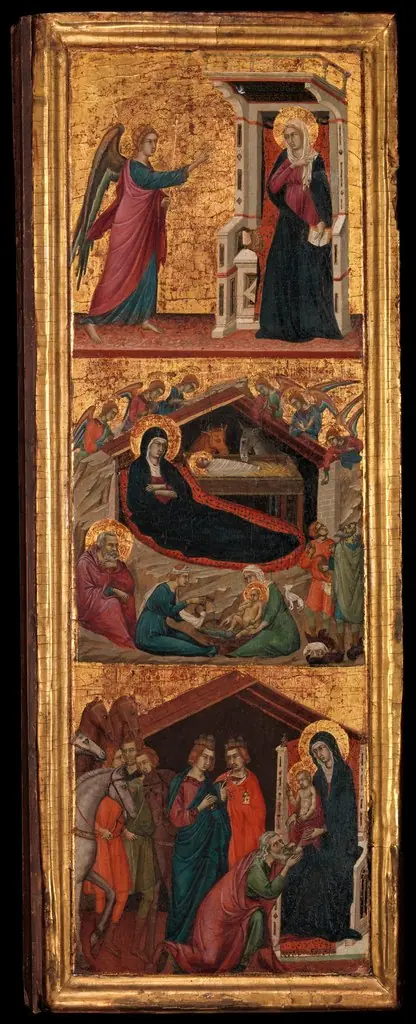 Saints and Scenes from the Life of the Virgin
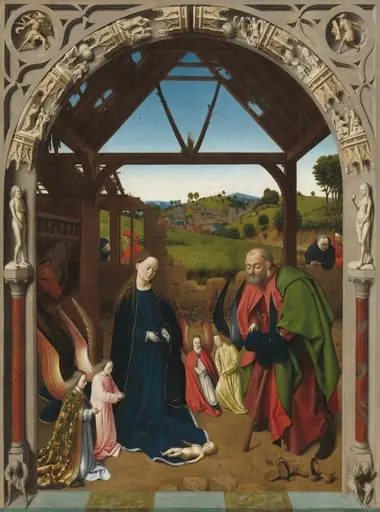 The Nativity
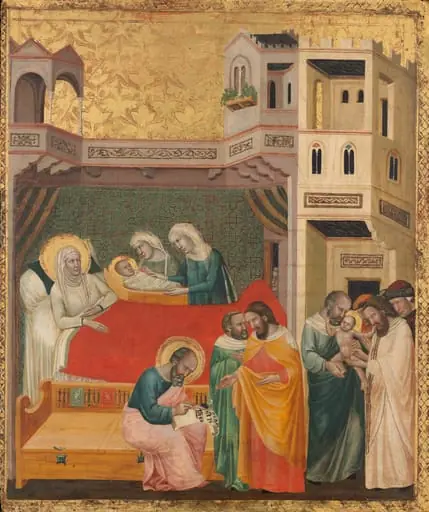 The Birth, Naming, and Circumcision of Saint John the Baptist
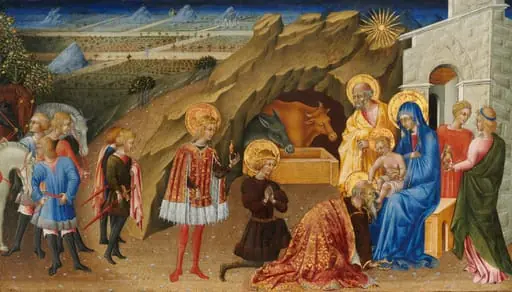 The Adoration of the Magi
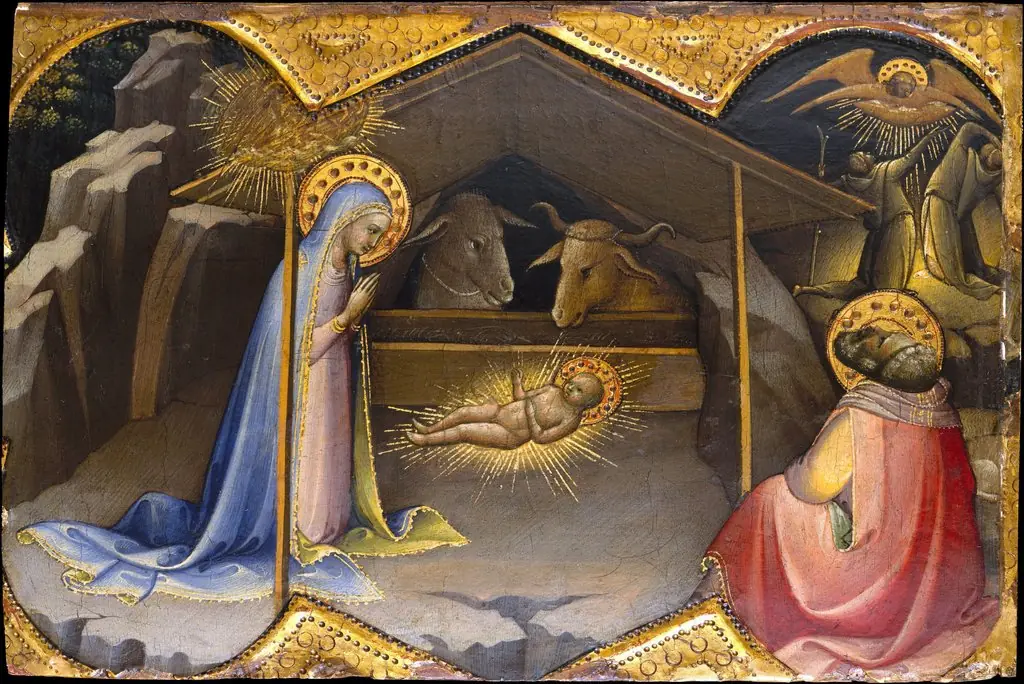 The Nativity
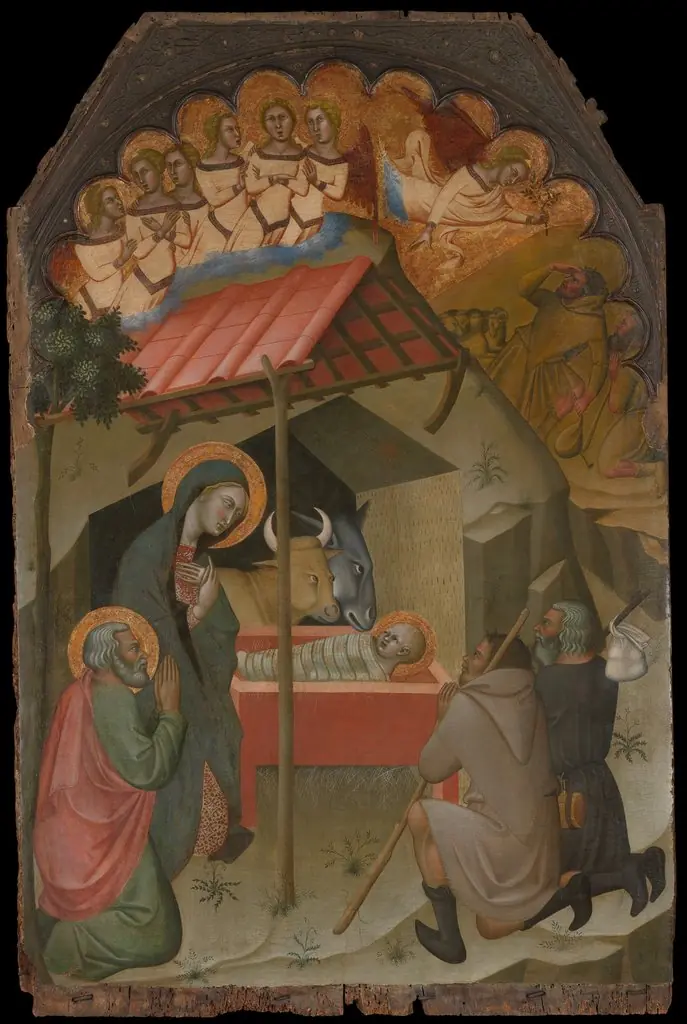 Adoration of the Magi
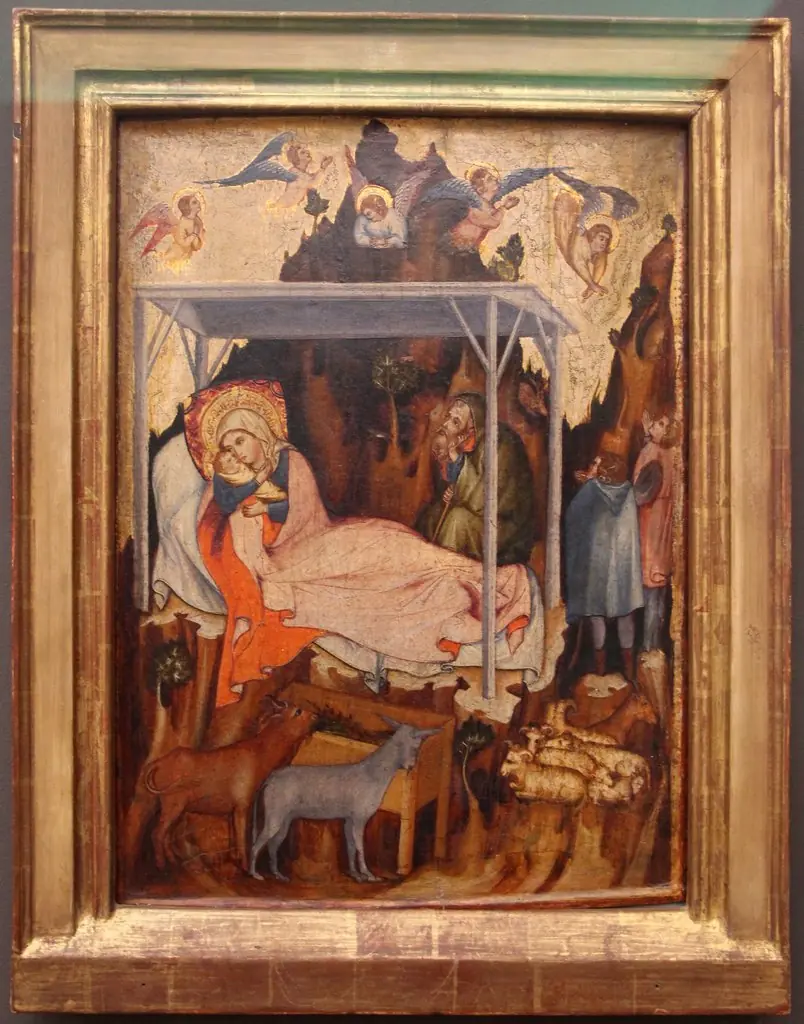 The birth of Christ
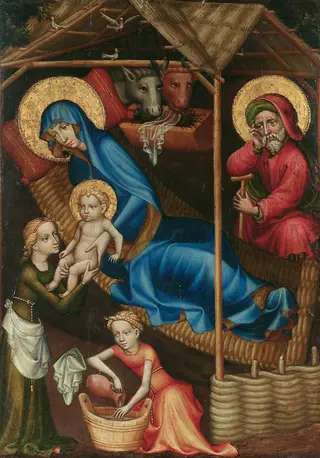 Geburt Christi
![Madonna of Humility, The Blessing Christ, Two Angels, and a Donor [obverse], by Andrea di Bartolo](https://artifactworldgallery.com/img/andrea-di-bartolo--madonna-of-humility-the-blessing-christ-two-angels-and-a-don--d37c382429905539-w320.webp) Madonna of Humility, The Blessing Christ, Two Angels, and a Donor [obverse]
Madonna of Humility, The Blessing Christ, Two Angels, and a Donor [obverse]