Artwork
The Calling of the Apostles Peter and Andrew
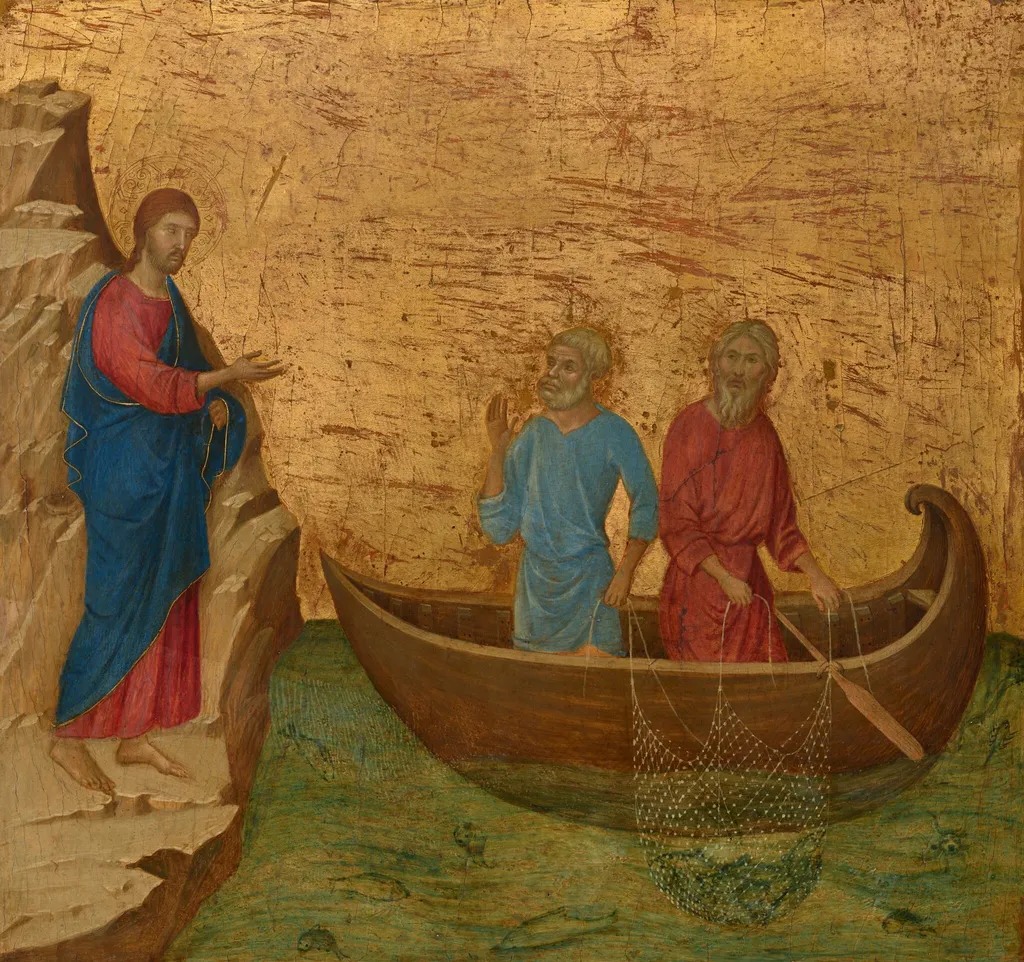
The Calling of the Apostles Peter and Andrew is an oil painting by the Byzantine icon painting artist Duccio di Buoninsegna. It dates from 1310 and is held in the collection of the National Gallery of Art.
About this work
Roughly sixteen inches square, it balances a gold ground with new naturalism: a translucent net bulges with fish.
On the shore of the Sea of Galilee, Christ calls two fishermen to leave their nets. Duccio di Buoninsegna painted the scene in tempera around 1308-1311 for the rear predella of the Maestà, the great double-sided altarpiece made for Siena Cathedral. Roughly sixteen inches square, it balances a gold ground with new naturalism: a translucent net bulges with fish. It now hangs in the National Gallery of Art.
Subject & Meaning
The painting depicts the biblical calling of the disciples, with Jesus Christ gesturing from the left toward the brothers Simon Peter and Andrew, who are shown in a boat on the Sea of Tiberias hauling a net full of fish. The fish, net, and boat are standard iconographic symbols of the apostles as "fishers of men." Duccio follows Byzantine tradition, rendering the objects in a flattened, symbolic manner against a gold ground, avoiding spatial depth.
The artist emphasizes the varied responses to the divine call: Peter turns eagerly toward Christ, while Andrew remains absorbed in his task, suggesting differing degrees of awareness and readiness. The work originally formed part of the predella of the Maestà altarpiece, reinforcing its function as a narrative of Christ's public ministry for clerical viewers.
Technique & Style
Executed in tempera and gold on a wooden panel, the painting measures 43.5 x 46 cm and originally formed part of the predella of Duccio's Maestà altarpiece. Stylistically, it adheres to Byzantine conventions with no interest in spatial depth or naturalistic representation; objects such as the chipped rock, weightless boat, and rhythmically floating fish are rendered as near-symbolic forms flattened against the gold ground. Duccio’s handling employs delicate chromatic harmonies and subtle sfumato, especially in the characterization of Peter and Andrew.
Their varied poses and intense expressions convey distinct responses: Peter diligently heeds Christ’s call, while Andrew seems absorbed in hauling the diaphanous net, revealing the artist’s narrative sensitivity within a Gothic ornamental framework.
History & Provenance
The panel originally formed part of the rear predella of Duccio's double-sided Maestà altarpiece, commissioned for the high altar of Siena Cathedral. The altarpiece was in execution by October 1308 and installed on 30 June 1311. After the Maestà was removed from the cathedral in 1506 and later dismantled, the panel passed into private hands.
By 1879 it belonged to Giuseppe and Marziale Dini of Colle Val d'Elsa. In 1886 it was purchased for Robert Henry and Evelyn Holford Benson; in 1927 the Benson collection was sold to Duveen Brothers, who sold it to Clarence H. Mackay in 1928. The Samuel H. Kress Foundation acquired it in 1934 and donated it to the National Gallery of Art in 1939.
The painting is held in the collection of the National Gallery of Art, Washington, D.C., as part of the Samuel H. Kress Collection, with the accession number NGA 1939.1.141. It entered the museum in 1939 as a gift from the Samuel H. Kress Foundation. Originally, the panel formed part of the rear predella of Duccio’s double-sided Maestà altarpiece for Siena Cathedral. No specific exhibition history is recorded in the provided sources.
Context
Duccio's The Calling of the Apostles Peter and Andrew, originally part of the rear predella of the Maestà (1308–1311), has been situated within the late Byzantine tradition while scholars note its transitional character. The composition eschews spatial depth, with flattened rock and weightless boat and fish that evoke symbolic rather than naturalistic representation. Yet the panel exhibits refined color harmonies and soft modeling, particularly in the varied poses and intense expressions of the brothers: Peter responds promptly to Christ’s call, while Andrew remains absorbed in hauling the ethereal net.
This balance between conservative iconographic conventions and a new attention to emotional nuance and surface delicacy marks the panel as a key example of early Sienese painting on the cusp of greater naturalism.
Overview
Duccio di Buoninsegna's tempera painting, The Calling of the Apostles Peter and Andrew, dates from 1308 to 1311. This small panel originally formed part of the predella, the base, of the monumental Maestà altarpiece. Commissioned for the high altar of Siena Cathedral, the Maestà featured numerous narrative scenes, including this depiction of Christ summoning the two fishermen.
Own this work as a print
Artist & collection