Artwork
Saint Catherine's Hill Near Guilford
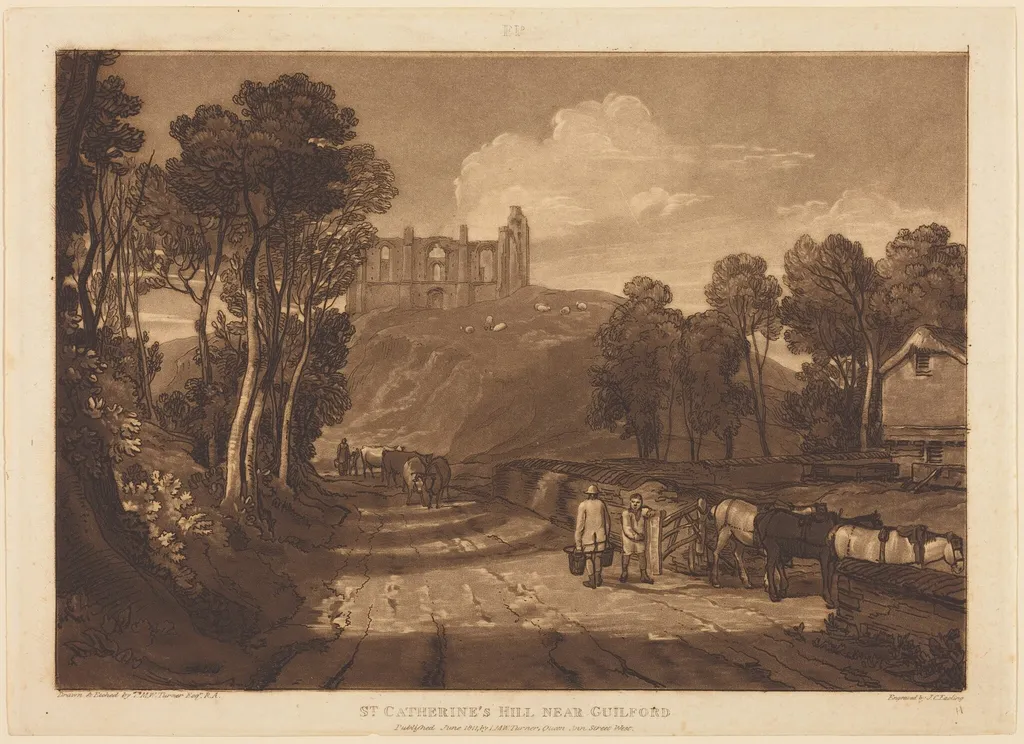
Saint Catherine's Hill Near Guilford is an ink print by the Romanticist artist J.C. Easling. It dates from 1811 and is held in the collection of the National Gallery of Art.
About this work
Overview
Saint Catherine's Hill Near Guilford is a printed landscape from 1811, produced by J.C. Easling using etching and mezzotint techniques. The work captures a rural scene in Surrey, England, with careful attention to atmospheric tone and spatial depth. Unlike bold narrative prints, it emphasizes quiet observation, blending natural topography with subtle human activity.
Subject & Meaning
The scene depicts a tranquil countryside path leading toward a stone structure atop Saint Catherine’s Hill, likely a chapel or ruin.
The scene depicts a tranquil countryside path leading toward a stone structure atop Saint Catherine’s Hill, likely a chapel or ruin. Two figures attend a horse-drawn cart near a small bridge, while others tend to livestock in the distance. Sheep graze on the slope, reinforcing the pastoral rhythm of daily life. The composition suggests contemplation rather than drama, aligning with early 19th-century ideals of serene rural existence.
Technique & Style
Easling combined etching for fine linear detail with mezzotint to achieve rich tonal gradations. The soft lighting and layered shadows give solidity to trees, stone, and rolling terrain. The sky, rendered in muted grays, enhances the sense of quiet weather. These methods allowed for nuanced texture without heavy ink lines, favoring atmospheric realism over dramatic contrast.
History & Provenance
Created in 1811, the print was likely made for private collectors interested in topographical views of southern England. Easling, active in the early 1800s, specialized in landscape prints that documented regional scenery. No major public collection records trace its early ownership, suggesting it circulated modestly among amateur connoisseurs rather than institutional patrons.
Context
During the early 19th century, landscape prints gained popularity as Britain’s rural areas became subjects of cultural reflection amid industrial change. Artists like Easling responded to a growing interest in local scenery, often emphasizing harmony between land and labor. This print reflects a broader trend of documenting the English countryside with precision and restraint.
Legacy
Though not widely exhibited today, the print remains an example of early 19th-century British printmaking’s quiet ambition. Its technical balance between etching and mezzotint influenced lesser-known regional artists. It endures as a record of a specific place and moment, valued more for its observational fidelity than for artistic fame.
Own this work as a print
Artist & collection


 River Wye
 Liber Studiorum: The Castle above the Meadows
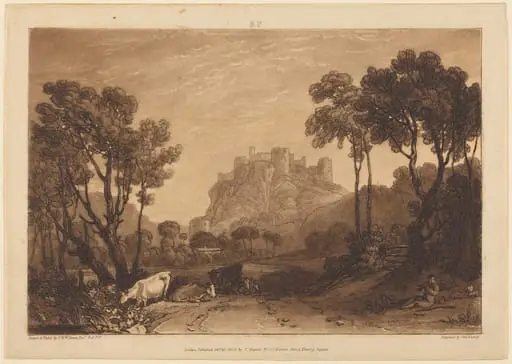 The Castle Above the Meadows
 Untitled
 Nottingham
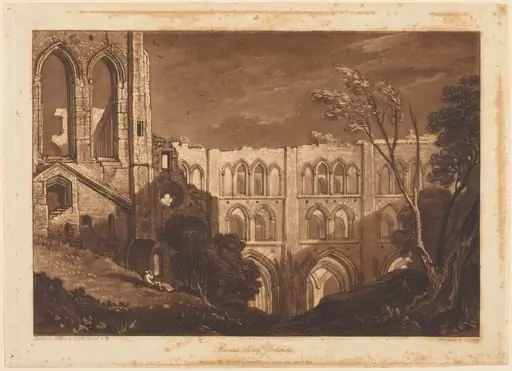 Rivaux Abbey
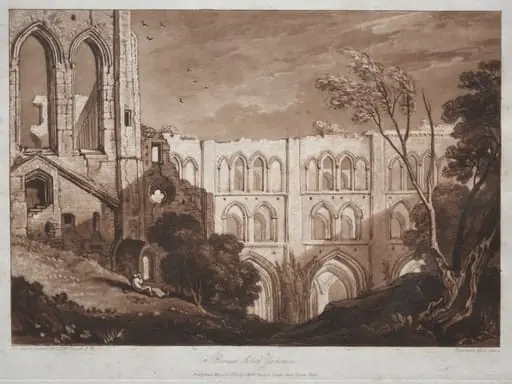 Liber Studiorum: Rivaux Abbey, Yorkshire
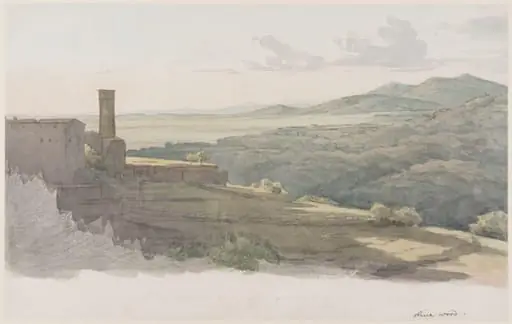 Villa of Maecenas at Tivoli
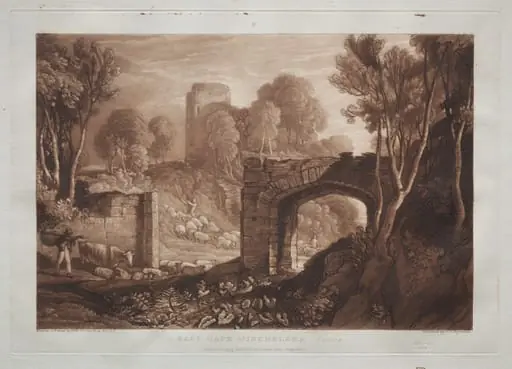 Liber Studiorum: East Gate, Winchelsea, Sussex
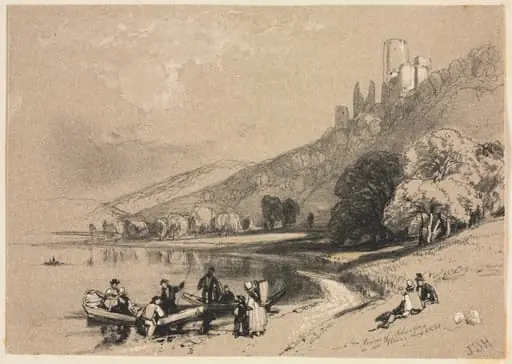 Sketches at Home and Abroad: Ruins of Schonberg on the Rhine
- Saint Catherine's Hill Near Guilford
 Holy Island Cathedral