Artwork
The Ballet from "Robert le Diable"
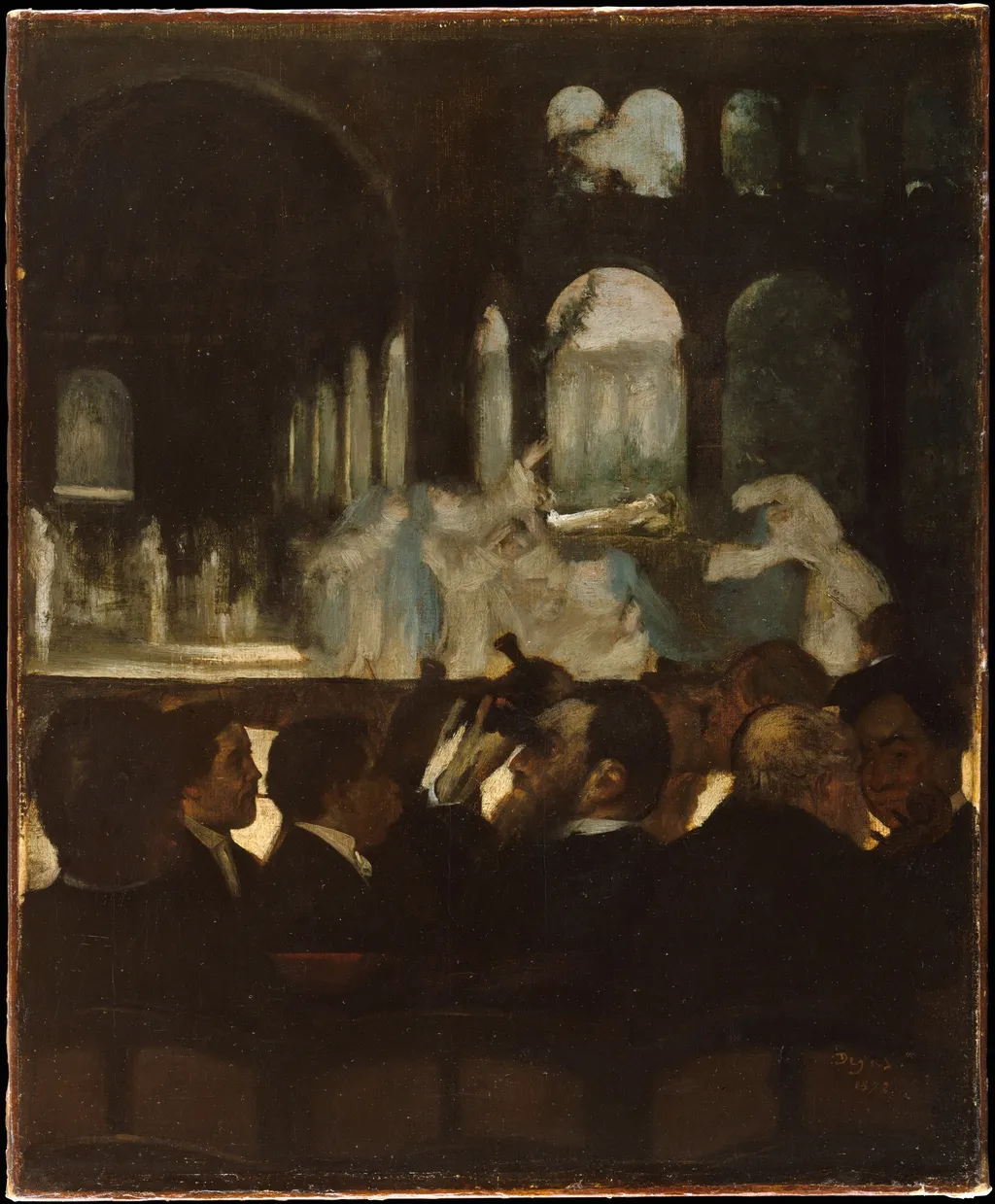
The Ballet from "Robert le Diable" is an oil painting by the Impressionist artist Edgar Degas. It dates from 1871 and is held in the collection of the Metropolitan Museum of Art.
About this work
Subject & Meaning
The bassoonist Désiré Dihau, a friend of the artist, is prominently featured in profile, silhouetted against the white sheet music on his stand.
The painting depicts the ballet scene from Giacomo Meyerbeer's opera Robert le Diable, specifically the "ballet of the nuns" performed at the Salle Le Peletier in 1871. Degas focuses on the orchestral setting rather than the dancers, emphasizing the musicians' roles. The bassoonist Désiré Dihau, a friend of the artist, is prominently featured in profile, silhouetted against the white sheet music on his stand.
The composition contrasts the musicians' absorption with the detached gaze of a spectator, identified as collector Albert Hecht, who uses opera glasses to observe the audience instead of the stage, underscoring the work's commentary on public indifference to a once-celebrated but now routine performance. The scene reflects Degas's fascination with modern urban spectacle and the interplay between performers and spectators.
Technique & Style
Executed in 1871, this work is an oil painting on canvas measuring 66 by 54.3 centimeters. It represents the first of two canvases Degas dedicated to the ballet scene from Giacomo Meyerbeer's opera. The composition is characterized by a dramatic use of chiaroscuro, contrasting the deep shadows of the orchestra pit with the illuminated white sheet music on the stand.
Stylistically, the painting focuses on a specific profile view of the bassoonist Désiré Dihau, capturing him mid-performance against the backdrop of Pierre-Luc-Charles Ciceri's stage design. The arrangement juxtaposes the musicians in the foreground with the theatrical action, while incorporating a spectator, identified as Albert Hecht, who turns away from the stage to observe the boxes through opera glasses, creating a complex, multi-layered spatial dynamic typical of Degas's interest in unconventional viewpoints.
History & Provenance
The Ballet from 'Robert le Diable' was executed by Edgar Degas in 1871, the first of two canvases he devoted to the subject, the second dating to 1876. Measuring 66 × 54.3 cm, the oil on canvas depicts the "ballet of the nuns" from Meyerbeer's opera Robert le Diable, a scene Degas observed from the orchestra pit. The work was owned by the singer and collector Jean-Baptiste Faure before passing into the collection of Louisine Havemeyer, whose 1929 bequest brought it to the Metropolitan Museum of Art, where it remains on view.
Context
The Ballet from 'Robert le Diable' (1871) is an oil on canvas measuring 66 × 54.3 cm, painted by Edgar Degas and classified as a painting. It depicts a ballet scene from Giacomo Meyerbeer's opera, set in the stage design of Pierre-Luc-Charles Cicéri, and is the first of a pair of works on the same theme, the second dating to 1876. The work entered the collection of the Metropolitan Museum of Art in New York, where it remains on view.
Its creation reflects Degas's early interest in theatrical performance and situates the piece within his broader exploration of ballet and opera subjects that defined much of his career.
Overview
Edgar Degas's The Ballet from 'Robert le Diable' (1871) depicts a scene from the third act of Giacomo Meyerbeer's opera, featuring the ghosts of nuns rising from their graves. The composition is viewed from a high, oblique angle, looking down onto the stage where a group of dancers in white tutus are captured in a moment of suspended animation with arms raised. Degas employs a stark contrast between the illuminated figures and the deep, shadowy background, emphasizing the theatrical lighting.
In the foreground, the heads of audience members, including a man in profile, intrude into the frame, grounding the scene in the reality of the Paris Opera house. Executed shortly after the artist's return from the Franco-Prussian War, this work marks a pivotal moment in Degas's career, signaling his shift toward modern subjects and his innovative approach to perspective and movement. The painting demonstrates his interest in capturing the mechanics of dance and the artificiality of the stage, moving away from idealized historical narratives toward the observation of contemporary life.
The thick, visible brushstrokes and the cropped composition reflect the influence of photography and Japanese prints, establishing a visual language that would define his subsequent ballet series.
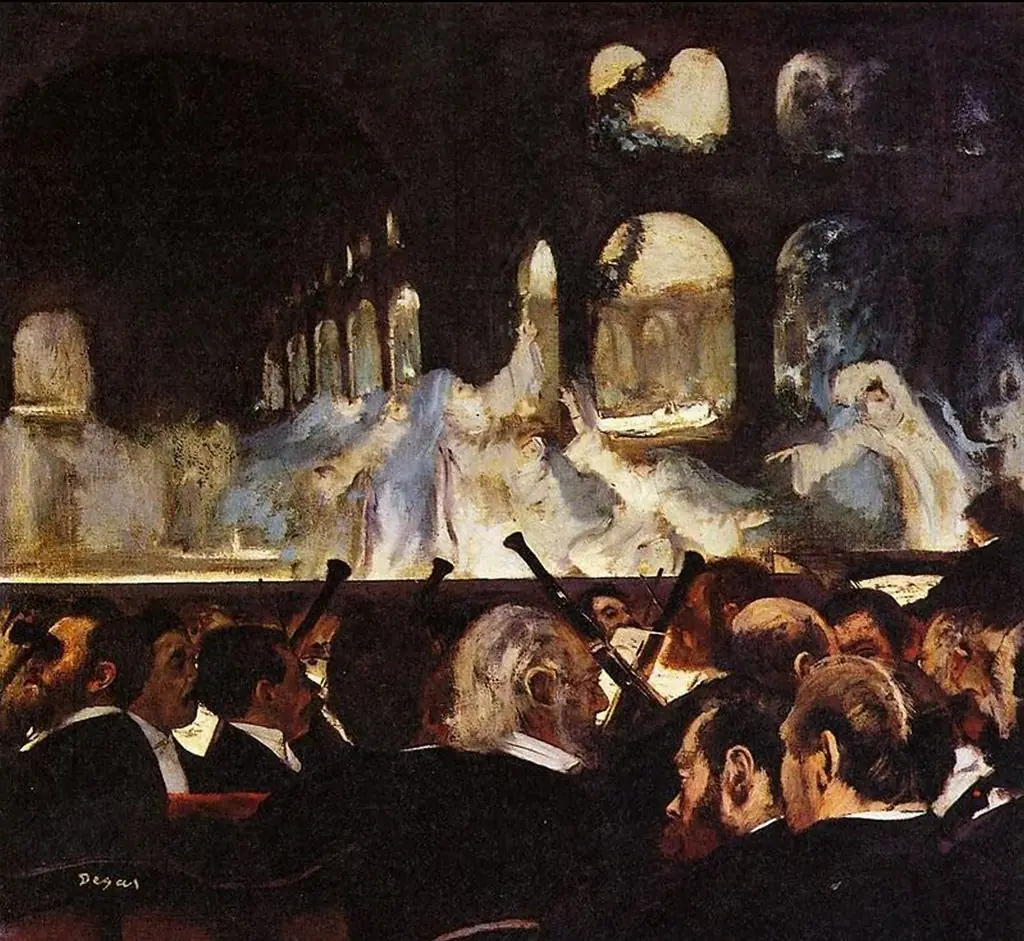
Own this work as a print
Artist & collection
Artist
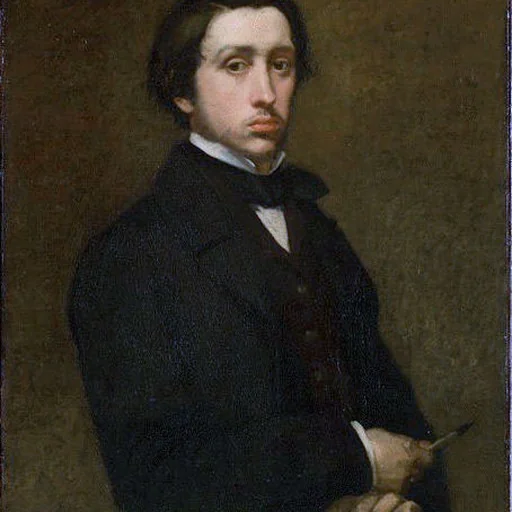
Born Hilaire-Germain-Edgar De Gas on 19 July 1834 in Paris, Edgar Degas came from an affluent banking family with aristocratic roots and spent his childhood among the cultivated circles of the French capital.

 Musiikin kuuntelijoita
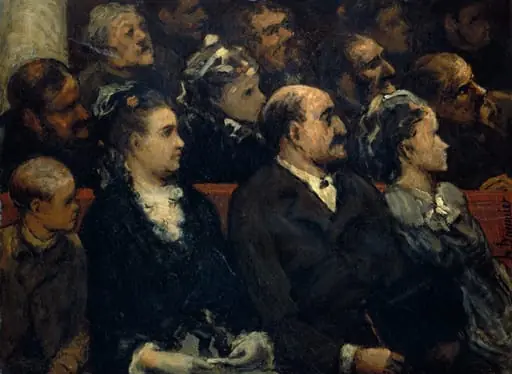 French Theater
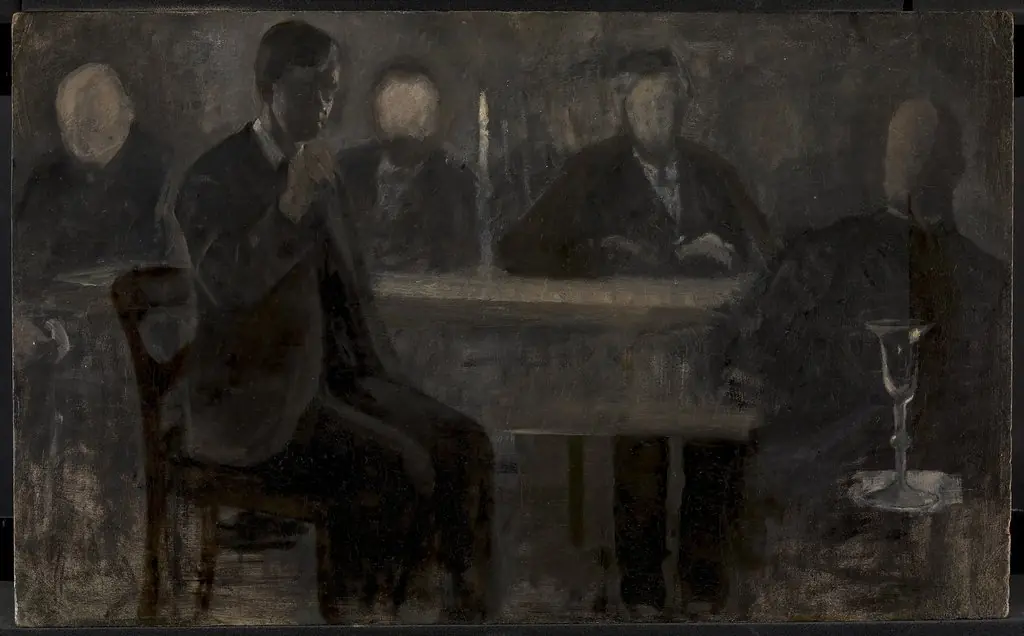 Five Portraits. Study for painting in Thielska Galleriet, Stockholm
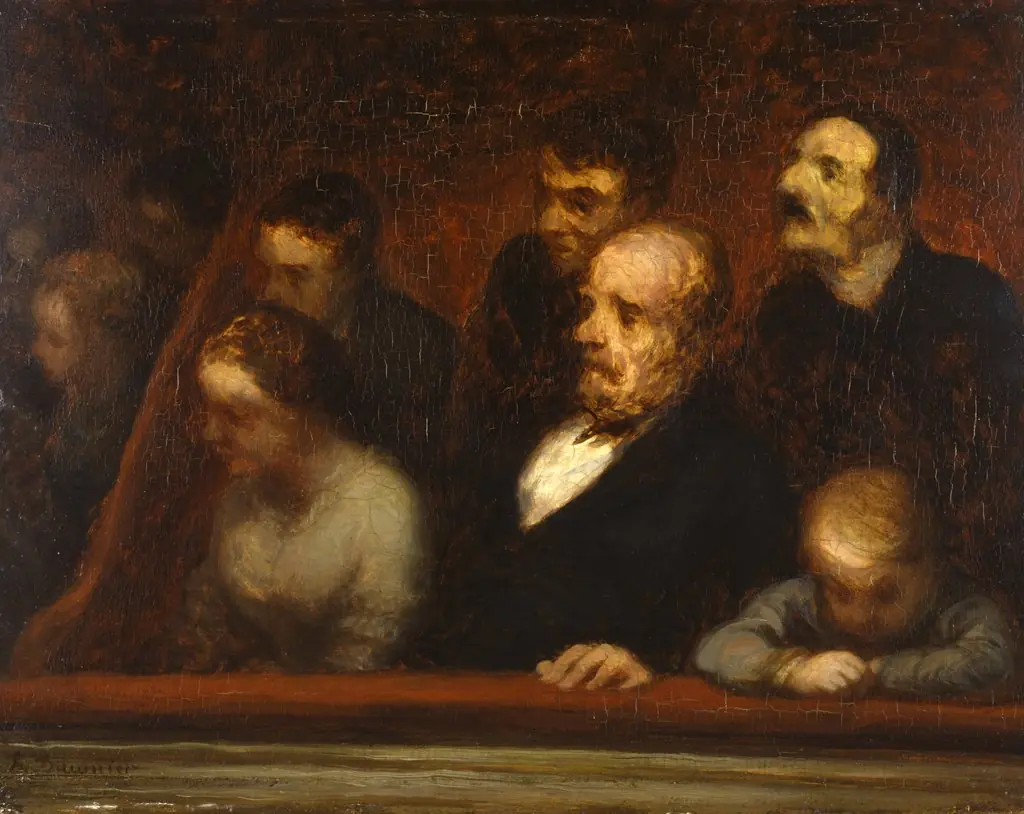 The Loge (In the Theatre Boxes)
 Five Portraits. Study for painting in Thielska Galleriet, Stockholm
 A church Service in the Island of Mors, Jutland
 The Rathskeller
 At the Moulin Rouge
 Spectators in the Theatre
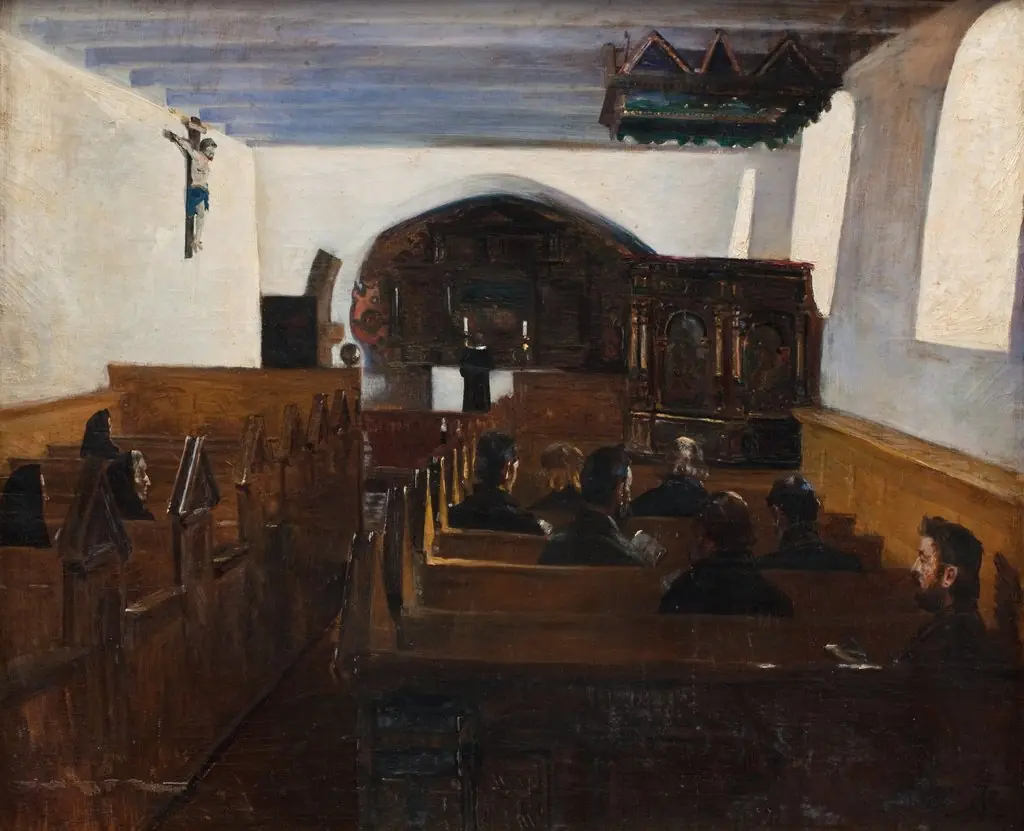 A church Service in the Island of Mors, Jutland