Artwork
French Theater
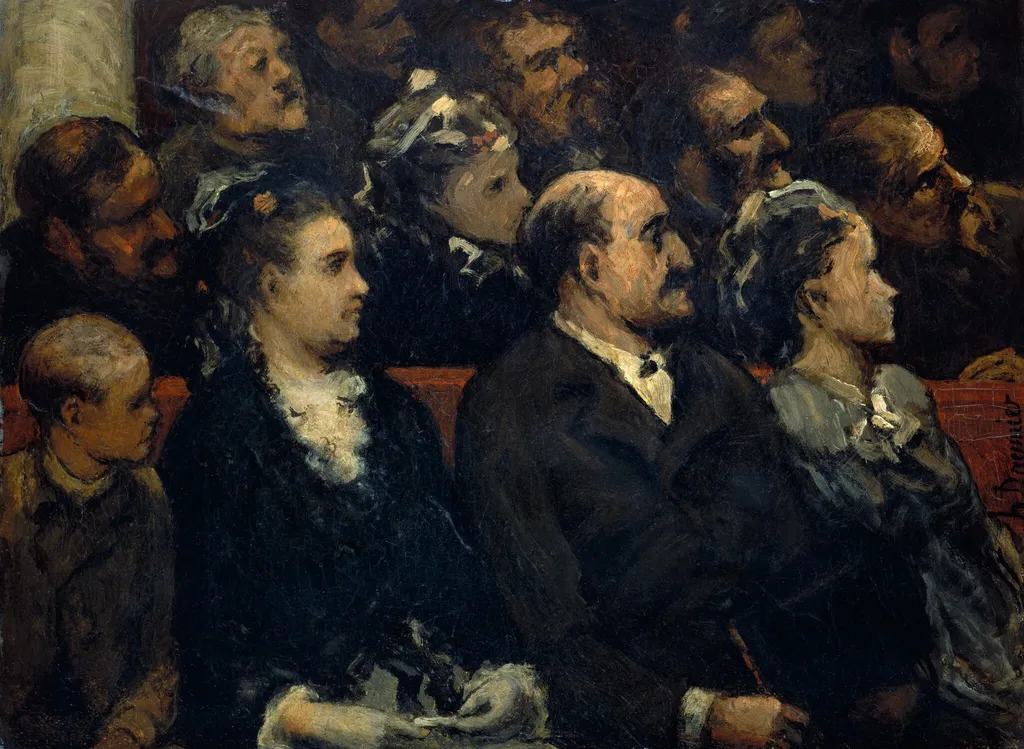
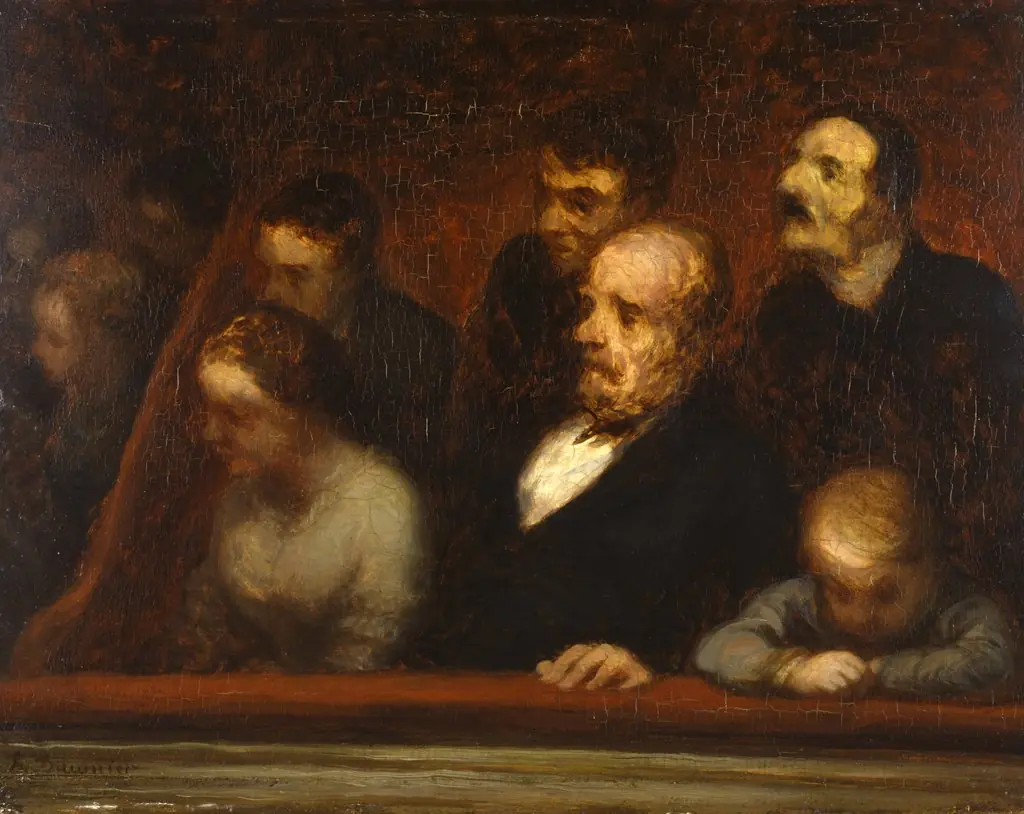
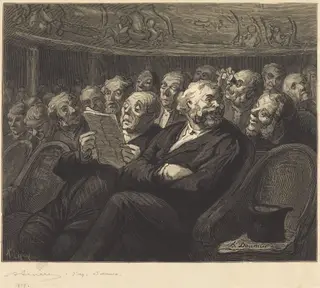
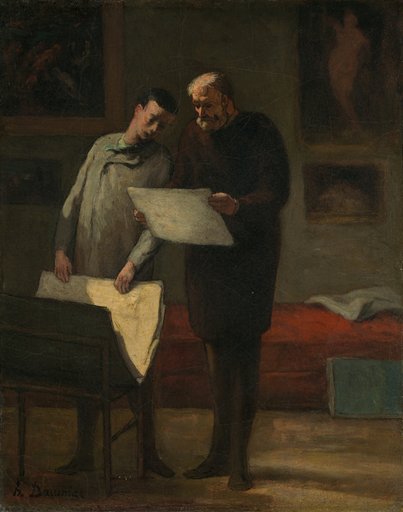
French Theater is an oil painting by the Impressionist artist Honoré Daumier. It dates from 1856 and is held in the collection of the National Gallery of Art.
- Inscription
- Inscribed:center right: h. Daumier
About this work
Technique & Style
These stylistic choices align with the painter’s broader approach to capturing contemporary stage culture through a blend of realism and expressive abstraction.
The work is an oil painting executed on a wooden panel, a support typical of mid‑nineteenth‑century French genre scenes. Daumier’s handling emphasizes stark chiaroscuro and vigorous brushwork that convey the theatricality of the subject, while the composition relies on flattened forms and dramatic contrasts of light and shadow to heighten narrative immediacy. The surface retains original pigment layers without significant abrasion, preserving the texture of the paint film.
The canvas‑like panel bears a smooth finish that allows fine detail in facial expression and costume, reinforcing the stylized realism characteristic of Daumier’s satirical portrayals. Formal analysis notes a restrained palette dominated by muted earth tones punctuated by brighter accents in drapery, contributing to a balanced yet dynamic visual rhythm. These stylistic choices align with the painter’s broader approach to capturing contemporary stage culture through a blend of realism and expressive abstraction.
History & Provenance
Honoré Daumier painted French Theater in 1856 as an oil on wood work. It entered the collection of Verdier in Paris by 1878 and was later owned by Egisto Fabbri in Florence by 1901. The painting was sold by Henri Rouart in December 1912 through Galerie Manzi-Joyant and acquired by Modernen Galerie Heinrich Thannhauser in Munich, where it remained until at least 1916.
Subsequent owners included Werner Feuz in Bern, Alex Reid and Lefevre in Glasgow, and Raphael Gérard in Paris before Chester Dale purchased it in March 1933. The work was bequeathed to the National Gallery of Art in 1963.
French Theater is held in the National Gallery of Art in Washington, D.C. Its inventory number is not specified in the sources. The work was exhibited at the 1878 Galeries Durand-Ruel exhibition in Paris and later at the 1901 Paris Ecole des Beaux-Arts exhibition. It appeared in the 1916 Galerie Thannhauser catalogue.
Provenance traces from Verdier in Paris to Egisto Fabbri in Florence by 1901, then to Henri Rouart in Paris, followed by a series of sales and transfers including to Werner Feuz in Bern, Alex Reid and Lefevre in Glasgow, M. Knoedler and Co., Raphael Gérard, Étienne Bignou, and finally Chester Dale, who bequeathed it to the National Gallery of Art in 1963.
Legacy
French Theater by Honoré Daumier exerted lasting influence through its vivid theatrical realism and social commentary, shaping later depictions of urban performance spaces. Its provenance across prominent collectors and dealers underscored its significance, leading to inclusion in major exhibitions such as the 1878 Durand-Ruel show and Thannhauser's 1916 catalogue. The work's journey through European and American markets cemented its reputation as a key example of 19th-century genre painting, culminating in its acquisition by the National Gallery of Art in 1963, where it remains on display.
The painting's legacy is further affirmed by its documented presence in institutional exhibitions and scholarly records, including references in auction archives and correspondence from the 1960s. Its formal qualities and narrative depth continue to inform studies of Daumier's impact on modern art movements.
Overview
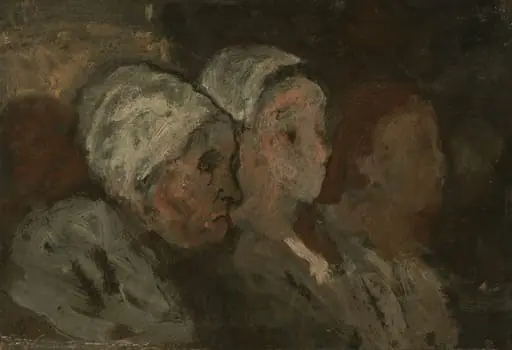
Created circa 1856, French Theater is an oil painting on wood by the French artist Honoré Daumier. The work depicts a compact group of figures seated together, all turned toward the same side of the canvas. Rendered in a limited, somber palette, the scene conveys a quiet, collective focus that invites the viewer to consider the shared experience of its subjects.
Subject & Meaning
The composition presents a crowd of individuals dressed in dark attire, their gazes directed to the right as if attending a performance or public event. While the exact narrative is not explicit, the arrangement reflects Daumier’s interest in everyday social gatherings and the subtle dynamics of public observation, a theme recurrent in his socially aware oeuvre.
Context
The painting emerged during a turbulent era in mid‑nineteenth‑century France, marked by political unrest and debates over the role of monarchy and clergy. Daumier, known for his satirical commentary on such institutions, often used genre scenes like this to subtly critique contemporary society while remaining within the broader Realist movement.
Own this work as a print
Artist & collection
Artist
Honoré-Victorin Daumier (French: ; 26 February 1808 – 10 or 11 February 1879) was a French painter, sculptor, and printmaker, whose many works offer commentary on the social and political life in France, from the…