Artwork
tavla, painting
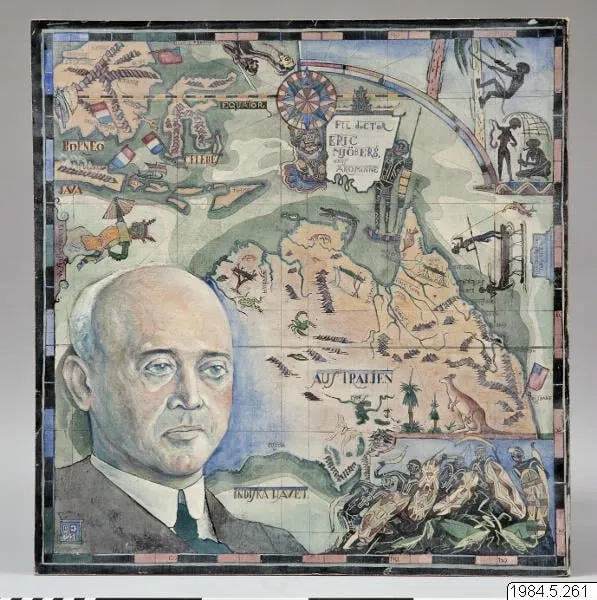
tavla, painting is a paint painting by Ossian Josef David Elgström. It dates from 1931 and is held in the collection of the ethnographic museum.
About this work
Overview
Tavla, painting is a 1931 oil work by Swedish artist Ossian Josef David Elgström. It presents a solitary male figure in formal attire positioned in the lower left, confronting a vast, turbulent expanse of cartographic fantasy. The composition contrasts the man’s stillness with the energetic, surreal geography that dominates the canvas, creating a tension between order and chaos.
Subject & Meaning
The figure, dressed in a dark suit and tie, appears detached and contemplative, possibly representing an observer or colonial authority.
The figure, dressed in a dark suit and tie, appears detached and contemplative, possibly representing an observer or colonial authority. Behind him, the map blends real locations like Australia with invented names such as Epic Fjödrkers, suggesting a psychological or satirical reimagining of exploration and empire. The presence of mythical creatures and vessels implies a world shaped by imagination rather than geography.
Technique & Style
Elgström employed thick, expressive brushwork and saturated hues to construct the map’s dense, layered surface. The background vibrates with unnatural colors and erratic forms, while the figure is rendered with restrained detail, enhancing his isolation. The stylistic clash between realism and fantasy gives the scene a dreamlike, almost hallucinatory quality.
History & Provenance
Created in 1931, Tavla, painting emerged during a period of experimental modernism in Sweden. It remained in private collections for much of the 20th century, with limited public exposure. Documentation is sparse, but its survival suggests it was valued by early 20th-century collectors interested in symbolic and surrealist-leaning works outside mainstream movements.
Context
In the early 1930s, European artists increasingly questioned rationalist narratives through symbolic imagery. Elgström’s map, with its hybrid geography and fantastical elements, aligns with broader interwar interests in the subconscious and the absurd. The painting reflects anxieties about colonialism and the instability of knowledge, common themes in post-WWI art.
Legacy
Though not widely exhibited, Tavla, painting has influenced later Swedish artists drawn to psychological landscapes and satirical cartography. Its unique fusion of realism and surrealism remains a distinctive example of regional modernism that resisted international trends. Scholars continue to study it as a quiet, enigmatic commentary on perception and power.
Artist & collection
Artist
Swedish painter Ossian Elgström spent years sketching Sápmi’s reindeer herders with blunt charcoal before switching to oil, then painting their faces so real they seem to breathe.
![Untitled. [Portrait of a man], by Elizabeth Berry](https://artifactworldgallery.com/img/elizabeth-berry--untitled-portrait-of-a-man--b0a03ed2c8d53259-w320.webp)