Artwork
Arab Horseman Attacked by a Lion
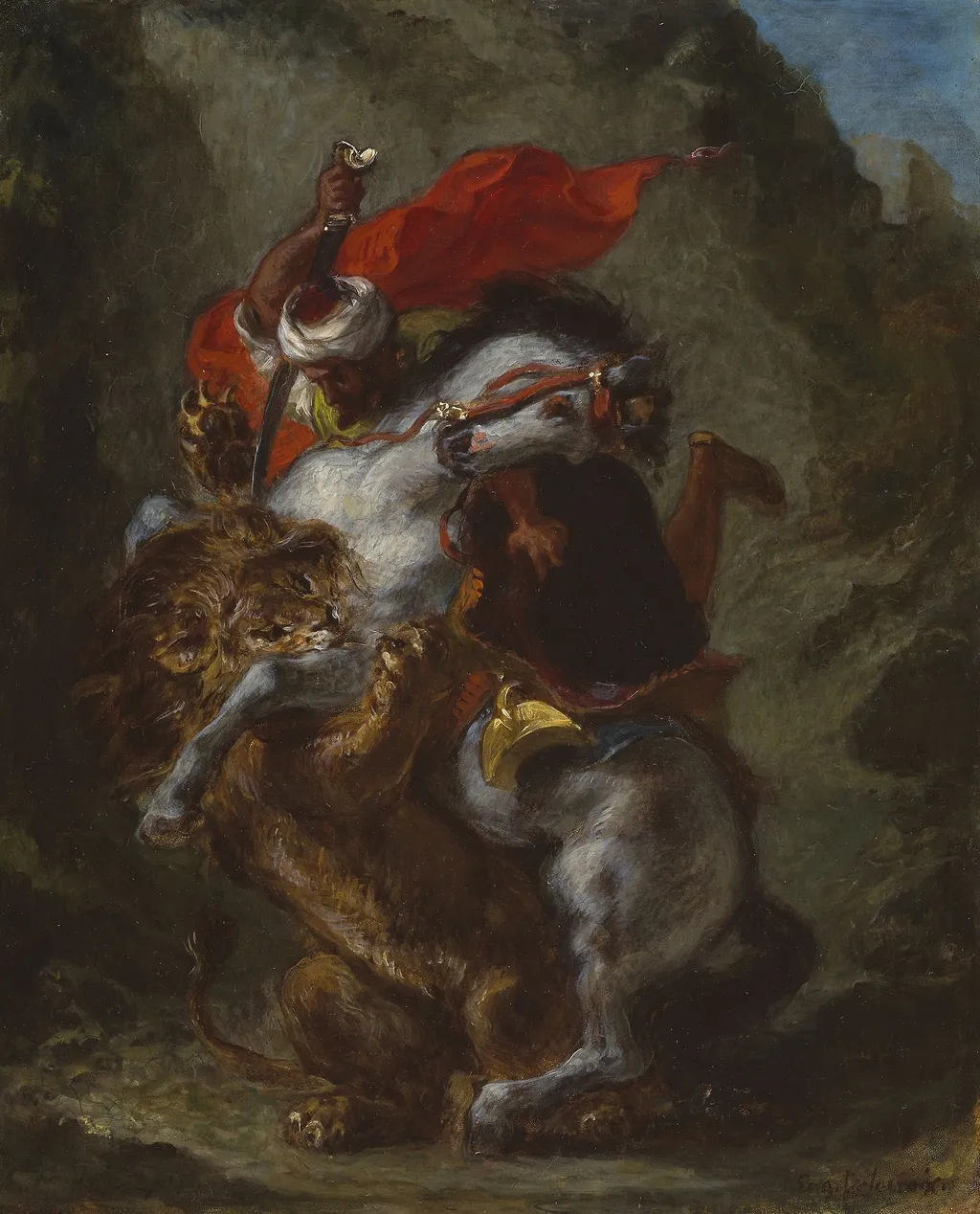
Arab Horseman Attacked by a Lion is an oil painting by Eugène Delacroix. It dates from 1849 and is held in the collection of the Art Institute of Chicago.
About this work
Overview
The painting exemplifies Delacroix's sustained engagement with Orientalist subjects and his mastery of dramatic, emotionally charged composition.
Arab Horseman Attacked by a Lion is an oil painting on panel by the French Romantic artist Eugène Delacroix, executed in 1849 or 1849-1850. Measuring 43.81 by 38.1 cm (approximately 17 1/4 by 15 inches), the work is held in the collection of the Art Institute of Chicago, where it remains on view in Gallery 220 as part of the Painting and Sculpture of Europe department. The painting exemplifies Delacroix's sustained engagement with Orientalist subjects and his mastery of dramatic, emotionally charged composition. It entered the museum's holdings through the Potter Palmer Collection and is catalogued under reference number 1922.403.
Subject & Meaning
The painting depicts a violent encounter between an Arab horseman and a lion, with man and beast intertwined in a single writhing mass of struggle. A rearing gray horse dominates the center, its body twisted as it confronts a lunging lion below. The rider, clad in flowing red garments and a white headwrap, leans backward with his right arm raised, gripping a sword. The lion, rendered in browns and golds, bites at the horse's chest. The composition carries propagandistic overtones common to Orientalist imagery of the period: depictions of Arab men entangled with wild animals served to justify French colonial rule by representing its subjects as violent and inhuman. The flowing red fabric of the rider's attire billows through the scene, amplifying the chaotic energy and sense of desperation.
Technique & Style
Delacroix executed the work in oil on panel, employing a vivid yet dark palette that centers on the striking red of the rider's garments against gray, brown, and ochre tones. Light falls dramatically on the struggling figures while shadows engulf the edges, creating carefully manipulated contrasts that heighten the emotional intensity. The brushwork is loose and energetic, visible in the swirling manes, fabric, and muscular forms; short, energetic strokes imbue the imagined scene with action and drama. Gold accents appear on the horse's bridle and saddle, adding decorative refinement to the violent subject. The surface shows fine craquelure throughout, consistent with the painting's age. The handling of paint creates a textured, evocative surface that conveys movement and tension, hallmarks of Delacroix's mature style within the Orientalist movement.
History & Provenance
The painting was created in 1849-1850, a period when Delacroix was deeply engaged with North African subjects following his journey to Morocco in 1832. The Art Institute of Chicago acquired the work as part of the Potter Palmer Collection, and it entered the collection with reference number 1922.403. The museum's records date the painting to 1849-1850, while some sources narrow this to 1849. The work has been exhibited as part of Delacroix retrospective programming, including an exhibition titled "Delacroix (1798-1863)" noted in its exhibition history. It is currently on public view in Gallery 220.
Context
Delacroix's fascination with equestrian combat and animal violence had deep roots in his practice. A graphite study titled Arab Horseman, dated circa 1849 and now at the Metropolitan Museum of Art, demonstrates the artist's sustained exploration of this theme across media. Earlier, in the 1830s, Delacroix had produced pen and ink studies of a rearing horse attacked by a lion and a lion wrestling with a serpent, works that reveal his long-standing preoccupation with interspecies conflict. These drawings, now in the Karen B. Cohen Collection at the Met, show the artist developing the dynamic poses and muscular tension that would animate his painted compositions. Within Delacroix's broader oeuvre, the horseman under attack became a recurring motif that allowed him to explore themes of vulnerability, courage, and the sublime violence of nature.
Legacy
Arab Horseman Attacked by a Lion occupies a significant place within the Orientalist movement and Delacroix's legacy as its leading exponent. The work exemplifies the romanticized and politically charged depictions of North African subjects that characterized much nineteenth-century French painting. Its continued display at the Art Institute of Chicago ensures public engagement with these complex visual narratives. The painting has been reproduced and studied as a key example of Delacroix's ability to synthesize observed detail with imaginative drama, a skill that cemented his reputation as the foremost Romantic painter of his generation. The work's afterlife in scholarship and public discourse reflects ongoing debates about the ideological functions of Orientalist art and its place within colonial visual culture.
Own this work as a print
Artist & collection
Artist
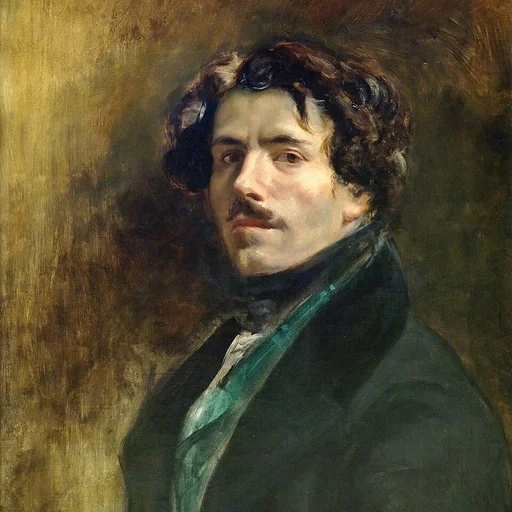
Ferdinand Victor Eugène Delacroix ( DEL-ə-krwah, -KRWAH; French:; 26 April 1798 – 13 August 1863) was a French Romantic artist who was regarded as the leader of the French Romantic school.