Artwork
Madonna and Child with an Angel
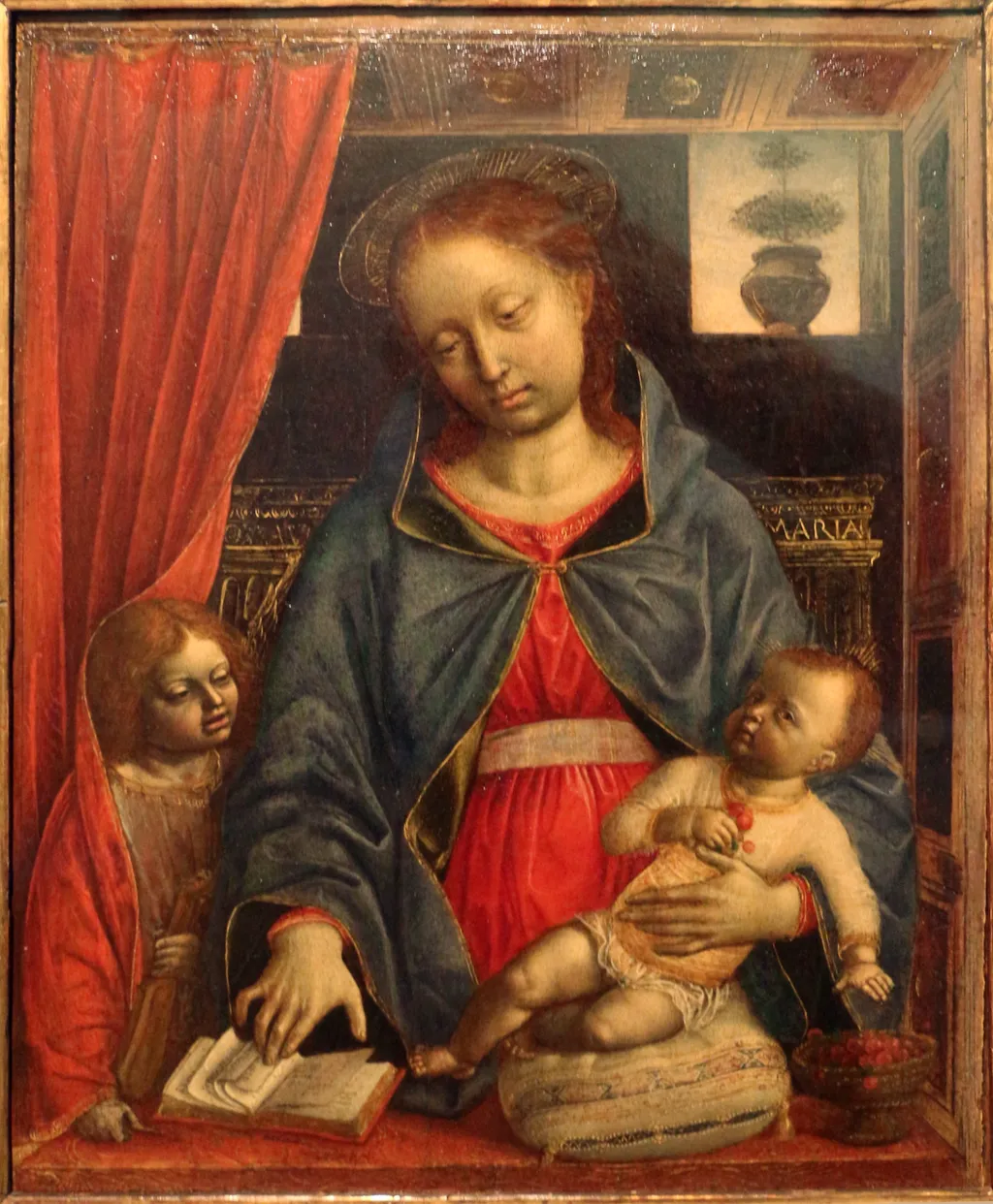
Madonna and Child with an Angel is a tempera painting by the Early Renaissance artist Vincenzo Foppa. It dates from 1490 and is held in the collection of the Uffizi Gallery. Created circa 1490, this tempera panel presents a devotional scene typical of the early Renaissance.
About this work
Subject & Meaning
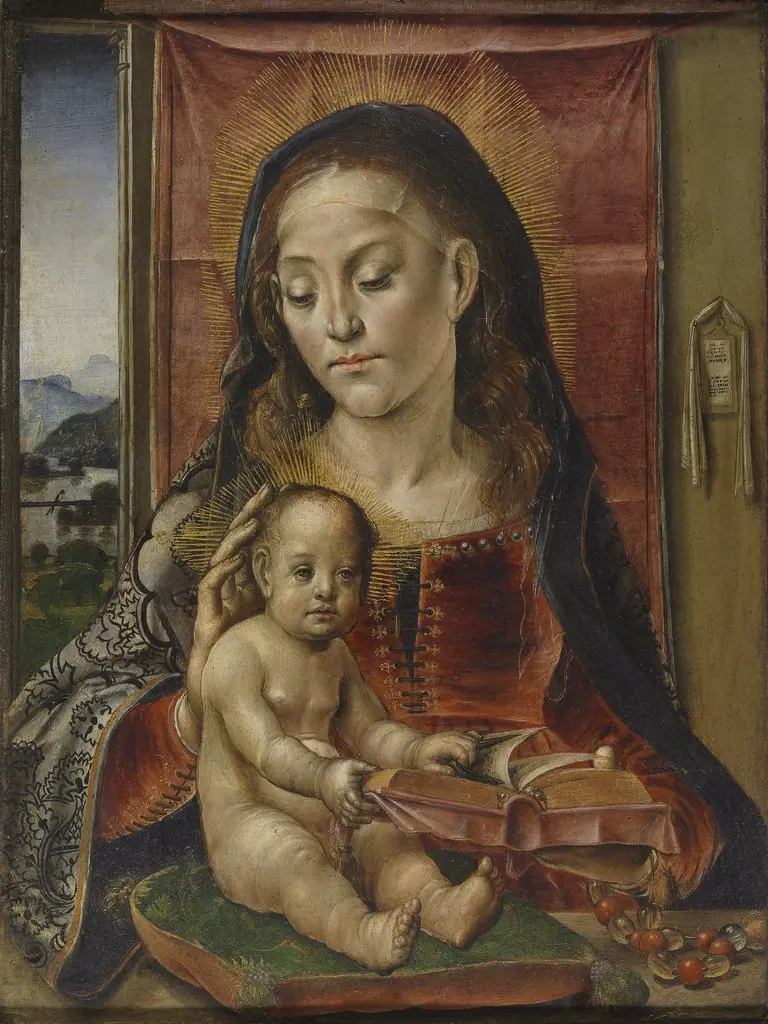
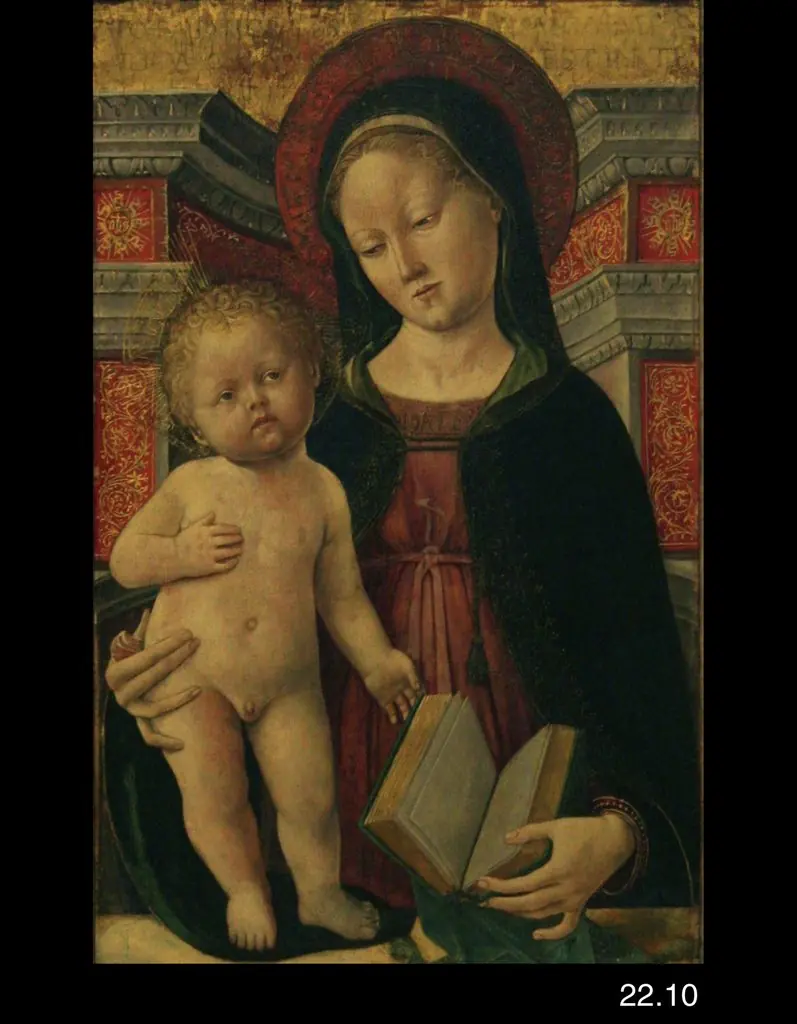
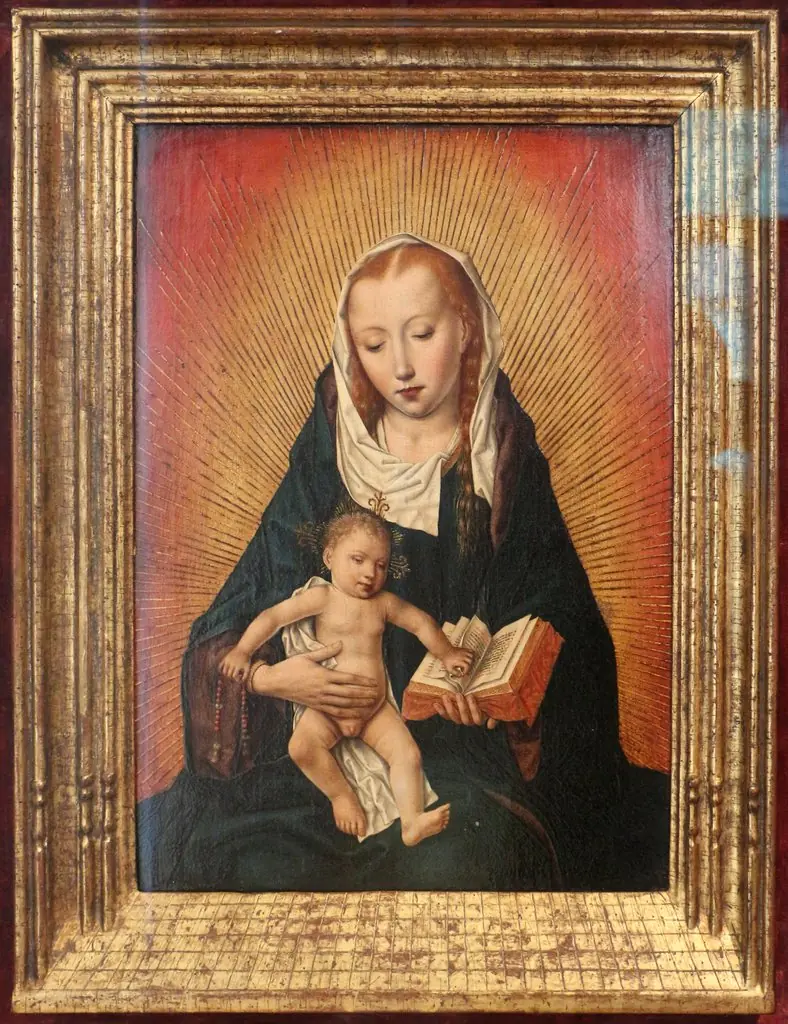
The painting depicts the Virgin Mary reading a book while holding the Christ Child, accompanied by an angel who has paused playing a violin to observe them.
The painting depicts the Virgin Mary reading a book while holding the Christ Child, accompanied by an angel who has paused playing a violin to observe them. The scene is framed by an illusionistic curtain and a window opening onto a dark interior, a composition emphasizing domestic devotion. Symbolism is concentrated on the parapet, where a book alludes to the prophecies of Sacred Scripture.
A raised bowl containing red fruits, identified as cherries or grapes, along with a red fruit held by the infant Jesus, serves as a direct reference to the blood of the Passion and Christ's acceptance of his sacrificial destiny. The angel's instrument and the Flemish-inspired vase on the distant windowsill further enrich the narrative of this sacred encounter.
Technique & Style
The work is a tempera painting on wooden panel, measuring 41 cm in height and 32.5 cm in width. It depicts the Virgin Mary holding the infant Jesus, accompanied by an angel who holds a violin, with symbolic objects such as a book, cushion, and fruit arranged near them. The composition features a draped curtain revealing an open window into a dark interior, showcasing a stylized interior with a gilded inscription and a vase on the windowsill, reflecting Flemish influence.
The stylistic features include naturalistic rendering, a muted color palette typical of Lombard art, and decorative spatial treatment, dating to around 1479-1480.
History & Provenance
The painting was acquired by the Italian state through the prerogative of the Florence Superintendent’s Export Office, filling a gap in the Uffizi’s collection of Lombard school works before Leonardo. It entered the Pinacoteca del Castello Sforzesco in Milan on loan from the Uffizi in 2015 as part of a regional exchange, remaining on display for fifteen years. The work has been in the possession of the Uffizi Gallery and later the Pinacoteca del Castello Sforzesco since its acquisition.
Dating to 1479, the tempera panel measures 41 × 32.5 cm and depicts the Madonna and Child with an Angel, a subject documented in both archival records and contemporary scholarship.
The composition features a curtained window opening onto a dark interior, a modest domestic setting that emphasizes devotional intimacy, and includes symbolic elements such as a book, cushion, and red fruit that allude to the Passion of Christ.
The work is held by the Pinacoteca del Castello Sforzesco in Milan, part of the Uffizi Gallery collection and on loan from the Uffizi, with inventory details not specified in the sources. It was acquired by the State through the right of pre-emption exercised by the Florence Superintendent’s Export Office, filling a gap in the Uffizi’s Lombard school collection prior to Leonardo, following the Contini Bonacossi collection sale. In December 2015 the painting was displayed in the Castello Sforzesco’s Pinacoteca for fifteen years under a regional agreement, exchanged for the San Benedetto by Antonello da Messina, which had been purchased by the Italian State in 2002 and was shown alongside two other Foppa panels at the Uffizi. The work has been exhibited in these locations and under the terms of the loan arrangement described.
Context
The painting has been discussed in scholarly and critical contexts as an example of late 15th-century Lombard religious art, notable for its blend of devotional intimacy and stylistic transition. It is recognized as part of Vincenzo Foppa's mature period, reflecting influences from earlier Paduan naturalism while still showing signs of the emerging Venetian coloristic tradition before Giovanni Bellini's dominance.
The work entered public discourse following its acquisition by the Italian state to fill a gap in the Uffizi's collection of Lombard school paintings before Leonardo, and later through a cultural exchange involving the San Benedetto by Antonello da Messina.
Art historians have highlighted its devotional function and symbolic details, such as the open book referencing scriptural prophecy and the red fruit alluding to the Passion, underscoring its theological depth within domestic devotional practices.
Stylistically, the painting features a shallow spatial layout with illusionistic drapery and a darkened interior opening to a Flemish-inspired window scene, combining Lombard naturalism with refined decorative elements and a subdued, almost cinerine palette in skin tones.
Legacy
Acquired by the Italian state through the right of pre-emption in 1996, the panel entered the Uffizi’s holdings to address a gap in its representation of Lombard school works predating Leonardo, reinforcing the gallery’s evolving survey of early Renaissance schools. After entering the Uffizi’s collection, the painting was lent to the Pinacoteca del Castello Sforzesco, Milan, under a fifteen-year agreement (from December 2015) that reciprocally brought Antonello da Messina’s San Benedetto to Florence for the same term, temporarily reuniting works previously separated by national distribution policies. Within Milanese cultural policy, the Foppa panel has been positioned as a key example of domestic-scale devotional painting from late fifteenth-century Lombardy, cited for its Lombard naturalism and muted palette that distinguish it from contemporaneous Venetian developments.
Overview
Created circa 1490, this tempera panel presents a devotional scene typical of the early Renaissance. The composition features the Virgin Mary seated with the infant Christ, an attendant angel, and an open book, all set against a red drapery. The work belongs to the collection of the Uffizi Gallery in Florence.
Own this work as a print
Artist & collection
Artist
Vincenzo Foppa (Brescia, c. 1427–1430 – Brescia, c. 1515–1516) was an Italian painter from the Renaissance period. While few of his works survive, he was an esteemed and influential painter during his time and is…