Artwork
The Toilette of Venus
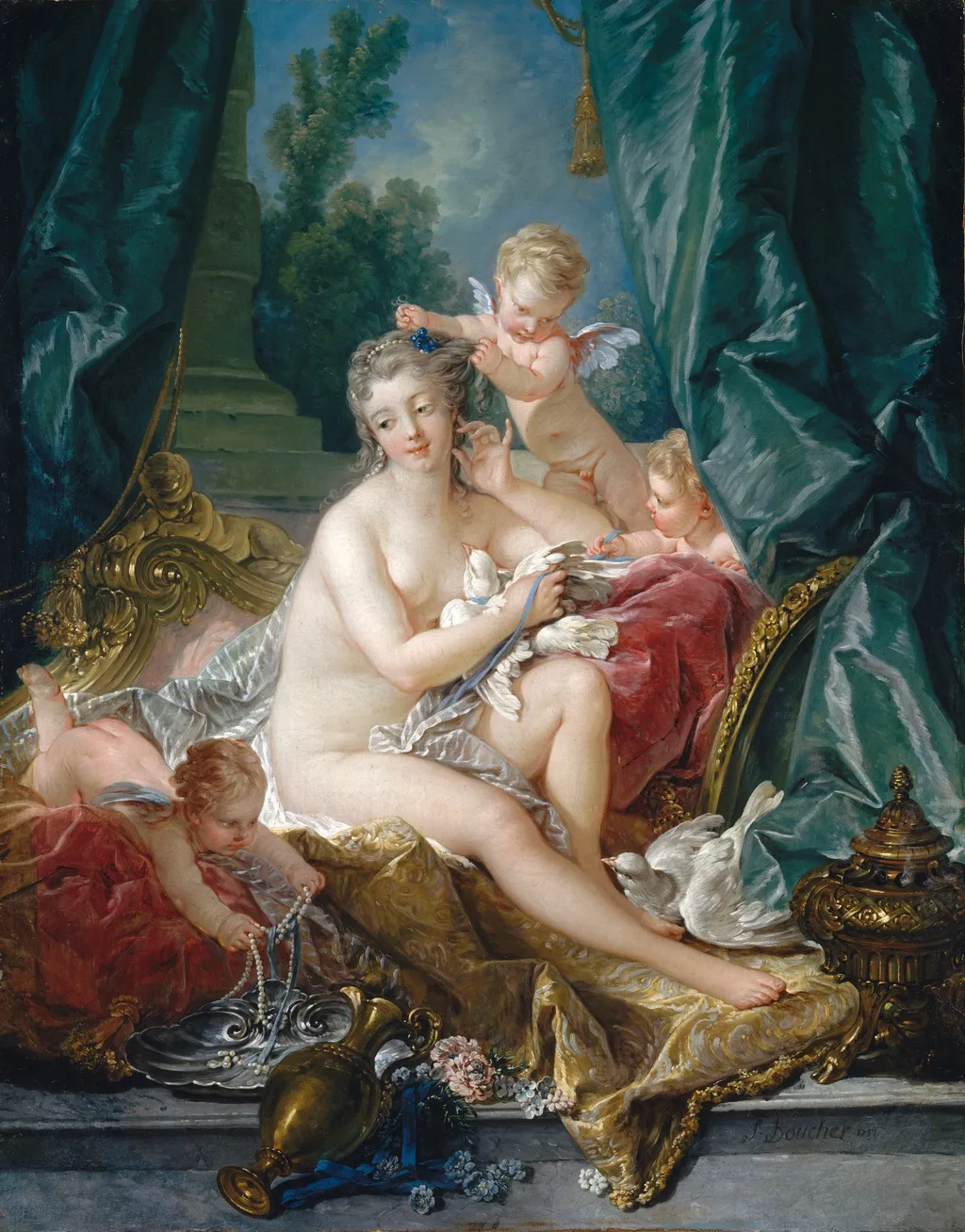
The Toilette of Venus is an oil painting by the Rococo painting artist François Boucher. It dates from 1751 and is held in the collection of the Metropolitan Museum of Art.
About this work
Subject & Meaning
The work was conceived as a pendant to Boucher’s Bath of Venus and later entered the Metropolitan Museum of Art.
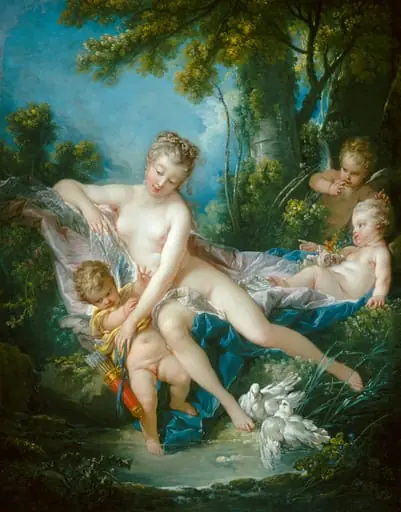
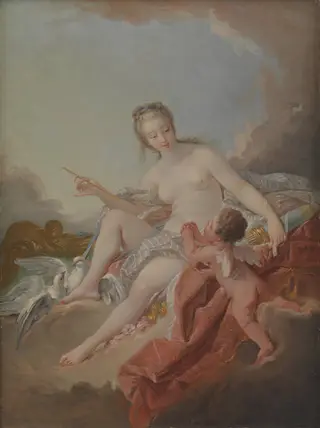
The painting shows the nude Roman goddess Venus seated on a richly draped rococo canapé, attended by three diminutive putti who adjust her hair, present a ribbon, and lift a pearl necklace. She holds one of two doves while a small cassolette with Classical motifs rests nearby, symbolising love and beauty through attributes such as the dove, shell tray, and pearl ornaments. The composition blends Rococo sensuality with subtle Classical references, and its patronage by Madame de Pompadour links Venus to the mistress’s own self‑presentation as the king’s enchantress.
The work was conceived as a pendant to Boucher’s Bath of Venus and later entered the Metropolitan Museum of Art.
Technique & Style
The Toilette of Venus is an oil painting on canvas executed by François Boucher in 1751, embodying the Rococo idiom through its pastel palette, soft modeling, and sumptuous textures. The composition features a nude Venus seated on a gilded, upholstered rococo canapé draped in pink velvet, surrounded by three putti engaged in toilette activities. Boucher employs delicate, feathery brushwork to render the goddess’s luminous flesh and cascading drapery, while gilt accents on the furniture and fabric heighten the work’s decorative immediacy.
The handling balances fluid linearity with subtle chiaroscuro, particularly in the modeling of Venus’s torso and the pearlescent highlights of the pearl necklace. The painting’s condition is stable, with no major losses reported; its original weave and impasto remain intact, consistent with Boucher’s characteristic handling of oil on canvas. Stylistically, the work integrates Classical motifs, such as the cassolette’s acanthus moldings and tripod form, within a Rococo framework, signaling a transitional synthesis between decorative exuberance and archaeological allusion.
History & Provenance
François Boucher completed the oil-on-canvas painting The Toilette of Venus in 1751. It was commissioned by Madame de Pompadour for the bathroom (salle de bain) of her Château de Bellevue, intended as a pendant to Boucher's Bath of Venus. Following Pompadour's death in 1764, the work passed to her brother, Abel-François Poisson.
Upon his death in 1781, the pendant pair was separated; Poisson's estate sold the painting in 1782 to financier Nicolas de Boullongne. After over a century in private hands, it was acquired in 1895 by Alva Belmont Smith from collector C. J. Wertheimer. The work subsequently entered the collection of William Kissam Vanderbilt I and was bequeathed to the Metropolitan Museum of Art in New York upon his death in 1920.
François Boucher's The Toilette of Venus (1751) is currently held in the collection of the Metropolitan Museum of Art in New York. The museum acquired the work in 1920 as a bequest from the estate of William Kissam Vanderbilt I, following its purchase in 1895 by his wife, Alva Belmont, from London collector C. J. Wertheimer. Prior to entering American collections, the painting passed through several notable owners, including Madame de Pompadour, her brother Abel-François Poisson, Nicolas de Boullongne, and Jean-Nicolas de Boullongne.
Historically, the work was exhibited in the show America Collects Eighteenth-Century French Painting. Originally commissioned for the Château de Bellevue, it was once paired with The Bath of Venus, though the two are now housed in different institutions.
Context
Critical scholarship identifies The Toilette of Venus as a hallmark of Boucher’s mature Rococo oeuvre, emphasizing its blend of sensuality and decorative excess. Art historians note the painting’s commission by Madame de Pompadour for the salle de bain of the Château de Bellevue, linking it to the patron’s self‑presentation as Venus and to Boucher’s involvement in contemporary opera‑ballet staging. The work’s iconography, featuring a nude goddess surrounded by putti, a cassolette, and Rococo motifs, reflects both mythological tradition and anticipatory Classical references, foreshadowing Neoclassical interests.
Its provenance, from Pompadour’s collection through Abel‑François Poisson to the Metropolitan Museum of Art, illustrates the circulation of Rococo art among elite circles. The painting is frequently discussed alongside its pendant, The Bath of Venus, as a paired decorative scheme for aristocratic interiors.
Legacy
The Toilette of Venus remains one of Boucher's most recognized works, exemplifying the Rococo style he helped define. The French and Spanish sources describe it as a defining example of the transition from a Baroque "fastueuse" France to a "galante rocaille" France, with Boucher identified as the foremost representative of his era's taste. The painting's cassolette, with its Classical deer-hoof feet, acanthus moldings, and pinecone finial, is noted as inadvertently foreshadowing the Neoclassical athénienne, a tripod-based furniture form invented in 1773.
Boucher's broader devotion to Venus, reportedly painted in no fewer than fifty canvases, anchors The Toilette of Venus within a sustained mythological program, and the work's pendant relationship with The Bath of Venus (now separated between the Metropolitan Museum of Art and the National Gallery of Art in Washington) has shaped its subsequent art-historical reception. Its inclusion in the exhibition "America Collects Eighteenth-Century French Painting" further reflects its standing in the canon of Rococo painting.
Overview
François Boucher's The Toilette of Venus, painted in 1751, is an oil on canvas embodying the Rococo aesthetic. This work was created for Madame de Pompadour's private retreat, shared with King Louis XV. It presents the goddess Venus amidst a lavish setting, attended by putti, reflecting the era's taste for mythological subjects rendered with elegance and sensuality. The painting highlights the luxurious and intimate atmosphere favored by its patron.
Own this work as a print
Artist & collection

Artist
François Boucher was a French painter, draughtsman and etcher, who worked in the Rococo style.