Artwork
Allegory of Music
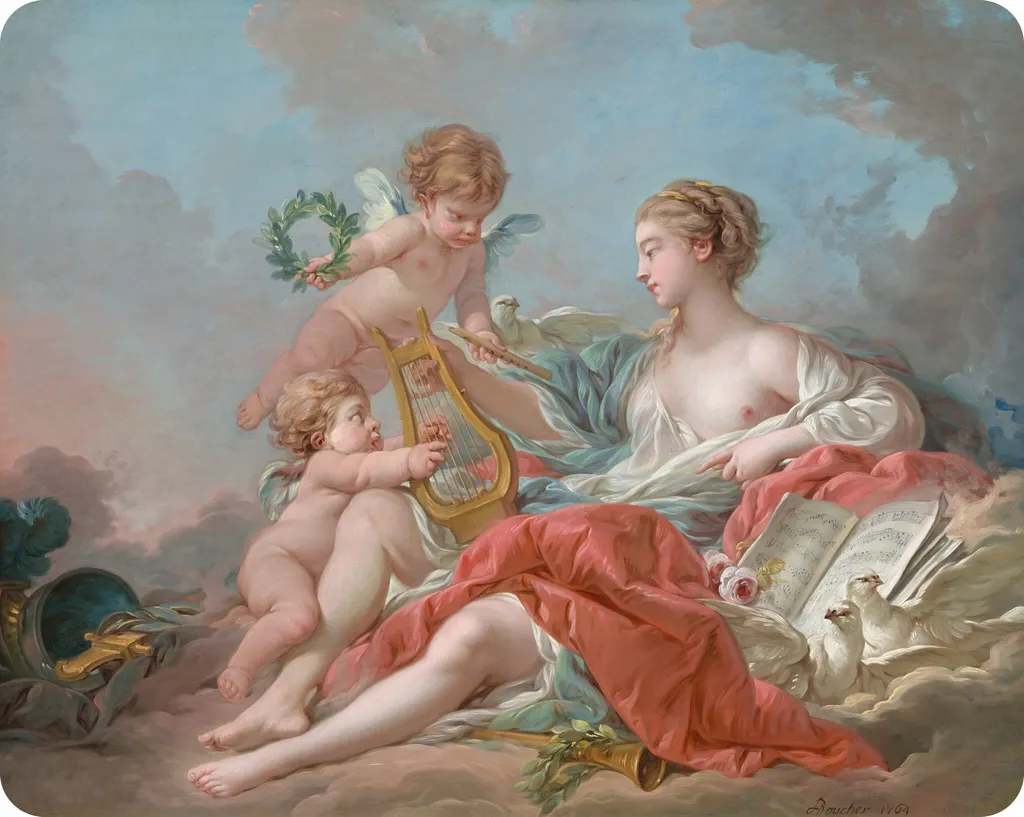
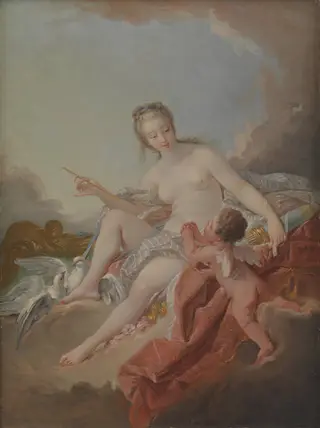
Allegory of Music is an oil painting by the Rococo painting artist François Boucher. It dates from 1764 and is held in the collection of the National Gallery of Art.
- Inscription
- Inscribed:lower right in black paint, FB in monogram: FBoucher 1764
About this work
Subject & Meaning
As an allegory, the work employs attributes such as instruments and figures associated with harmony and rhythm to convey the auditory realm in visual form.
The painting titled Allegory of Music, executed by Francois Boucher in 1764, is an eighteenth-century allegorical composition that visualizes the abstract concept of music through symbolic personifications. As an allegory, the work employs attributes such as instruments and figures associated with harmony and rhythm to convey the auditory realm in visual form. Boucher's treatment reflects the period's tendency to translate intangible arts into tangible, emblematic scenes, using graceful forms and decorative motifs to suggest the order and pleasure of musical expression. The composition thus serves as a symbolic representation of music's universal and harmonious nature.
Technique & Style
Executed in 1764, this allegorical work by Francois Boucher is an oil painting on canvas. The composition measures 103.5 centimeters in height and 130 centimeters in width. As a mid-eighteenth-century piece, the medium and support align with standard French academic practices of the period, using oil pigments applied to a woven textile ground. The work is classified formally as a painting within the allegorical genre.
The physical object is held in the Samuel H. Kress Collection at the National Gallery of Art in Washington, D.C. While specific details regarding surface condition or technical handling procedures are not explicitly detailed in the available records, the material constitution remains consistent with Boucher's known production methods during the 1760s.
History & Provenance
The Allegory of Music was painted by Francois Boucher in 1764. Although its original commission is undocumented, tradition holds that it was created for Maximilian III Joseph, Elector of Bavaria, an early attribution that rests on tradition rather than documentation. The work reportedly entered France in the early nineteenth century through General de Saint-Maurice, who kept it for about sixty years before selling it to M. Maillet du Boullay of Paris, whose 1870 sale at the Hotel Drouot transferred it to M. Feral.
Gustave Rothan owned it by 1874 and sold it at the Galerie Georges Petit in 1890. Adele, 4th duchesse de Dino, held it by 1907, after which it likely passed to her daughter, Countess Mabel Stevens Orlowski. After passing through Wildenstein & Co., the canvas was sold to the Samuel H. Kress Foundation in 1942 and donated to the National Gallery of Art in 1946, where it is held under accession number 1946.7.1 as part of the Samuel H. Kress Collection. Exhibition history is not documented in the available sources.
Context
The Allegory of Music (1764) exemplifies Francois Boucher's late Rococo fascination with allegorical personifications, integrating music as a symbolic motif within a decorative composition that reflects the ornamental sensibilities of mid-eighteenth-century French art. The painting entered the National Gallery of Art through the Samuel H. Kress Foundation gift in 1946, marking its acceptance as a representative example of Boucher's decorative allegories in American collections.
Provenance records rely on tradition linking the work to Maximilian III Joseph, Elector of Bavaria, but scholars such as Alastair Laing have highlighted the lack of documentary evidence and questioned this narrative, emphasizing the need for further research into its early history.
Critical discourse surrounding the piece remains limited, yet its inclusion in the Kress collection underscores early twentieth-century appreciation of Boucher's stylistic influence on French decorative painting.
Overview
François Boucher's Allegory of Music, created in 1764, is an oil-on-canvas painting that embodies the Rococo aesthetic. As a prominent French artist of the 18th century, Boucher frequently explored themes of classical mythology and pastoral beauty, rendered with a distinctive decorative flair. This work exemplifies his approach to allegorical subjects, presenting an abstract concept through a gracefully composed, idealized scene.
Own this work as a print
Artist & collection

Artist
François Boucher was a French painter, draughtsman and etcher, who worked in the Rococo style.