Artwork
Vertumnus and Pomona
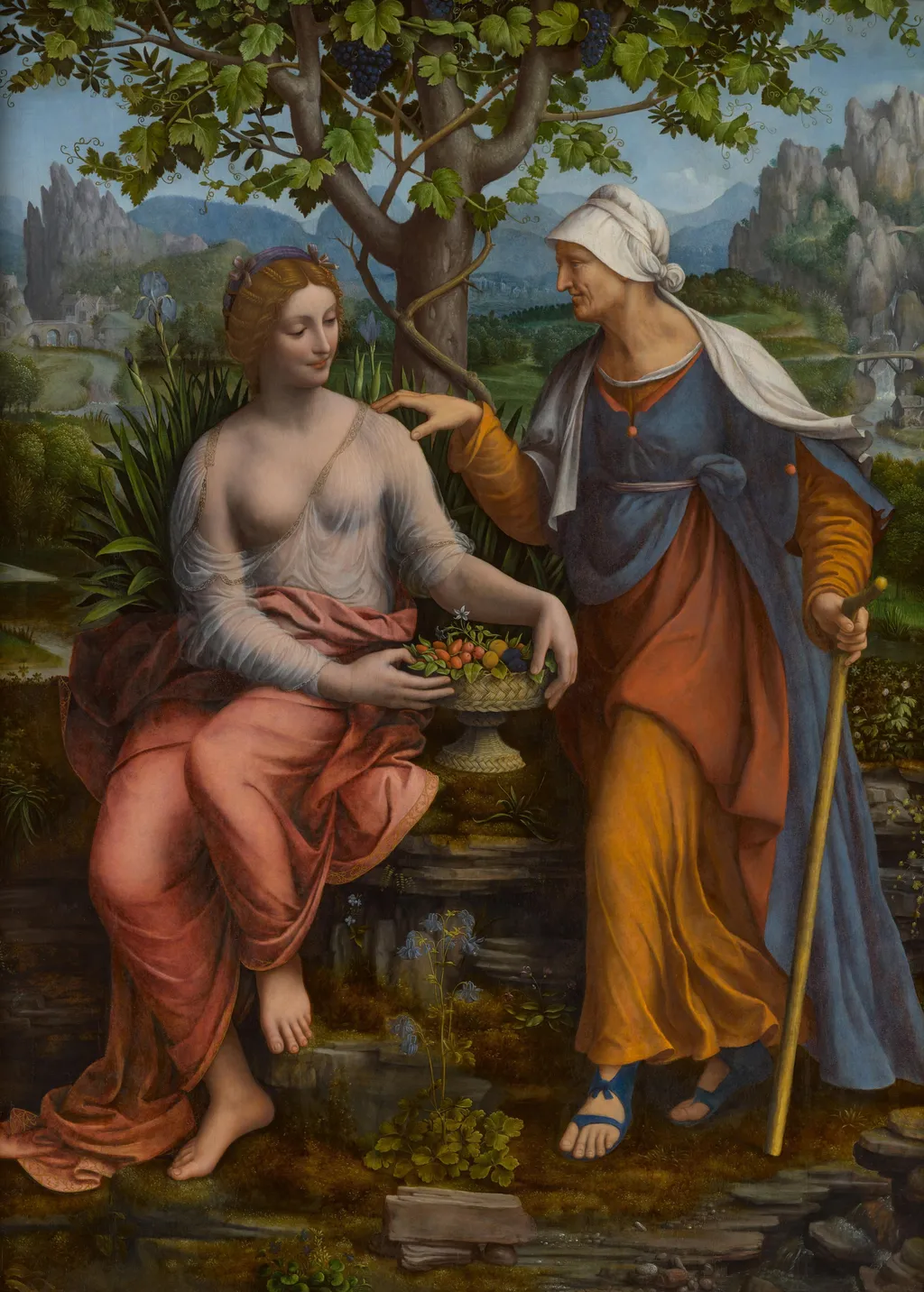
Vertumnus and Pomona is an oil painting by the Mannerist artist Francesco Melzi. It dates from 1520 and is held in the collection of the Gemäldegalerie Berlin.
About this work
Overview
Vertumnus and Pomona is a mythological painting by the Italian Renaissance artist Francesco Melzi, dated roughly between 1518 and 1522.
Vertumnus and Pomona is a mythological painting by the Italian Renaissance artist Francesco Melzi, dated roughly between 1518 and 1522. Executed in oil on poplar wood, the work measures 186 by 135.5 centimeters. It depicts a scene from Ovid's Metamorphoses where the Roman god of the seasons, Vertumnus, disguises himself as an old woman to woo Pomona, the goddess of orchards. The painting is a quintessential example of the Leonardeschi style, heavily reflecting the compositional and technical innovations of Leonardo da Vinci, with whom Melzi closely worked. Today, the painting is held in the Gemäldegalerie of the Berlin State Museums under accession number 222.
Subject & Meaning
The painting illustrates an episode from Book XIV of Ovid's Metamorphoses. Pomona, a nymph devoted to her orchards who rejected all suitors, is approached by Vertumnus, a god of vegetation and the seasons. Utilizing his shape-shifting ability, Vertumnus disguises himself as an elderly woman to gain access to her. In this guise, he praises Pomona's beauty and dedication, warning her of the dangers of rejecting love. Central to his argument is the parable of the elm and the vine, visually represented in the painting by a thick vine climbing a central trunk. Pruned elms were historically used as supports for vines, and Latin authors frequently used this pairing as a symbol of marital union. In the immediate foreground, a growth of columbine further reinforces themes of fertility, a motif that also appears prominently in Melzi's Flora.
Technique & Style
Melzi executed the work firmly in the style of the Leonardeschi, employing Leonardo da Vinci's sfumato technique to render flesh and fabric with a polished, almost invisible brushwork and soft shadows. The figure of Pomona directly borrows Leonardo's female facial type, characterized by downcast eyes and a tight, subtle smile. The composition relies heavily on known Leonardo works from before 1513. The color scheme, blending warm oranges and pinks with cool blues and greens, mirrors Leonardo's Virgin and Child with Saint Anne at the Louvre. The background of distant mountains, rocky crags, and an arched bridge on the left derives from the Mona Lisa, while Pomona's seated pose closely relates to the Virgin Mary in Leonardo's Burlington House Cartoon. The painting also reflects Leonardo's precise observation of botany, with dense vegetation and small blue flowers filling the foreground under an even light.
History & Provenance
The painting's early history remains obscure before the eighteenth century, when it entered the collection of the Duke of Saint-Simon in Paris. By 1771, it had entered the collection of Frederick the Great at Sanssouci, where it was catalogued as a work by Leonardo da Vinci. In 1820, the Gemäldegalerie of the Berlin State Museums purchased the painting from a seller named von Hurt, at which time it was attributed to Salaì. The painting remained in the Gemäldegalerie's collection, eventually receiving the accession number 222. Remnants of Melzi's signature, surviving as the Greek letters S and H on a rock near Vertumnus's foot, were uncovered during a 1995 examination. These remnants align with early descriptions noting the presence of a signature until at least the eighteenth century, which was likely removed to facilitate selling the work as an autograph Leonardo.
Context
Francesco Melzi met Leonardo da Vinci as a young man and became his devoted pupil and companion, traveling with him to Rome in 1513 and to the court of François I in France before 1517, ultimately receiving Leonardo's artistic estate upon the master's death in 1519 at Chateau Cloux. Despite this close relationship, the attribution of Vertumnus and Pomona to Melzi has been debated. Pierre-Jean Mariette was the first to attribute it to Melzi, followed by Giovanni Morelli in 1877. Wilhelm von Bode confirmed the attribution in 1905, linking it stylistically to Melzi's Flora. Marion Wilcox argued in 1919 that Melzi was the sole plausible author, as the alternative, Giampietrino, lacked the necessary distinction. Wilhelm Suida concurred in 1929 based on stylistic ties to Leonardo. Detractors, however, including Georg Hirth and Richard Muther in 1889, and Rodman Henry in 1959, argued that Melzi was merely a dilettante, noting the absence of sixteenth-century evidence that he was a practicing painter and pointing out that Leonardo never mentioned Melzi as an artist. The 1995 discovery of Melzi's signature provided physical evidence supporting the traditional attribution.
Legacy
The confusion over the painting's authorship highlights its historical reception as a work of exceptional quality, easily mistaken for an autograph Leonardo. The deliberate removal of Melzi's signature to pass the painting off as Leonardo's underscores the economic and cultural premiums placed on Leonardo's name, which overshadowed his followers. The eventual identification and physical evidence of Melzi's signature re-centered the work within the oeuvre of the Leonardeschi, helping to define Melzi not merely as a custodian of Leonardo's estate but as a significant practicing artist in his own right. The painting remains a critical reference point for understanding how Leonardo's compositional motifs and techniques were disseminated and adapted by his closest circle.
Own this work as a print
Artist & collection
Artist
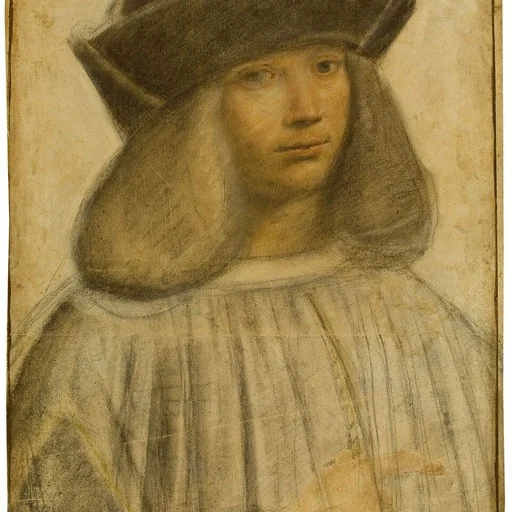
Francesco Melzi, or Francesco de Melzi (1491 – 1570) was an Italian painter born into a family of the Milanese nobility in Lombardy.

- Procris' Prayer to Diana
 The Meeting of the Young Christ and the Young St. John
 Saint Mary Magdalen in the Wilderness
 Neitsyt Maria, Jeesus-lapsi ja lahjoittajat
 Judith with her servant
 Noli me tangere
 Ruth and Naomi in Boaz's field
 Venus
Venus Heimsuchung Mariae zwischen St. Ursula mit den Zehntausend Jungfrauen und St. Martha. Aussenseiten der Flügel: Verkündigung Mariae
 Maria Magdalena
 Allegory
 Venus with Cupid Stealing Honey