Artwork
Dead turkey
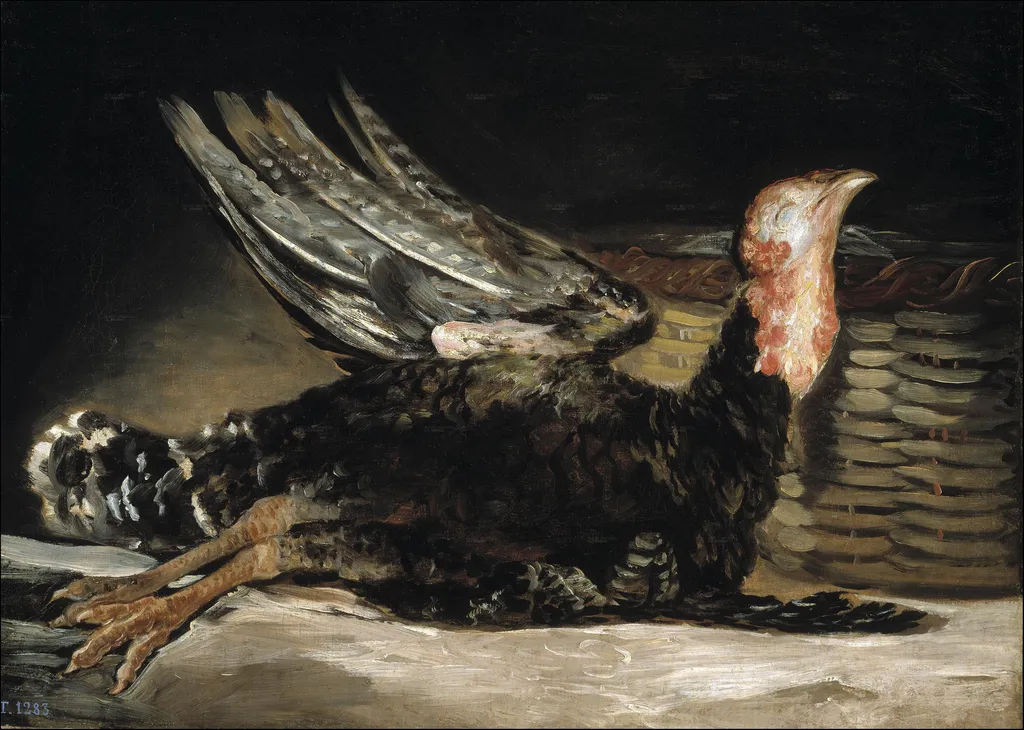
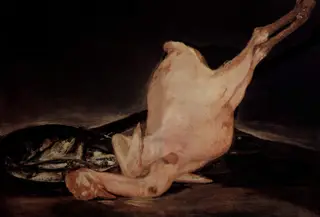
Dead turkey is an oil painting by Francisco de Goya. It dates from 1808 and is held in the collection of the Museo del Prado.
About this work
Subject & Meaning
While bird paintings traditionally celebrated life through rich color, Goya's image provokes empathy rather than festivity.
The painting depicts a dead turkey (Meleagris) leaning against a wicker basket, the sole spatial reference, set against a dark, uniform background that concentrates attention on the bird. Goya strips away idealization, applying paint in rapid, thick strokes and restricting the palette to ocher, white, black, and red, with the bird's red head standing out against the gloom. While bird paintings traditionally celebrated life through rich color, Goya's image provokes empathy rather than festivity. The corpse-like rigidity of the raised wing and joined feet underscores the recent death of the animal. This stark treatment is widely interpreted as a metaphor for the victims of the Spanish War of Independence (1807-1814), situating the work within Goya's broader meditation on death, the ephemeral, and fatalism that would intensify in his later output.
Technique & Style
Dead Turkey is painted in oil on canvas with a dark, uniform background that isolates the subject. The work employs rapid, thick brushstrokes, including single broad strokes for each ridge of the wicker basket, emphasizing tactile handling over fine detail. Goya’s palette is deliberately restricted to ocher, white, black, and a muted red, the latter concentrated on the bird’s head to heighten dramatic realism against the shadowed backdrop.
The composition centers on the stiffened cadaver of the turkey, its raised wing and joined feet rendered with corpse-like rigidity. The limited elements and restrained color heighten the viewer’s focus on the bird’s recent death, evoking empathy rather than the celebratory associations typical of bird still lifes. The absence of idealization underscores the work’s stark confrontation with mortality.
History & Provenance
Dead Turkey (El Pavo muerto) is an oil on canvas by Francisco Goya dated to 1808, painted during the Peninsular War period. Art historians situate the work within a broader series of still lifes Goya produced between 1808 and 1812, linking them stylistically to The Disasters of War.
The painting passed from Goya to his son Javier, who transmitted it to his grandson Mariano. Mariano Goya then gave the still life series to Rafael García Palencia, Conde de Yumurí, in settlement of debts. Following the count's death in 1865, the paintings were sold and dispersed across various collections worldwide, with some works lost. In 1900, the painting was acquired at the initiative of the Spanish Ministry of Fine Arts with the aim of placing it in the Museo del Prado, where it is now held alongside its companion piece Dead Birds.
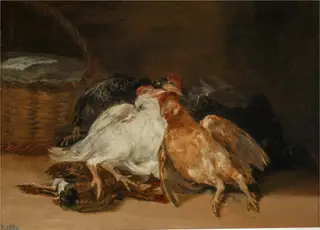
Francisco Goya's *Dead Turkey* is held in the collection of the Museo del Prado in Madrid, Spain. The work is exhibited alongside its pair, *Dead Birds*, within the museum. The painting entered the Prado's holdings in 1900, acquired by the initiative of the Ministry of Fine Arts. Prior to this acquisition, the work had a complex provenance involving the artist's grandson, Mariano Goya, who transferred the painting to Rafael Garcia Palencia, the Count of Yumuri, to settle debts following the Count's death in 1865. After the Count's estate was dispersed, the painting was eventually purchased for the national collection. It remains one of only two still-life paintings by Goya currently in the Prado's possession.
Context
Francisco Goya's *Dead Turkey* (1808) occupies a unique place in his oeuvre, as the still life genre was rarely explored by the artist and held lower status than portraits or historical works in 19th-century Spain. Unlike the Rococo naturalism of contemporaries like Luis Meléndez, Goya's approach during the Spanish War of Independence is defined by thick brushwork, a restricted palette, and a stark, unidealized treatment of death. Scholars interpret the painting's dramatic realism and the bird's corpse-like rigidity as a direct metaphor for the violence and victims of the war, drawing parallels to his *Disasters of War* series. The work forms a pair with *Dead Birds*, and together they represent the only still lifes by Goya held in the Museo del Prado, where they were acquired in 1900 after a complex provenance involving the artist's descendants and the Count of Yumuri.
Legacy
After Goya’s death the painting remained in his family; his son Javier inherited the series of still lifes and passed it to his grandson Mariano Goya. Mariano later gave the works to Rafael Garcia Palencia, comte Yumuri, to settle debts. Following the comte’s death in 1865 the canvases were sold and scattered among various collections, with some lost. In 1900 the French Ministry of Fine Arts acquired Dead Turkey specifically to return it to the Prado, where it hangs alongside its companion piece Dead Birds. Today it is one of only two still‑life paintings by Goya in the Prado’s collection, underscoring its enduring place in the museum’s holdings and in the artist’s legacy.
Own this work as a print
Artist & collection
Artist
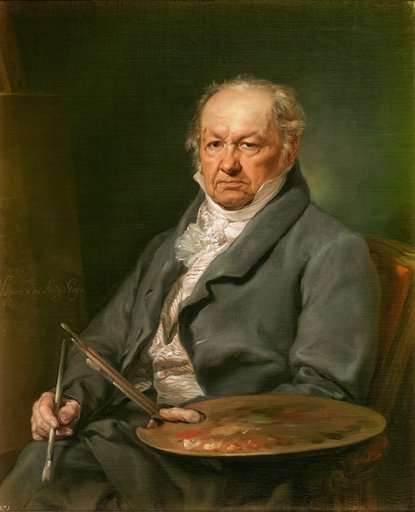
Francisco José de Goya y Lucientes was a Spanish romantic painter and printmaker.