Artwork
Don Manuel Osorio de Zuniga
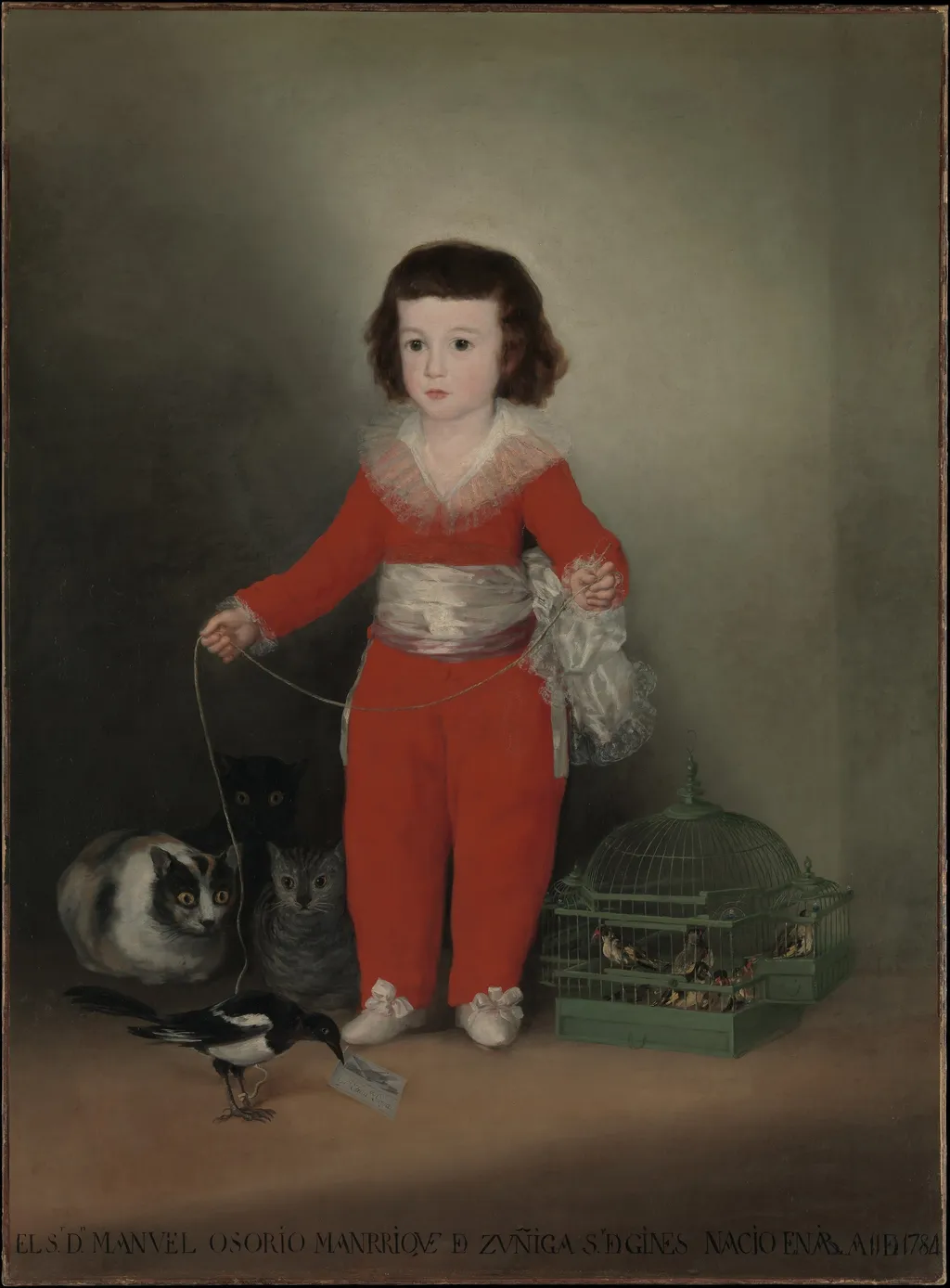
Don Manuel Osorio de Zuniga is an oil painting by the Rococo painting artist Francisco de Goya. It dates from 1794 and is held in the collection of the Metropolitan Museum of Art. Francisco Goya completed the oil portrait Don Manuel Osorio de Zúñiga between 1787 and 1788.
About this work
A boy in bright red stands against a dark ground, holding a small wheeled birdcage and a cord tied to a black dog. Two cats watch a bird at his feet. His lace-trimmed suit and sash look fine but a little rumpled, as if from play. Francisco Goya, 1794.
Subject & Meaning
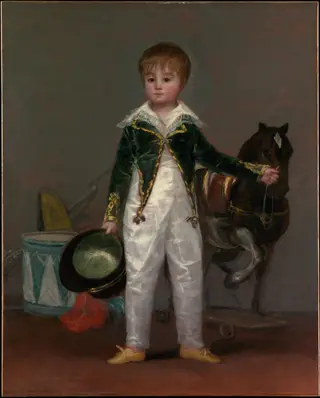
The painting depicts Manuel Osorio Manrique de Zúñiga, a boy of three or four, dressed in a vibrant red costume with a white collar and silver sash.
The painting depicts Manuel Osorio Manrique de Zúñiga, a boy of three or four, dressed in a vibrant red costume with a white collar and silver sash. He holds a string attached to a magpie that grips the artist's visiting card in its beak; to his left finches are confined in a cage, while three cats watch the magpie intently on his right. These animals carry distinct symbolic weight: the caged birds and the magpie evoke innocence and the soul, a common Christian motif, while the magpie also signifies curiosity, and the three cats represent the world of instinct and lurking danger.
The composition juxtaposes the child's purity against these predatory forces, creating a tension between innocence and potential corruption.
Technique & Style
The painting is executed in oil on canvas and measures 127 by 101.6 centimetres. Goya renders the boy in a vivid red costume with white collar and cuffs, a silver sash, and white bow-trimmed shoes, set against a drab olive-brown background that creates a strong light-dark contrast. The figure is posed rigidly, with a grave, almost impenetrable expression resembling a puppet more than a lively child.
The symbolic animals, a magpie on a string holding Goya's visiting card, a cage of finches, and three watchful cats, are carefully described, contributing to the work's allegorical tone.
History & Provenance
Painted between 1787 and 1788, this portrait was commissioned by Vicente Joaquín Osorio de Moscoso y Guzmán, Conde de Altamira, who engaged Francisco Goya for several family portraits. It depicts the count's youngest son, Manuel, born in April 1784. The painting hung at the Altamira palace in Madrid before being auctioned in Paris in 1878 for 1,200 francs.
It was acquired by the playwright Henri Bernstein, who sold it to the dealer Joseph Duveen in 1925; Jules Bache then bought it in 1926 after his daughter, Kathryn Bache Miller, admired it at Duveen's gallery. Bache bequeathed the painting to the Metropolitan Museum of Art on his death in 1944, and it entered the collection in 1949. It was displayed in Kathryn Bache Miller's New York apartment until her death in 1979 and is now shown in the museum's galleries.
Context
The portrait of Don Manuel Osorio de Zúñiga has been praised as one of Goya's most compelling child portraits; the curator Claus Virch called it "one of the most appealing and successful portraits of children ever painted." Scholars highlight its layered symbolism: the caged birds and watchful cats reference innocence and hidden danger, a motif Goya revisited in Los Caprichos. As a court work commissioned by the Altamira family, it reflects Goya's role as a painter to the Spanish court and his integration of aristocratic patronage into intimate domestic imagery.
Legacy
The portrait has become a touchstone for studies of childhood symbolism in Spanish art, and its use of animal motifs to convey moral contrast has shaped scholarly discourse. Its passage from the 1878 Paris auction through Henri Bernstein, Joseph Duveen, and Jules Bache to the Metropolitan Museum of Art in 1949 illustrates its movement through elite private collections before entering a public institution. Its inclusion in the 2014 exhibition "Goya and the Altamira Family," which reunited related portraits, reinforced its standing within Goya's aristocratic oeuvre, and its iconography continues to inform analyses of his symbolic language and its influence on later portraiture.
Overview
Francisco Goya completed the oil portrait Don Manuel Osorio de Zúñiga between 1787 and 1788. This painting depicts a young boy, likely three or four years old, dressed in a striking red suit. The composition includes various animals, such as birds and cats, which add a narrative element to the formal portraiture.
The work is recognized for its vivid depiction of childhood and the artist's characteristic attention to detail and psychological insight.
Own this work as a print
Artist & collection
Artist
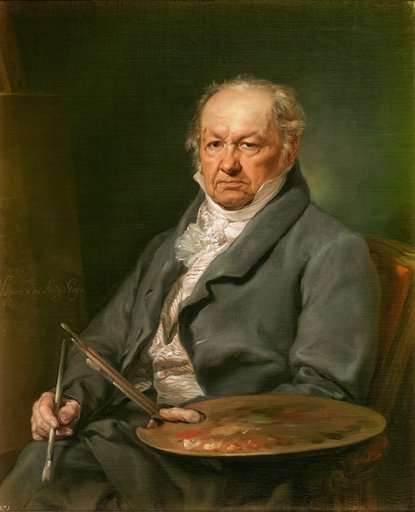
Francisco José de Goya y Lucientes was a Spanish romantic painter and printmaker.