Artwork
Majas on a Balcony
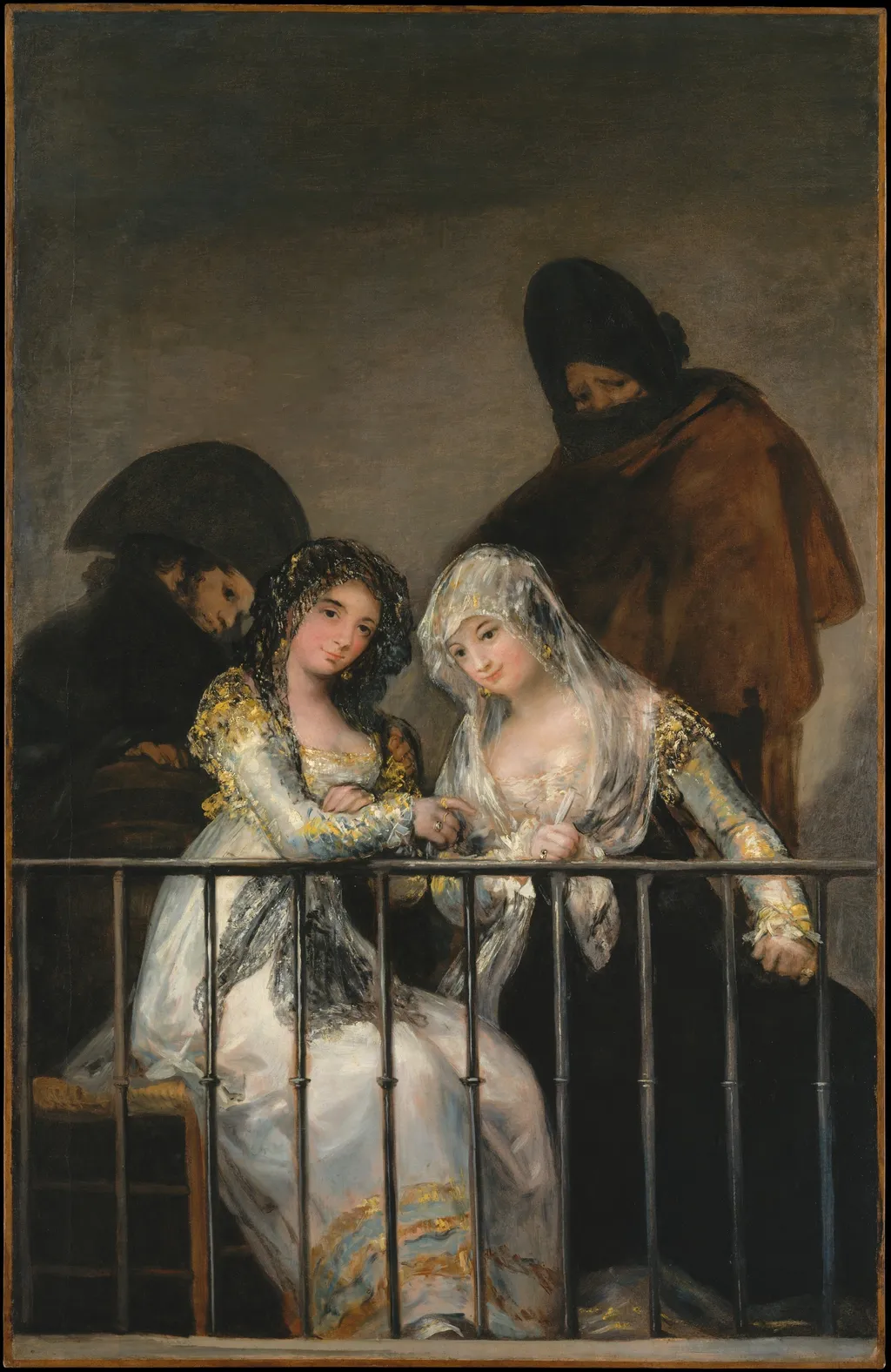
Majas on a Balcony is an oil painting by Francisco de Goya. It dates from 1808 and is held in the collection of the Metropolitan Museum of Art.
About this work
Subject & Meaning
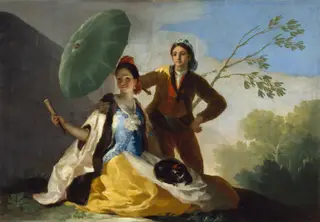
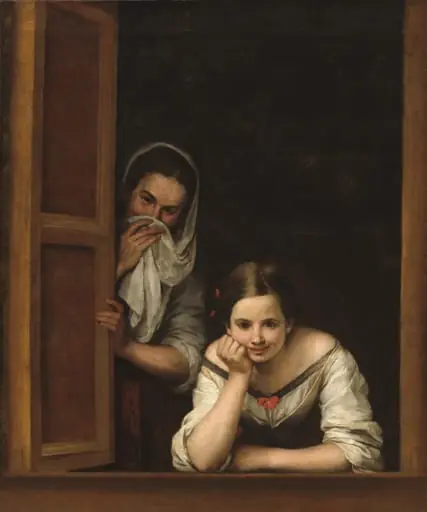
The work depicts two women, identified as Majas dressed in traditional Spanish costume, seated on a balcony with a balustrade.
The work depicts two women, identified as Majas dressed in traditional Spanish costume, seated on a balcony with a balustrade. Behind them, two male figures appear as shadowy silhouettes in the background. Created during the Napoleonic invasion of Spain, the painting represents a shift in Goya's focus toward lighter subjects while retaining a sense of irony and detachment.
The composition transforms a scene of daily life into schematic symbols, contrasting the intense color and theatrical presence of the women in the foreground with the dark, ghostly obscurity of the men behind. This juxtaposition reflects a transition between the artist's earlier vibrant depictions of society and the emerging bitterness of his later Black Paintings, suggesting themes of beauty and the underlying social tensions of the era.
Technique & Style
Executed in oil paint on canvas (194.8 × 125.7 cm, painted 1808–1814), the work depicts two women in Spanish dress seated on a balcony with a balustrade that forms a rectangular frame; the composition is organized around geometric squares and a central diamond, creating a strict spatial logic. The bright, theatrical foreground contrasts with the shadowy background, and the figures are rendered with simplified anatomy that turns the scene into schematic symbols, reflecting Goya's transitional tone. The painting's intense colour in the foreground and its dark, ghost-like rear figures were noted by contemporaries and later inspired Édouard Manet's Le Balcon.
History & Provenance
Majas on a Balcony is attributed to Francisco Goya and dated to 1808, with the possible execution window extending to between 1808 and 1814. The canvas is related thematically to Maja and Celestina on a Balcony (1808–1814, Palma, March Collection). The work passed into the collection of Louisine Havemeyer and was at some point exhibited at the Galerie espagnole before entering the Metropolitan Museum of Art, where it is now displayed in Gallery 619.
The painting is held in the collection of the Metropolitan Museum of Art, where it is displayed in Gallery 619 within the section dedicated to Goya and Eighteenth-Century Italy. The work was previously owned by Louisine Havemeyer before entering the museum's holdings.
Context
Majas on a Balcony has been discussed as a transitional work in Goya's oeuvre, reflecting his shift from the sunny genre scenes of earlier years to a more ironic, detached style that foreshadows his later Black Paintings. Scholars note the painting's geometric composition, contrasting the vivid foreground with shadowy background figures interpreted as procurators. Created during the Peninsular War, the work belongs to a series of maja subjects that offered lighter themes amid the turmoil.
Its ownership by Louisine Havemeyer helped introduce it to American audiences, and its compositional influence is cited as a precursor to Édouard Manet's Le Balcon, securing its place in 19th-century art history.
Legacy
Majas on a Balcony has become a reference point for later artists, most notably Édouard Manet, who cited the composition when creating his own balcony scene (exhibited at the Salon of 1869), demonstrating the work's lasting compositional impact. The painting's presence in the Metropolitan Museum of Art has helped cement Goya's reputation as a master of genre scenes during the early 19th century. Its dual portrayal of fashionable women and shadowy onlookers reflects the transitional tone of Goya's career, bridging the light-handed courtly subjects of his early period with the darker, psychological themes that would dominate his later work.
Overview
Majas on a Balcony is an oil painting by Francisco Goya, executed between 1808 and 1814 during the Peninsular War following Napoleon's invasion of Spain. The composition features two women, known as majas, seated side by side on a balcony with a black wrought-iron railing. The figure on the left wears a white dress with a veil and a headpiece adorned with gold trim, while her companion on the right is dressed in dark clothing with a curly wig featuring gold accents.
Behind them, a man in dark attire leans against the wall, his face partially obscured by shadow. The painting is characterized by its stark contrast between the brightly lit figures and the dark, ambiguous background, creating a sense of tension and immediacy. While the Metropolitan Museum of Art in New York holds a version attributed to a copyist, the work in the collection of Edmond de Rothschild in Switzerland is widely considered the original.
This piece stands as a significant example of Goya's genre scenes from his later period, reflecting the social atmosphere of Madrid during a time of political upheaval.
Own this work as a print
Artist & collection
Artist
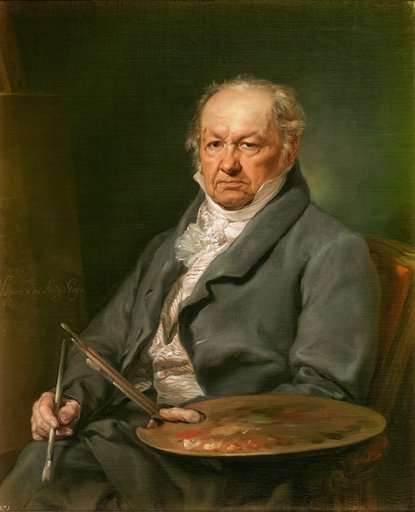
Francisco José de Goya y Lucientes was a Spanish romantic painter and printmaker.