Artwork
Thérèse Louise de Sureda
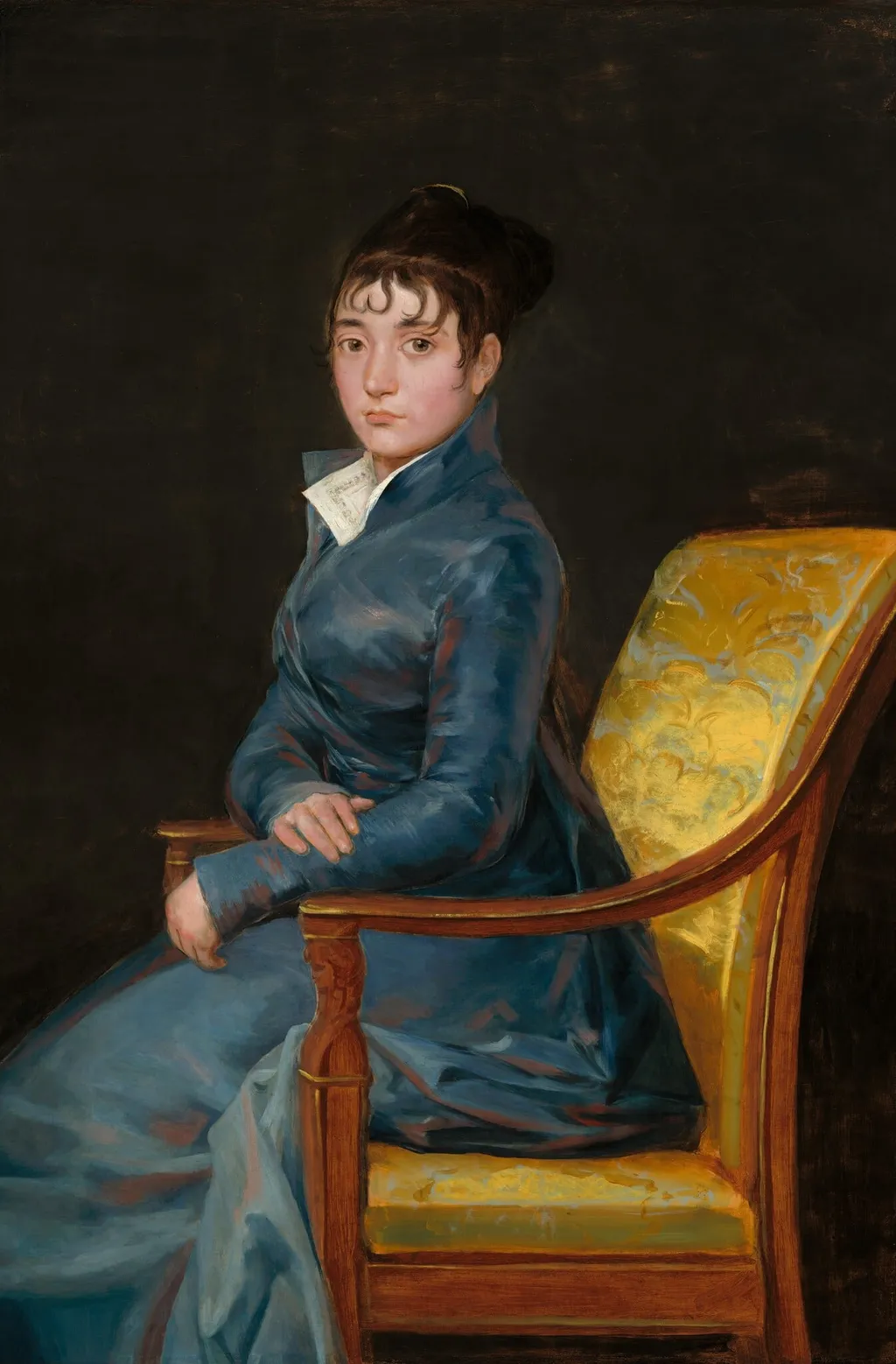
Thérèse Louise de Sureda is an oil painting by the Romanticist artist Francisco de Goya. It dates from 1804 and is held in the collection of the National Gallery of Art.
About this work
Thérèse Louise de Sureda sits bolt upright in an Empire armchair carved with Egyptian heads, arms folded across a coatdress of blue shot silk. Goya painted the young Frenchwoman around 1803 to 1804, soon after she married Bartolomé Sureda y Miserol, who had taught him the aquatint technique behind Los Caprichos. It hangs at the National Gallery as a pendant to her husband's portrait.
Subject & Meaning
The painting depicts Teresa Luisa de Sureda seated in an Empire-style armchair, her body turned in profile while her head faces the viewer.
The painting depicts Teresa Luisa de Sureda seated in an Empire-style armchair, her body turned in profile while her head faces the viewer. She has black hair styled in a chignon and wears a formal dress. Her right hand rests on her left arm, which lies on the armrest, creating a sense of movement.
The dark green background enhances the figure's volume in a manner recalling Titian or Tintoretto. As the pendant to Goya's portrait of her husband, Bartolomé Sureda, the work deliberately avoids the symmetrical or mirroring poses typical of Baroque marital portraits. Instead, Goya presents each sitter with a distinct attitude, and Teresa's engaged, direct gaze and asymmetrical posture convey a modern, individualized presence that emphasizes both her social standing and the painter's innovative approach to portraiture.
Technique & Style
The portrait is executed in oil on canvas, a medium typical of Goya's practice. The composition presents Thérèse Louise de Sureda seated with her body in profile on an Empire-style armchair, while her head turns to face the viewer. Her right hand rests on her left arm, which is placed on the chair's armrest.
The dark green background is used to enhance the figure's volume, a technique echoing the Venetian masters Titian and Tintoretto. This formal arrangement, with the sitter's torso set at a three-quarter angle and the subtle play of light on her face and clothing, conveys both elegance and a sense of contained movement.
History & Provenance
Painted in 1804, this portrait of Thérèse Louise de Sureda (née Teresa Sureda) was commissioned as the pendant to the portrait of her husband, the Mallorcan industrialist Bartolomé Sureda, who was a friend of Francisco Goya. The painting likely remained with the Sureda family in Madrid and Seville before passing through the Parisian dealer Durand-Ruel et Cie. It was purchased on 28 September 1897 by Mr. and Mrs. H.O. Havemeyer of New York.
Upon Louisine Havemeyer's death in 1929, it passed to their daughter, Adaline Havemeyer Frelinghuysen, who gifted it to the National Gallery of Art in Washington in 1942. An earlier owner, possibly Pedro Escat of Palma de Mallorca, has been suggested.
Context
Painted in 1804, the work belongs to a period when Goya was a highly sought-after portraitist for both the aristocracy and the high bourgeoisie of Madrid. As the pendant to the portrait of Bartolomé Sureda, it departs from the symmetrical conventions of earlier double portraiture, instead presenting the husband and wife in distinct, individualized poses. Scholarship has noted the influence of Venetian masters such as Titian and Tintoretto in the dark green background, which enhances the figure's volume.
The early provenance was recorded by 19th-century scholars Charles Yriarte and the Conde de la Viñaza, and the painting later entered the prominent Havemeyer collection before being gifted to the National Gallery of Art in 1942. This portrait exemplifies Goya's move toward a more modern, informal approach to portraiture.
Overview
Francisco de Goya painted this oil on canvas portrait of Thérèse Louise de Sureda around 1803 or 1804. Measuring 119.7 by 79.4 centimeters, it captures the young Frenchwoman shortly after her marriage to Bartolomé Sureda y Miserol. This work serves as a pendant to a corresponding portrait of her husband, both created by Goya after the couple settled in Madrid. The painting offers a glimpse into early 19th-century European portraiture.
Own this work as a print
Artist & collection
Artist
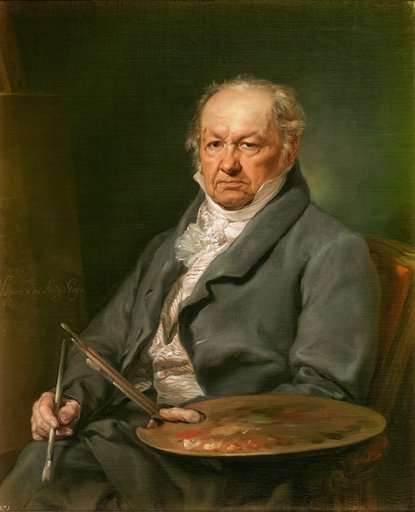
Francisco José de Goya y Lucientes was a Spanish romantic painter and printmaker.

- Señora Sabasa Garcia
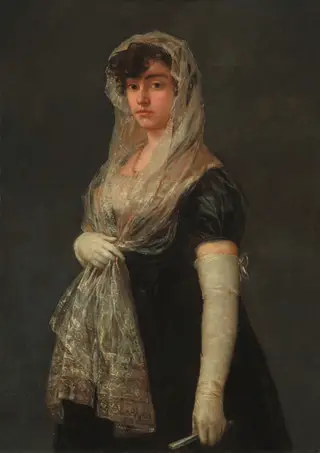 Young Lady Wearing a Mantilla and Basquina
 Portrait of a young woman leaning on a meridienne
 Portrait of Doña Antonia Zárate
 Portrait of a Lady in a Black Mantilla
 Portrait of Adriana Johanna van Wijck, Wife of Johannes Ploos van Amstel
 Berthe Morisot
 Claire Campbell
 Portrait of Madame Brunet
 Mademoiselle Malot
 Portret de tânără
 Portrait of Jenny Kamerlingh Onnes