Artwork
Plucked turkey
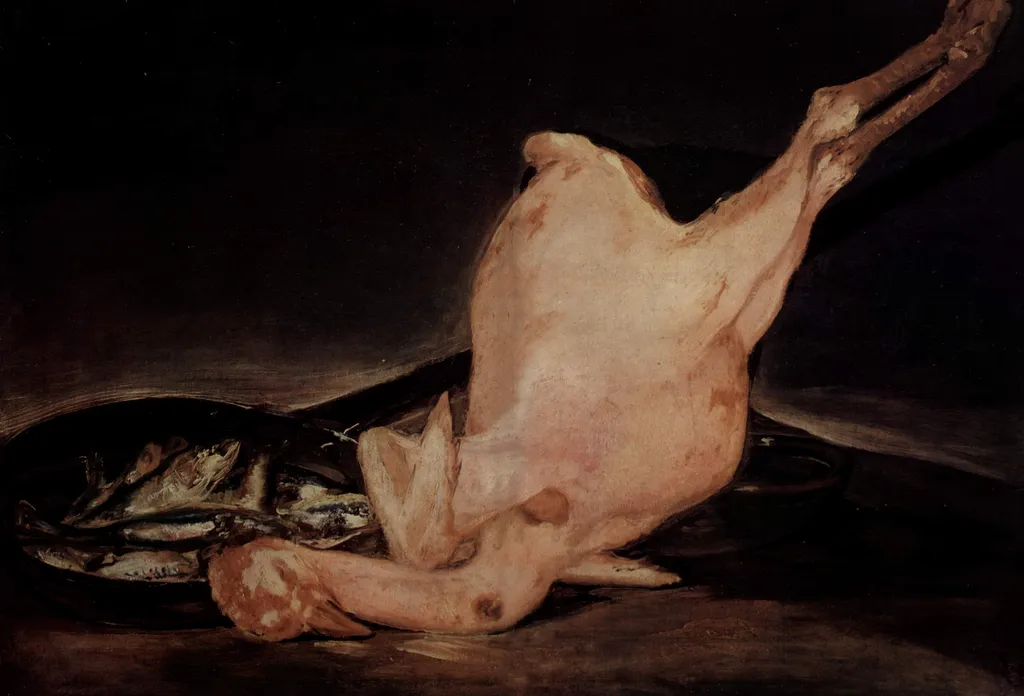
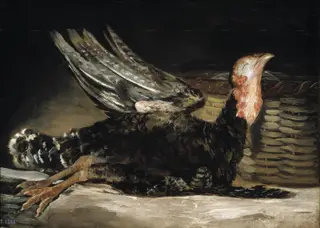
Plucked turkey is an oil painting by Francisco de Goya. It dates from 1810 and is held in the collection of the Bavarian State Painting Collections.
About this work
Overview
The painting resides in the Alte Pinakothek in Munich, part of a small group of Goya’s non-portrait still lifes from his later years.
Painted in 1810, Plucked Turkey is a still life by Francisco Goya, executed in oil on canvas. Unlike his more politically charged works, this piece focuses on a solitary, lifeless bird laid bare. Its quiet realism marks a departure from grand narrative, instead emphasizing the physical presence of an ordinary subject.
The painting resides in the Alte Pinakothek in Munich, part of a small group of Goya’s non-portrait still lifes from his later years.
Subject & Meaning
The painting presents a plucked turkey, its pale flesh exposed, limbs stretched unnaturally upward. The absence of life, the vulnerability of the carcass, and the starkness of its placement suggest themes of mortality and consumption. Goya, who had witnessed war and social upheaval, may have used the bird as a quiet metaphor for the fragility of the body, devoid of ornament, stripped to its essential form.
Technique & Style
Goya employed oil paint with restrained precision to render the turkey’s skin, feathers, and underlying musculature. Subtle gradations of pink and gray, along with soft shadows, create a tactile sense of weight and surface. The background remains indistinct, dark and undefined, directing focus entirely to the bird.
The handling of light and form reflects a mastery of chiaroscuro, though without theatricality, its effect is intimate, not dramatic.
History & Provenance
Created during Goya’s later years, when he lived in relative seclusion, Plucked Turkey belongs to a series of small still lifes he painted between 1808 and 1812. These works were likely personal experiments, not commissioned. The painting entered the Alte Pinakothek’s collection in the 19th century, acquired through European art markets, and has remained there since, preserved as an example of Goya’s quieter, observational phase.
Context
In the early 1810s, Spain was reeling from the Peninsular War and political instability. While Goya’s other works from this period confront violence and madness, Plucked Turkey offers a subdued counterpoint. Its focus on a domestic, almost mundane object may reflect a retreat from public commentary, or an attempt to find meaning in the physical world amid chaos. It aligns with a broader European trend of introspective still life in times of unrest.
Legacy
Though not widely exhibited, Plucked Turkey has influenced later artists interested in the emotional weight of ordinary subjects. Its unadorned realism and psychological undertones prefigure 19th-century naturalism and even 20th-century modernist still lifes. The painting stands as a testament to Goya’s ability to infuse simplicity with depth, transforming a carcass into a quiet meditation on presence and absence.
Own this work as a print
Artist & collection
Artist
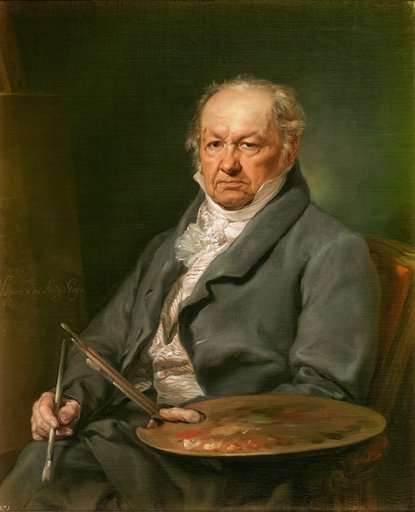
Francisco José de Goya y Lucientes was a Spanish romantic painter and printmaker.