Artwork
Dogs and hunting gear
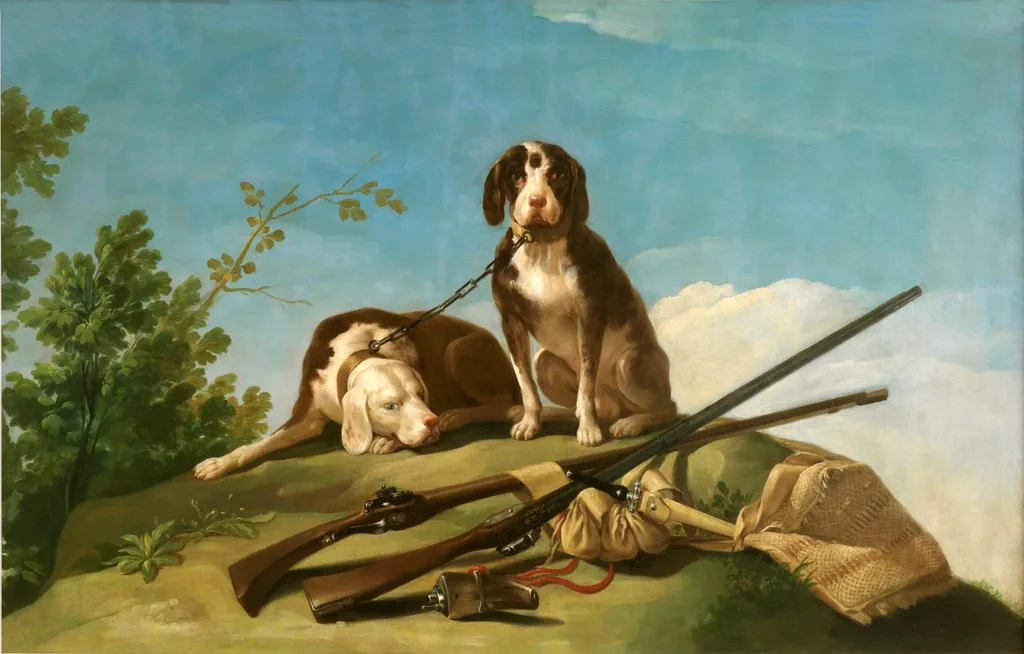
Dogs and hunting gear is an oil painting by the Rococo painting artist Francisco de Goya. It dates from 1775 and is held in the collection of the Museo del Prado.
About this work
Subject & Meaning
Designed as an overdoor piece, the elongated format and low viewing angle reflect its intended architectural placement above a doorway.
Executed in 1775 as a tapestry cartoon for the dining room of the Prince of Asturias at El Escorial, this work depicts a still-life arrangement of hunting equipment and animals. The composition features hunting dogs restrained by leashes and collars, positioned alongside a shotgun, powder flask, and knife against a backdrop of sky and clouds. Designed as an overdoor piece, the elongated format and low viewing angle reflect its intended architectural placement above a doorway.
The subject matter directly references hunting, the favored leisure activity of the royal family at this specific location. Stylistically, the dogs are arranged on a mound forming a pyramid, a compositional structure influenced by Anton Raphael Mengs, while the blending of blue and green tones in the foliage and sky mirrors its pendant piece. The work represents a formal exercise in animal painting within the constraints of royal decorative programs.
Technique & Style
The work is an oil painting on canvas measuring 112 × 174 cm, created by Francisco de Goya in 1775 as part of the first series of cartoons intended for royal tapestry. It was executed in oil on canvas and originally installed as an over‑door in the Prince of Asturias’ dining room at the Monastery of El Escorial, giving it a markedly elongated format. The composition features a pyramidal arrangement of hunting dogs on a mound, rendered with a low viewpoint that emphasizes depth; the sky and foliage are subdued in blue‑green tones, echoing the adjacent piece “Hunting with a Whistle.”
Stylistically the influence of Francisco Bayeu and Anton Raphael Mengs is evident, while the handling of animals demonstrates Goya’s skill in depicting canine forms. The painting remained in the Royal Palace’s basement until its rediscovery in 1869 and was later acquired by the Museo del Prado, where it is displayed in room 90 (catalogue no. 753).
History & Provenance
The work, titled Dogs and hunting gear, was commissioned in 1775 as part of Goya’s first series of cartoon designs for tapestry intended for the dining room of the Prince of Asturias at the Royal Palace of El Escurial. It was delivered to the Royal Tapestry Factory on 24–25 May 1775 (source_ids: 3,4). The painting, executed in oil on canvas, dates to 1775 (source_ids: 1,2).
After being stored in precarious conditions in the basement of the Palace of Oriente, it was considered lost until its rediscovery in 1869 by Gregorio Cruzada Villaamil (source_id: 3). It subsequently entered the collection of Raimundo de Madrazo, was donated to the Museo del Prado in 1894 (source_id: 3), and has remained in room 90, catalogued as 753, paired with Caza con reclamo (source_ids: 3,4).
The painting is housed in the Museo del Prado, Madrid, where it carries inventory number 753 and is displayed in Sala 90. After being lost for decades, the canvas was found in 1869 in the basement of the Royal Palace of Madrid by Gregorio Cruzada Villaamil. It subsequently entered the collection of Raimundo de Madrazo, who donated it to the Prado in 1894.
Since that donation the work has remained on view in the Prado, paired with its companion piece Caza con reclamo.
Context
The critical fortunes of Dogs and hunting gear shifted markedly after its rediscovery in 1869 in the basement of the Madrid Royal Palace, having been lost since its delivery as a tapestry cartoon in 1775. Early scholarship, notably Gregorio Cruzada Villaamil’s 1870 survey, situated the work within Goya’s first series of court tapestry cartoons, underscoring its original function as an overdoor panel for the Escurial dining room of the Prince and Princess of Asturias. Later studies, such as V. de Sambricio’s 1946 catalogue and José Manuel Arnaiz’s 1987 monograph, emphasized Goya’s stylistic indebtedness to Francisco Bayeu and Anton Raphael Mengs during this formative court phase, noting how the elongated format and pyramidal arrangement of dogs reflect Mengs’s neoclassical compositional ideals.
Modern analyses, including Janis Tomlinson’s 1993 account, recognize the painting’s preparatory role within a broader decorative program celebrating royal pastimes, aligning it with contemporaneous expectations for still-life hunting scenes in Spanish palace interiors.
Legacy
After being regarded as lost for nearly a century, Dogs and hunting gear was rediscovered in the basement of the Royal Palace of Madrid in 1869 and subsequently entered the collection of Raimundo de Madrazo, who donated it to the Museo del Prado in 1894, where it has been displayed in room 90 alongside its pendant, Caza con reclamo. Its reappearance secured the work’s place within Goya’s early tapestry‑cartoon series intended for the Prince of Asturias’ dining room at El Escorial, affirming its role in the artist’s formative court commissions and contributing to the modern appreciation of his animal subjects.
Overview
Francisco Goya painted Dogs and hunting gear in 1775, an oil-on-canvas still life from his early career. This work exemplifies the Rococo aesthetic prevalent at the time, showcasing his developing skill before his later, more dramatic artistic shifts. The painting presents a tranquil scene featuring canines amidst various hunting implements, offering a glimpse into leisure pursuits of the era. It is currently housed in the Museo del Prado.
Own this work as a print
Artist & collection
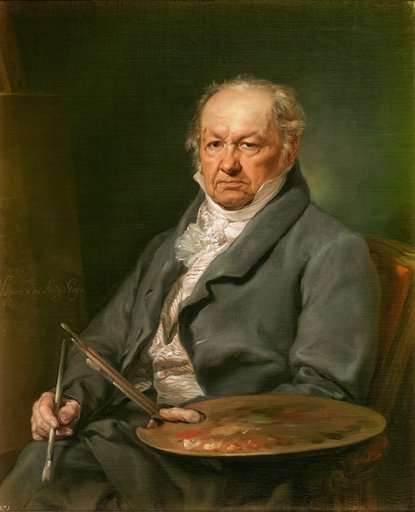
Artist
Francisco José de Goya y Lucientes was a Spanish romantic painter and printmaker.