Artwork
Untitled
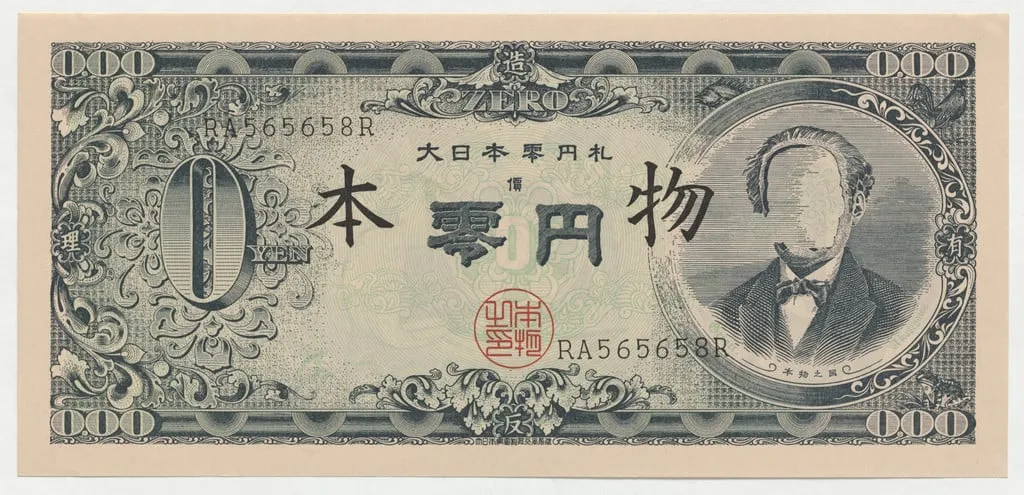
Untitled is an ink print by Genpei Akasegawa. It dates from 1967 and is held in the collection of the Museum of Modern Art.
About this work
The man’s face is blurred, but his clothes and the formal style suggest someone important.
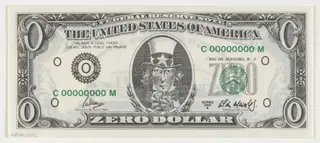
This bill has a big zero in the middle and a portrait of a man in a suit with a bow tie. The background is filled with swirly black designs and Japanese text. The edges look fancy, with tiny patterns and the number "1000" in circles at the corners.
The man’s face is blurred, but his clothes and the formal style suggest someone important. The text reads "日本銀行券," which means "Bank of Japan note."
Look up lithography to see how this kind of print was made.
Overview
Created in 1967, this offset lithograph by Genpei Akasegawa mimics the appearance of a Japanese banknote but is not legal tender. It was produced as part of a conceptual art project that interrogated value, authority, and reproduction. The work is held in the collection of The Museum of Modern Art, where it is recognized for its critical engagement with institutional and economic symbols.
Subject & Meaning
The image resembles a 1000-yen note, featuring a blurred portrait of a man in formal attire, surrounded by ornate borders and Japanese script identifying it as a Bank of Japan note. The central zero subverts monetary value, while the decorative elements and faded face suggest the fragility of authority. The piece questions the legitimacy of currency as a social construct rather than an inherent measure of worth.
Technique & Style
Produced via offset lithography, the work replicates the fine detail and tonal gradations typical of official printing. Akasegawa employed precise graphic design to imitate the look of genuine currency, including micro-patterns, circular numerals at the corners, and swirling background motifs. The deliberate blurring of the portrait and the use of black ink against white create a tension between authenticity and simulation.
History & Provenance
Made during a period of experimental art in Japan, the piece emerged from Akasegawa’s involvement with the Neo-Dadaist movement and his later legal troubles over reproducing currency. Though initially treated as a forgery, it was later recontextualized as conceptual art. The Museum of Modern Art acquired it as part of its broader interest in postwar Japanese avant-garde practices.
Context
In late 1960s Japan, artists like Akasegawa challenged state institutions through subversive imagery. The government had recently prosecuted artists for reproducing banknotes, framing such acts as criminal. Akasegawa’s work responded to this climate by transforming the forbidden object into a subject of artistic inquiry, exposing the symbolic power embedded in everyday currency.
Legacy
Untitled remains a key example of Japanese conceptual art that redefines the boundaries between art, law, and economics. It influenced later generations of artists who use institutional critique to explore systems of value. Its presence in major collections signals its role in expanding the definition of printmaking beyond traditional aesthetics into political and philosophical domains.
Artist & collection

Artist
Katsuhiko Akasegawa, known by his pseudonym Genpei Akasegawa, was a Japanese artist and writer.