Artwork
Barbarian Royalty Worshiping the Buddha

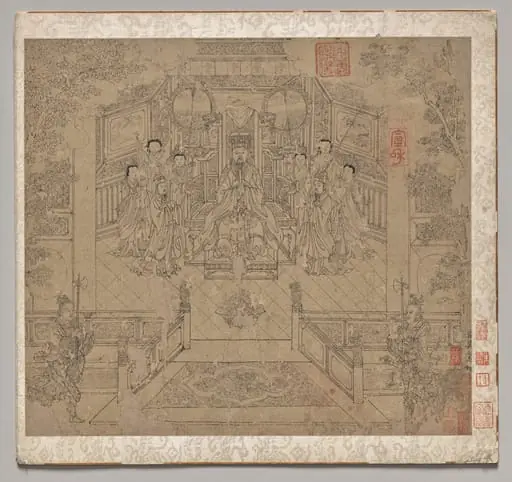
Barbarian Royalty Worshiping the Buddha is an unspecified painting by the Song dynasty painting artist Zhao Guangfu. It dates from 950 and is held in the collection of the Cleveland Museum of Art. The work depicts a procession of fifteen figures advancing from the right toward a seated Buddha.
- Accession no.
- 1957.358
- Credit line
- Gift of Severance and Greta Millikin
About this work
You see a line of fifteen people in fancy robes and feathered hats, stepping forward to offer incense to a golden Buddha on a flower throne.
You see a line of fifteen people in fancy robes and feathered hats, stepping forward to offer incense to a golden Buddha on a flower throne.
The painting shows how Buddhism spread across cultures. The worshipers have different faces and clothes, hinting they came from lands beyond China. It’s like a snapshot of the Northern Song court welcoming foreign visitors.
To see more art from this time, look up china, northern song dynasty (960-1127).
Overview
The work depicts a procession of fifteen figures advancing from the right toward a seated Buddha. The central dignitary, distinguished by a headdress bearing twin pheasant feathers, holds an incense burner aloft. The Buddha occupies a lotus‑styled throne, accompanied by two haloed disciples and a pair of Heavenly Kings on either side, creating a formal devotional tableau.
Subject & Meaning
The varied physiognomies, garments, and accessories of the worshippers suggest a gathering of peoples from multiple regions, emphasizing Buddhism’s capacity to transcend ethnic and cultural boundaries. By presenting these foreign adherents in a respectful pose before the Buddha, the painting conveys the religion’s universal appeal and its role as a bridge between disparate societies.
Technique & Style
Executed in the refined brushwork characteristic of the Northern Song period, the composition balances linear procession with a centralized focal point. Delicate detailing on the feathered headdress and the intricate patterns of the robes highlights the artist’s attention to texture, while the luminous halos around the disciples and Kings employ subtle color washes to suggest sanctity.
History & Provenance
The scene draws inspiration from the frequent arrival of foreign envoys who presented tribute at the Chinese imperial court. In the Song era such visitors were labeled “barbarians,” and their inclusion in the painting reflects contemporary attitudes toward external diplomatic relations and the acknowledgment of China’s political stature.
Context
Created during the Northern Song dynasty (960–1127), the work aligns with a broader visual tradition that documented the empire’s cosmopolitan court life. It serves as a visual record of how Buddhist iconography was employed to illustrate the empire’s cultural openness while simultaneously reinforcing the centrality of the Chinese ruler’s authority.

Artist & collection

 Rain-coming Pavilion by the Stone Bridge at Mt. Tiantai
 Landscape with Bamboo
 Eight Views of Xiao-Xiang
 River and Mountains on a Clear Autumn Day
 Saying Farewell at Xunyang (Song of the Pipa)
 Bamboo, Rocks and Lonely Orchids
 "In Exchange for Tea" with Wen Zhengming’s Calligraphy of The Heart Sutra
 Landscape with Bamboo
 Regatta on Dragon Lake