Artwork
Orpheus
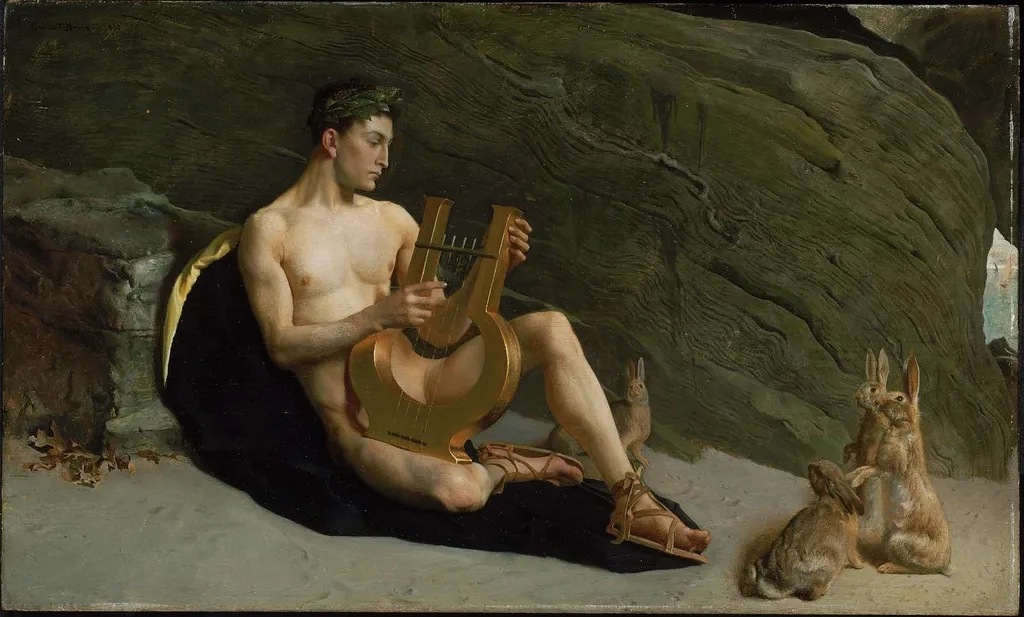
Orpheus is an oil painting by the Post-Impressionist artist George de Forest Brush. It dates from 1896 and is held in the collection of the Museum of Fine Arts Boston.
About this work
Overview
8 cm (12 by 20 inches), the work depicts the mythological musician Orpheus in a moment of quiet contemplation with his lyre, surrounded by a group of rabbits.
Orpheus is an oil-on-panel painting by the American artist George de Forest Brush, completed in 1890. Measuring 30.48 by 50.8 cm (12 by 20 inches), the work depicts the mythological musician Orpheus in a moment of quiet contemplation with his lyre, surrounded by a group of rabbits. The painting is held in the collection of the Museum of Fine Arts, Boston, where it is displayed in Gallery 221, having been acquired in 1995 through the gift of JoAnn and Julian Ganz, Jr. (accession number 1995.767). Signed and dated "Geo. de F. Brush. 1890" in the upper left corner, the painting exemplifies Brush's meticulous technique and his engagement with classical mythology during a period when American artists increasingly turned to European academic traditions and archetypal subjects.
Subject & Meaning
The painting depicts Orpheus, the legendary musician, poet, and prophet of Greek mythology, son of the muse Calliope and pupil of Apollo. In Brush's interpretation, the nude male figure sits on a dark cloth with golden lining before a rocky outcrop, wearing a green leaf crown and leather sandals. He holds a golden lyre across his lap, his fingers touching the strings, his body turned slightly to the right and his gaze directed downward toward the instrument. The iconography of the lyre and leaf crown clearly identifies the figure as Orpheus, the musician whose divine gift could charm all living things. To his right, five rabbits of varying sizes gather on pale sandy ground, some sitting upright, others crouching, their presence illustrating the legendary power of Orpheus's music to draw and tame wild beasts. This motif of animal attraction alludes to the broader mythological tradition in which Orpheus's melodies moved not only gods and mortals but also the natural world. The rabbits serve as humble, domesticated counterparts to the more common depictions of Orpheus charming lions, tigers, or the denizens of the underworld, perhaps suggesting a more intimate, contemplative aspect of the musician's gift.
Technique & Style
Brush executed Orpheus in oil on panel, a support that allowed for the smooth, highly finished brushwork evident throughout the composition. The palette is dominated by earthy greens, warm golds, and pale flesh tones, with light falling from the upper left to illuminate the figure's torso, the golden lyre, and the gathered rabbits. Deep shadows pool beneath the cloth and within the rock crevices, creating a dramatic chiaroscuro that models the forms and enhances the painting's contemplative mood. The artist rendered textures with meticulous precision, the smoothness of skin, the softness of fur, the reflective quality of metal, and the rough stratification of stone each receiving careful attention. The dark green and brown stratified rock curves behind the figure, forming a natural backdrop that contains the scene, while a small glimpse of blue sky at the far right edge provides the only release from the enclosed, earthy setting. The overall effect is one of polished academic naturalism, characteristic of Brush's training and his commitment to technical mastery.
History & Provenance
George de Forest Brush painted Orpheus in 1890 in the United States, during a mature phase of his career. The work remained in private hands until it was given to the Museum of Fine Arts, Boston in 1995 by collectors JoAnn and Julian Ganz, Jr., entering the museum's collection with the accession number 1995.767. The painting is now permanently installed in Gallery 221 at the Museum of Fine Arts, Boston. While specific exhibition history prior to its acquisition is not documented in the available sources, the work has been digitized and distributed through major image databases including the AMICA Library, indicating its recognition as a significant example of American mythological painting.
Context
George de Forest Brush (1855-1941) was an American painter whose career spanned the late nineteenth and early twentieth centuries. His work on Orpheus in 1890 places him within a generation of American artists who, following training in European academies, applied rigorous technical standards to subjects drawn from classical mythology and allegory. The choice of Orpheus as subject aligns with a broader nineteenth-century fascination with the myth, as evidenced by other treatments of the theme by artists such as Nicolas Poussin, Louis Jacquesson de la Chevreuse, and Edward Poynter. Brush's particular interpretation, with its intimate scale and focus on the musician's quiet power rather than dramatic narrative action, distinguishes his approach from more theatrical contemporaneous treatments. The painting reflects the influence of academic naturalism on American art of the period, as well as the cultural aspiration to claim classical subjects as legitimate territory for American painters.
Legacy
Orpheus remains a significant work within George de Forest Brush's oeuvre and in the collection of the Museum of Fine Arts, Boston. The painting's presence in major digital image archives, including the AMICA Library and Wikimedia Commons, has ensured its continued visibility to scholars and the public. Its public domain status has facilitated widespread reproduction and study. While not as widely reproduced as some contemporary mythological paintings, Brush's Orpheus represents an important American contribution to the iconography of the legendary musician, demonstrating how classical subjects could be adapted through the lens of academic naturalism and intimate scale. The work continues to serve as a valuable document of American artistic engagement with classical mythology at the close of the nineteenth century.
Artist & collection

Artist
George de Forest Brush (September 28, 1855 – April 24, 1941) was an American painter and Georgist.