Artwork
Pompeian Scene
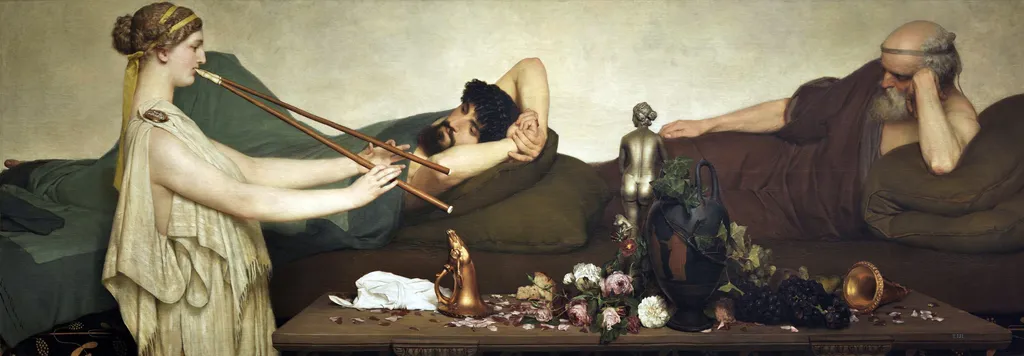
Pompeian Scene is an oil painting by Lawrence Alma-Tadema. It dates from 1868 and is held in the collection of the Museo del Prado.
About this work
Subject & Meaning
Classical objects such as the Venus de’ Medici and Greek vases appear as decorative references, while the aulos and rhyton signal musical and ritual activity.
The painting depicts a tranquil ancient Greek interior in which a young woman plays the aulos while two men recline nearby. One listener, an older man, appears to drift into sleep, lending the scene its alternate title, La Sieste. Alma-Tadema drew on the Parthenon frieze attributed to Phidias for the composition’s rhythmic arrangement of draped figures and horizontal format.
Classical objects such as the Venus de’ Medici and Greek vases appear as decorative references, while the aulos and rhyton signal musical and ritual activity. Within the artist’s early Pompeian series, the scene evokes leisure, antiquity, and sensory pleasure, situating contemporary Victorian viewers within an idealized classical past.
The work’s iconography blends genre and classical allusion to convey a mood of cultivated repose.
Technique & Style
Executed in 1868, this work is an oil painting on canvas characterized by a pronounced horizontal format, measuring 130 cm in height and 369 cm in width. The composition functions as a genre scene set in antiquity, depicting a young woman playing an aulos for two reclining male figures amidst classical sculptures and vessels. Stylistically, the arrangement of the figures draws direct inspiration from the frieze of the Parthenon, originally executed by Phidias and his workshop.
The narrative focus captures the moment the older listener succumbs to sleep, a detail that informs the work's alternative title, The Siesta.
History & Provenance
Painted in 1868, Pompeian Scene (also known as The Siesta or Scène pompéienne) was created by Lawrence Alma-Tadema as a horizontal oil on canvas depicting an antique genre scene.
It entered the Museo del Prado, Madrid, in 1887 as a gift from the British art dealer Ernest Gambart. The work has remained in the museum’s holdings since that date.
Lawrence Alma-Tadema's 1868 painting Pompeian Scene (also known as The Siesta) is held in the collection of the Museo del Prado in Madrid, Spain. The work was acquired by the museum as a gift from the art dealer Ernest Gambart in 1887. While the painting is currently part of the Prado's permanent holdings, the provided sources do not list specific inventory numbers or record any past or future exhibition history for the piece.
Context
Executed in 1868, this horizontal oil painting represents a genre scene set in antiquity, depicting a young woman playing the aulos for two reclining men. The composition draws direct inspiration from the Parthenon frieze created by Phidias and his workshop, specifically illustrating the elder listener succumbing to sleep, which informs the work's alternative title, The Siesta.
Scholarship identifies the depicted figures and objects as including the Venus de' Medici, a rhyton, Greek vases, and various sculptures, anchoring the piece within the artist's broader practice of reconstructing classical life through archaeological detail. The painting entered the collection of the Museo del Prado in Madrid in 1887 as a gift from the dealer Ernest Gambart, securing its place in a major European institution.
Legacy
The painting influenced later genre scenes that combined archaeological precision with intimate narrative moments, and its reputation grew through exhibitions in Paris salons before entering the Spanish royal collection. Contemporary critics praised its technical virtuosity and its evocation of antiquity, leading to repeated reproductions in engravings that circulated widely across Europe. The work's legacy persists in modern museum displays that highlight Alma-Tadema's role in shaping Victorian perceptions of ancient life, and it remains a reference point for scholars studying the intersection of art and archaeology.
Overview
Lawrence Alma‑Tadema’s Pompeian Scene (1868) presents an intimate interior reminiscent of a Roman villa. A woman in a white garment plays a long wooden flute while a reclining man rests with his eyes shut, and an older figure holds his head in apparent fatigue. The composition is populated with classical artifacts, a golden cup, floral arrangements, grapes, and two large vases adorned with green foliage, creating a tableau of quiet leisure.
Artist & collection

Artist
Sir Lawrence Alma-Tadema ( AL-mə TAD-ay-mə; born Lourens Alma Tadema, Dutch:; 8 January 1836 – 25 June 1912) was a Dutch painter who later settled in the United Kingdom, becoming the last officially recognised denizen in 1873.