Artwork
The Stone Breaker
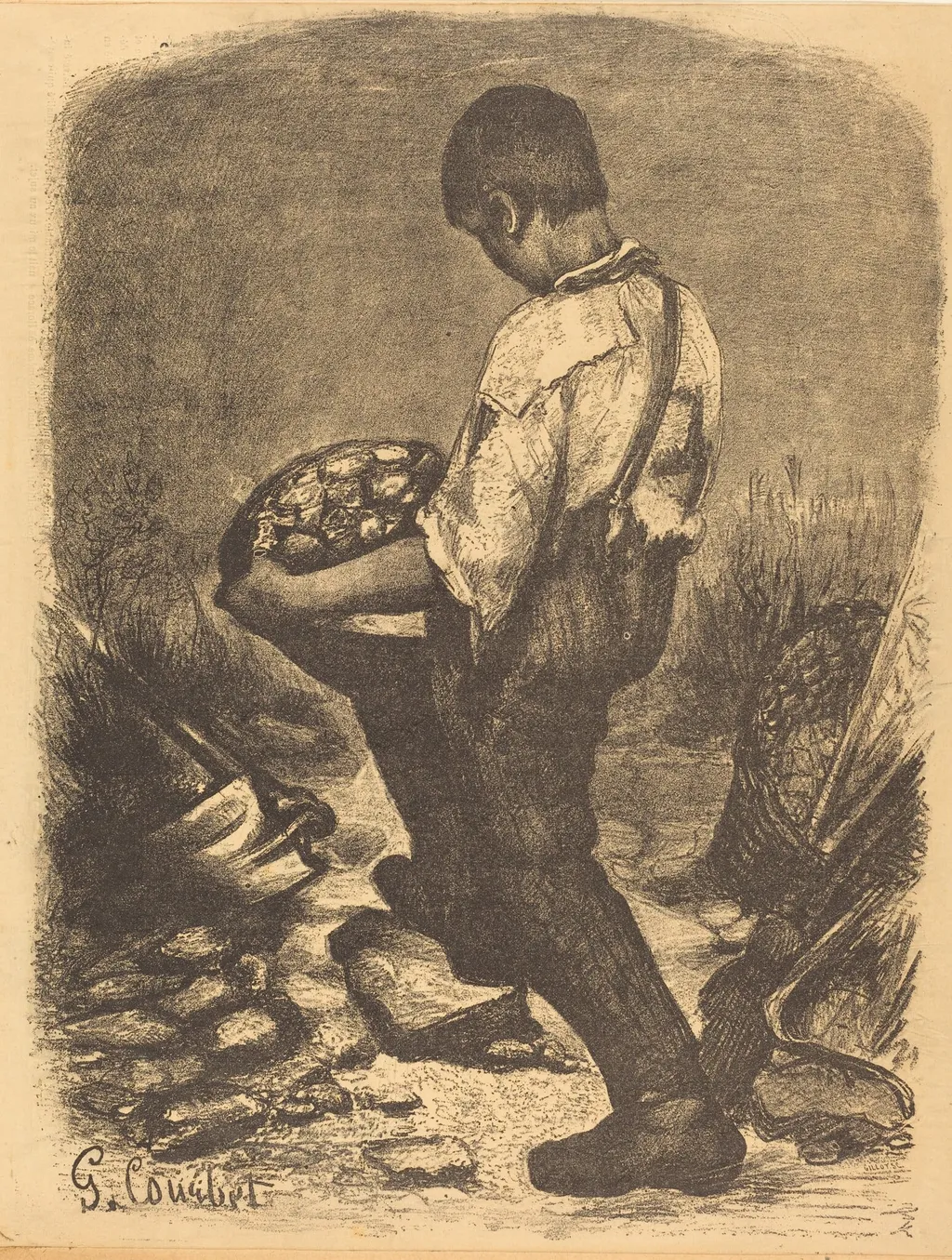
The Stone Breaker is a print by the Romanticist artist Firmin Gillot. It dates from 1849 and is held in the collection of the National Gallery of Art.
- Inscription
- Inscribed:lower left in stone: G. Courbet; lower left in stone: GILLOT. SC; by later hand, upper right in ink: France XIX; by later hand, lower right in ink: Courbet
About this work
Overview
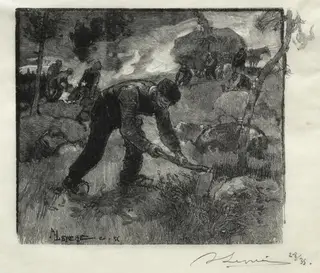
Created in 1849 by Firmin Gillot, this print is a gillotype in black on wove paper, mounted on a support. It captures a moment of labor with minimal detail, emphasizing gesture over finish. The work belongs to a tradition of observational drawings that record everyday life, executed with a sense of immediacy and restrained technique.
Subject & Meaning
The image depicts a young boy engaged in the arduous task of breaking stones, his body bent under the weight of physical exertion. His worn clothing and the barren, stony ground suggest poverty and relentless toil. The scene carries no overt sentiment, instead presenting labor as an unvarnished, habitual condition of rural existence.
Technique & Style
Gillot employed swift, linear strokes to convey form and movement, avoiding polished detail. The sketchlike quality suggests direct observation, possibly drawn on-site. The contrast between the boy’s solid silhouette and the loose, atmospheric background of grass and branch enhances the sense of isolation and fatigue.
History & Provenance
The print was produced during a period when French artists increasingly turned to scenes of working-class life. Gillot, known for his illustrations and graphic work, likely created this as a study or independent piece, not for mass reproduction. Its survival as a single impression indicates it was valued as a personal or artistic record rather than a commercial product.
Context
In mid-19th century France, artists began documenting laborers with greater attention to social reality, influenced by emerging realism. Gillot’s drawing aligns with this shift, though it lacks the monumental scale of contemporaries like Millet. Its intimacy and informality reflect a more private engagement with the subject, rooted in direct observation rather than ideological statement.
Legacy
Though not widely exhibited or reproduced, the work contributes to a broader archive of 19th-century graphic studies that recorded labor with honesty and restraint. It stands as an example of how printmakers used quick, unembellished techniques to preserve the dignity and hardship of ordinary lives, influencing later documentary approaches in visual art.
Own this work as a print
Artist & collection