Artwork
The Plow
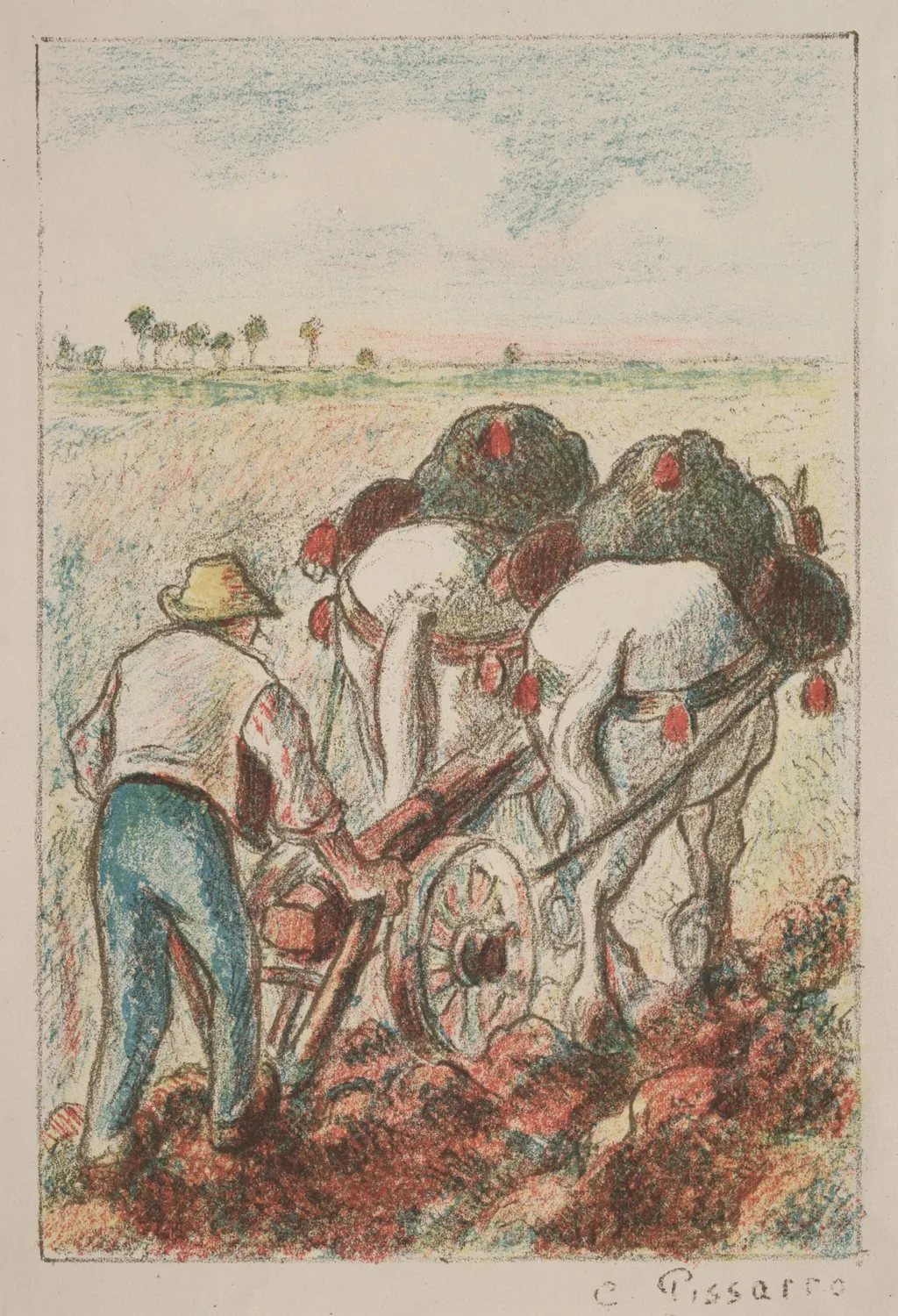
The Plow is a print by Camille Pissarro. It dates from 1901 and is held in the collection of the Cleveland Museum of Art.
- Accession no.
- 1962.105
- Credit line
- Membership Income Fund
About this work
Overview
This work reflects his sustained focus on agrarian labor and the rhythms of the countryside, capturing a moment of quiet diligence without romanticization.
Created in 1901, The Plow is an oil painting by Camille Pissarro, a key figure in the evolution of modern French painting. Though often associated with Impressionism, Pissarro also embraced Neo-Impressionist methods in his later years, integrating pointillist brushwork into his depictions of rural life. This work reflects his sustained focus on agrarian labor and the rhythms of the countryside, capturing a moment of quiet diligence without romanticization.
Subject & Meaning
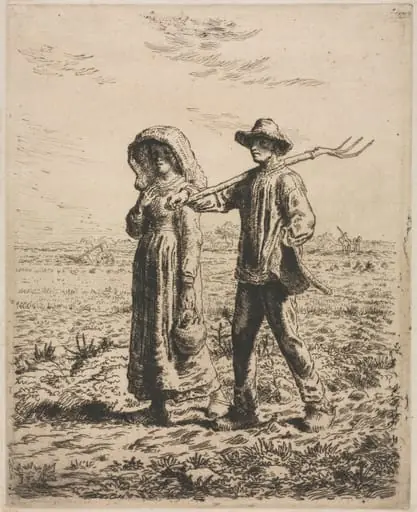
The painting portrays a peasant farmer guiding a plow drawn by two horses across a field. The figure’s bent posture and the earth’s furrowed surface emphasize physical toil, while the calm horizon and muted sky suggest continuity rather than drama. Pissarro avoids sentimentality, presenting labor as an unremarkable, essential part of daily life.
The harmony between human and animal, tool and land, conveys a sense of quiet dignity rooted in observation rather than idealization.
Technique & Style
Pissarro employs a refined, broken brushwork characteristic of his Neo-Impressionist phase, using small, deliberate strokes to build form and atmosphere. Color is applied with subtle modulation, avoiding strong contrasts in favor of tonal gradations that evoke natural light. The composition is deliberately restrained, with the plowman placed low in the frame, allowing the land and sky to dominate. This approach prioritizes atmospheric cohesion over dramatic focal points.
History & Provenance
Painted during Pissarro’s final decade, The Plow belongs to a series of rural scenes he produced after settling in Éragny-sur-Epte. He returned repeatedly to agricultural themes, influenced by his anarchist beliefs and commitment to depicting working-class life. The painting remained in private hands after its creation and entered a public collection in the mid-20th century, where it is now preserved as part of a broader archive of his late-period work.
Context
In the early 20th century, France’s rural population was declining as industrialization reshaped society. Pissarro’s focus on plowing and fieldwork stood in contrast to urban modernity, offering a deliberate meditation on disappearing traditions. His choice to depict labor without heroism aligned with his political views and his rejection of academic grandeur, situating the painting within a broader critique of social change.
Legacy
Though less celebrated than his earlier Impressionist works, The Plow exemplifies Pissarro’s enduring commitment to truthful representation and his willingness to evolve stylistically. It influenced later realist and socially conscious painters who sought to elevate everyday labor through careful observation. The painting remains a quiet testament to his belief in art as a record of lived experience, not spectacle.
Own this work as a print
Artist & collection