Artwork
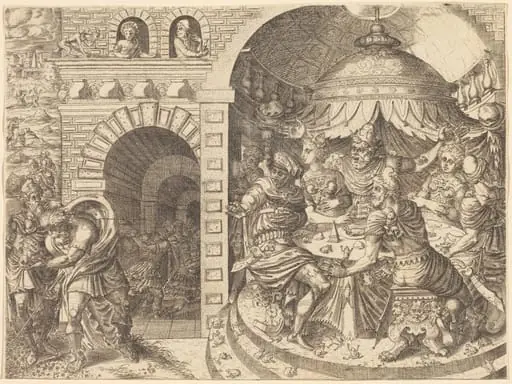
Banquet at the House of Tarquinius Collatinus
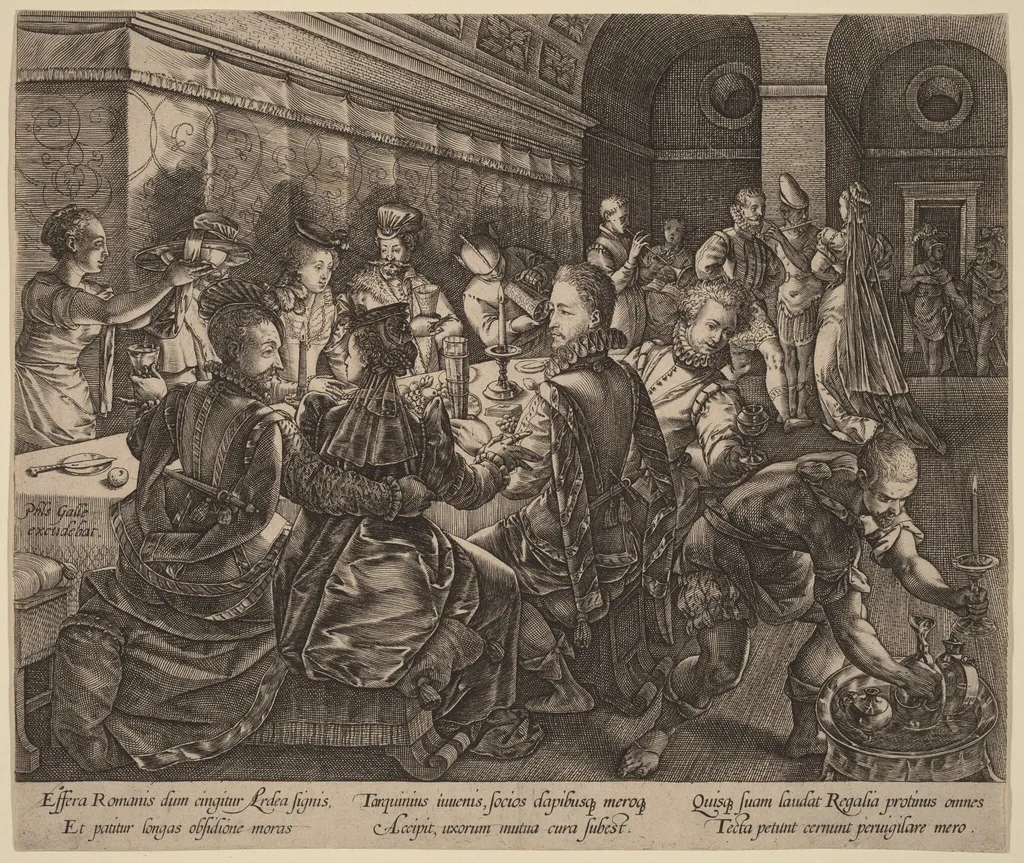
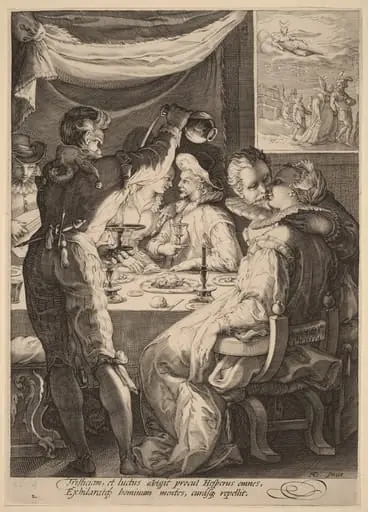
Banquet at the House of Tarquinius Collatinus is an ink print by the Renaissance artist Hendrick Goltzius. It dates from 1578 and is held in the collection of the National Gallery of Art.
- Inscription
- Inscribed:at left, in image on table cloth, in plate: Phls Galle / excudebat.; below image, in plate: Effera Romanis dum cingitur Ardea signis, / Et patitur longas obsidione moras / Tarquinius iuvenis, socios dapibusque meroque / Accipit, uxorum mutua cura subest. / Quisque suam laudat Regalia protinus omnes / Tecta petunt cernunt pervigilare mero. (While the besieged Ardea is surrounded by Roman legions and has to withstand a lengthy siege, the young Tarquin entertains his friends with a lavish meal; they talk about the love between them and their wives. Each man praises his own wife. They all go straight away to the royal palace and drink wine there all night.) [translation from Leeflang, Huigen, and Ger Luijten. _Hendrick Goltzius (1558-1617): Drawings, Prints and Paintings._ Amsterdam: Rijksmuseum, 2003, p. 40.)]
About this work
Overview
Created around 1578 by Hendrick Goltzius, this engraving on laid paper captures a moment from Roman legend set in the household of Tarquinius Collatinus.
Created around 1578 by Hendrick Goltzius, this engraving on laid paper captures a moment from Roman legend set in the household of Tarquinius Collatinus. As a leading printmaker of the Northern Mannerist tradition, Goltzius employed fine, controlled lines to render complex scenes with precision. The work exemplifies his mastery of the engraving technique, translating narrative drama into intricate black-and-white detail on paper.
Subject & Meaning
The scene illustrates a banquet described in ancient Roman sources, likely referencing the moment when Lucretia’s virtue is tested by the prince Sextus Tarquinius. Figures are arranged in a lively, crowded interior: guests dine, converse, and play music, while a central figure holds a candle, casting subtle light across the scene. The atmosphere blends festivity with underlying tension, hinting at the moral stakes of the story.
Technique & Style
Goltzius used fine, intersecting lines to model form, texture, and shadow with exceptional control. The elaborate costumes, characterized by ruffled collars and layered fabrics, are rendered through dense hatching and cross-contour strokes. Facial expressions vary subtly, conveying individual emotion amid the bustle. The composition avoids symmetry, instead favoring dynamic, almost chaotic energy typical of Northern Mannerist aesthetics.
History & Provenance
Produced early in Goltzius’s career, this print reflects his training in the Netherlands and his engagement with classical narratives popular among humanist patrons. It was likely circulated among collectors and artists as a demonstration of technical virtuosity. No definitive early ownership records survive, but its survival in multiple institutional collections suggests it was widely admired and reproduced in print form.
Context
In late 16th-century Northern Europe, engravings served both artistic and intellectual purposes, often illustrating mythological or historical tales for educated audiences. Goltzius’s work aligned with a broader trend of reviving Roman themes through detailed graphic art. His prints were studied by contemporaries for their compositional daring and technical rigor, bridging Renaissance humanism and emerging Baroque expressiveness.
Legacy
This engraving contributed to Goltzius’s reputation as a pivotal figure in printmaking, influencing later artists through his precise line work and narrative complexity. While not widely reproduced in later centuries, it remains a key example of Northern Mannerist engraving, studied for its ability to convey movement, emotion, and texture with minimal tonal variation. It endures as a testament to the print’s role as a vehicle for historical storytelling.
Own this work as a print
Artist & collection
Artist
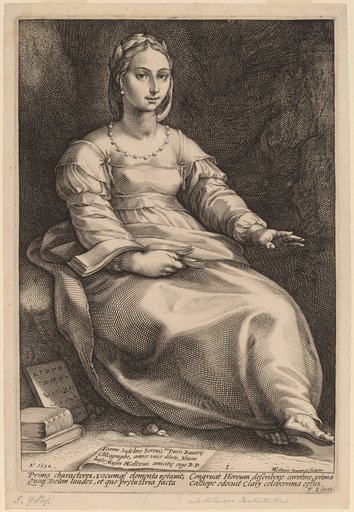
Hendrick Goltzius (German: , Dutch: ; né Goltz; January or February 1558 – 1 January 1617) was a German-born Dutch printmaker, draftsman, and painter.