Movement
Renaissance humanism
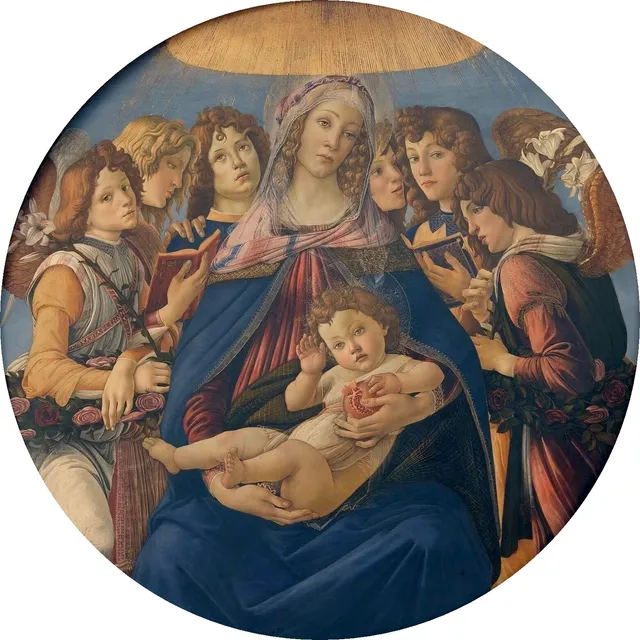
Renaissance humanism is an art movement. The gallery holds 1 work in this movement. Browse Renaissance humanism paintings, portraits, pictures and artworks from the world's public-domain museum collections.
Renaissance humanism was the intellectual movement that, beginning in fourteenth-century Italy, recovered and revived the literature, art, and ideals of classical Greek and Roman antiquity. Its acknowledged founder, the poet Francesco Petrarca (Petrarch, 1304–1374), hunted down forgotten ancient manuscripts—most famously the letters of Cicero—and argued that a new golden age could be reached by returning to the wisdom of the ancients. Centred on Florence and nourished by the patronage of merchant families such as the Medici, humanism shifted the focus of learning from purely theological questions toward the dignity, capacity, and worldly experience of the individual. By the fifteenth century these ideas had spread across Europe, transforming not only scholarship but the aims of painting, sculpture, and architecture.
In the visual arts, humanism translated into a pursuit of naturalism, harmony, and the rational ordering of space. Filippo Brunelleschi formalised the mathematics of linear perspective in the early 1400s, and Leon Battista Alberti codified it in his treatise On Painting; Masaccio (1401–1428) applied these principles in monumental frescoes such as the Holy Trinity. Artists studied anatomy, proportion, and the antique to render convincing, weighty human figures—seen in Donatello's bronze David, the first free-standing nude since antiquity, with its revived classical contrapposto. Classical mythology, long marginal, returned as serious subject matter alongside religious themes.
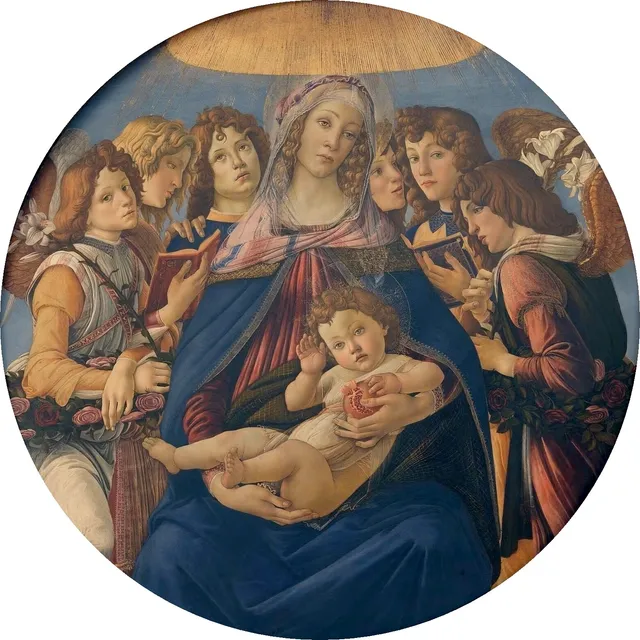
No artist embodied this synthesis more lyrically than Sandro Botticelli, who worked closely with the Medici and effectively reinvented the large-scale mythological scene. His Primavera and Birth of Venus (c. 1485), both in the Uffizi, fuse pagan allegory with the Neoplatonic philosophy cultivated in Lorenzo de' Medici's circle, where beauty and love were understood as forces lifting the soul toward the divine. The same refined line and tender humanity inform his religious tondi, including the Madonna of the Pomegranate (c. 1487), a tempera panel held in this catalogue.
Renaissance humanism's legacy was immense. It set the stage for the High Renaissance of Leonardo da Vinci, Michelangelo, and Raphael, fostering an ideal union of intellect, observation, and craft. Its elevation of the artist and its classical vocabulary shaped subsequent Mannerist, Baroque, and Neoclassical art, making humanism the foundational current of the modern Western tradition.
Works
Frequently asked questions
What is Renaissance humanism?
Renaissance humanism is an art movement. The philosophical and educational program of the Italian Renaissance that placed human beings — their capacities, dignity, and classical past — at the center of culture.
Where can I see Renaissance humanism works?
Renaissance humanism works in the collection are held by Uffizi Gallery.