Artwork
Danae
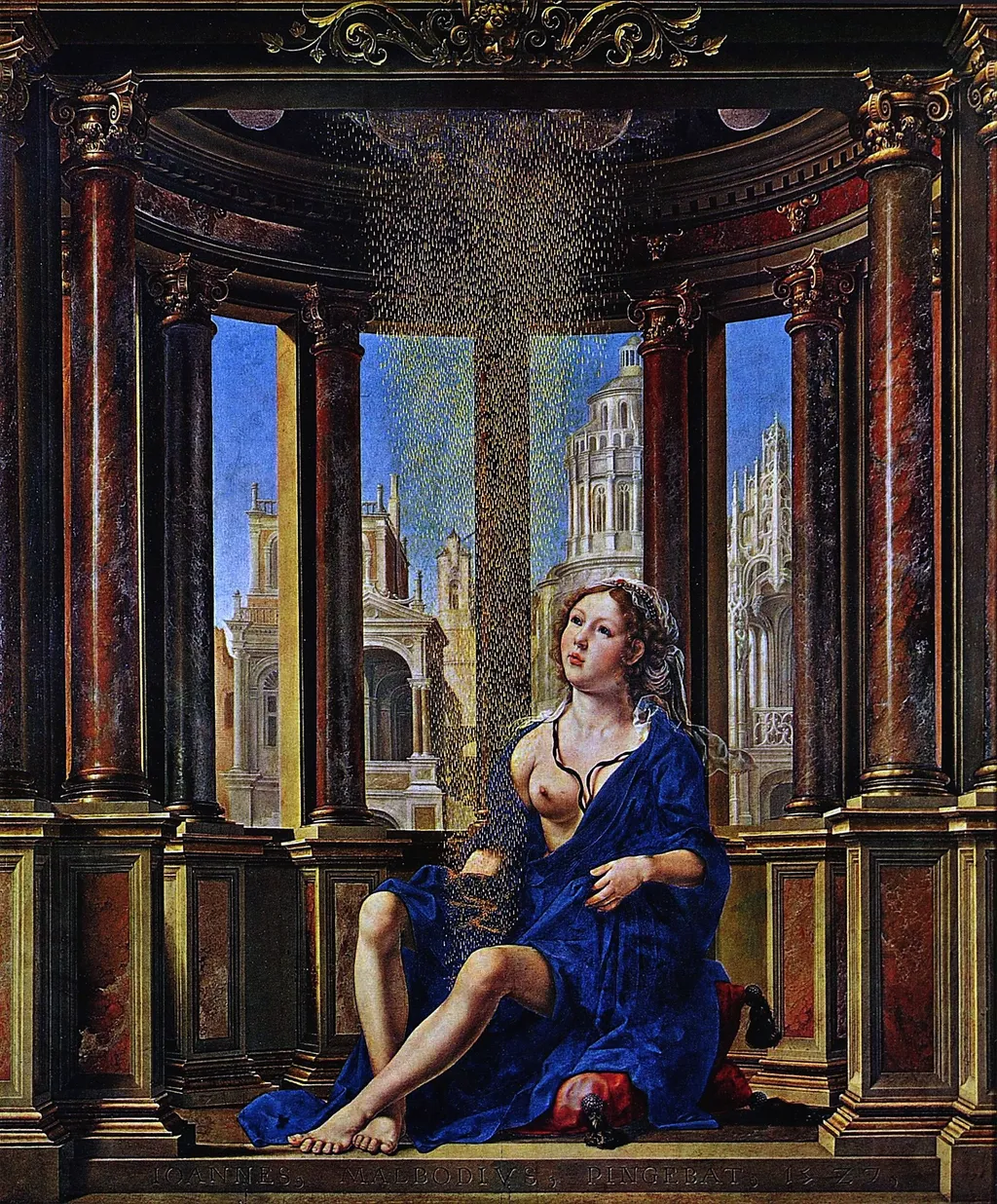
Danae is an oil painting by the Early Baroque Italian artist Jan Gossaert. It dates from 1527 and is held in the collection of the Bavarian State Painting Collections.
About this work
Subject & Meaning
The composition features a rich, limited palette with striking use of ultramarine and crimson, and the golden rain is rendered with detailed gilded stippling.
Danae is depicted as a mythological figure receiving Zeus in the guise of a shower of gold, symbolizing divine seduction and the fulfillment of prophecy. The painting shows her seated, opening her robe to receive the golden rain, with her exposed legs emphasized by focused light, conveying sensuality without nudity. She is framed within a theatrical, Renaissance-inspired architecture with columns and a semicircular setting, reflecting architectural influences from Bramante and the ideal city motif.
The work incorporates symbolic elements such as a transparent veil representing purity and a pearl-tiara with a ruby, underscoring themes of virginity and divine intervention. The composition features a rich, limited palette with striking use of ultramarine and crimson, and the golden rain is rendered with detailed gilded stippling. The signature and date appear on the step below the figure, and the painting exemplifies Mabuse’s mature style, blending Italian Renaissance ideals with Northern artistic conventions.
Technique & Style
The work is an oil painting on panel, measuring 177.2 cm by 161.8 cm, created in 1527 and housed in the Alte Pinakothek in Munich. Executed in oil on wooden support, it depicts the mythological scene of Danaë receiving a shower of gold as Zeus, rendered with a cold, glazed palette punctuated by vivid ultramarine and deep reds. The composition is framed by a semicircular architectural setting that blends Renaissance perspective with Flemish detail, including a stepped plinth bearing the artist’s signature and date.
The figure is shown seated, modestly revealing her legs and a transparent veil, while the golden rain is rendered through fine gilded hatching that appears to emanate from a domed oculus. This mature composition reflects Jan Gossaert’s synthesis of Italian classicism and Northern naturalism, emphasizing formal balance, tactile handling of light, and rich materiality.
History & Provenance
Jan Gossaert’s oil-on-panel painting Danae was completed in 1527, bearing the artist’s signature and date inscribed as if carved into the step at the figure's feet. The specific commissioner of the work remains unidentified, though scholars have suggested it may have been Philippe de Clèves or Adolphe de Bourgogne. The painting's early provenance is partially obscure, with evidence suggesting it may have once formed part of the collection of Emperor Rudolf II in Prague.
By 1748, the work was documented within the gallery of the Electorate of Bavaria. It subsequently entered the holdings of the Bavarian State Painting Collections, where it is currently preserved at the Alte Pinakothek in Munich.
Jan Gossaert’s Danae (1527) is currently held by the Alte Pinakothek in Munich, Germany, as part of the Bavarian State Painting Collections. The work was first documented in the gallery of the Electorate in 1748 before being transferred to its present location. Prior to this, the painting may have belonged to the collections of Emperor Rudolf II in Prague.
The artwork is signed with the inscription "IOANNES MALBODIVS PINGEBAT 1527" on a step at the figure's feet, confirming its creation date and attribution. No specific inventory or accession numbers are provided in the available sources, but its provenance traces clearly from the Electorate to the Alte Pinakothek.
Context
Danae (1527) by Jan Gossaert, known as Mabuse, is a mythological oil painting on panel housed in Munich's Alte Pinakothek. The work depicts the mythological moment of Danaë receiving Zeus in the form of a golden rain, symbolizing divine conception of Perseus. Gossaert situates the figure within a perspectival architectural setting inspired by Bramante's Tempietto, reflecting Renaissance ideals of ideal urban harmony.
Art historians note the painting's mature style, characterized by a cool, enamel-like palette with striking accents of ultramarine and vermilion, and its synthesis of Italianate classicizing structure with Northern naturalism. The composition features theatrical framing with columns, a semicircular pediment, and a stepped plinth bearing the artist's signature and date. The golden rain is rendered through dense golden stippling, creating a luminous effect within the interior space. The patron remains unidentified, though speculation links it to members of the Habsburg circle.
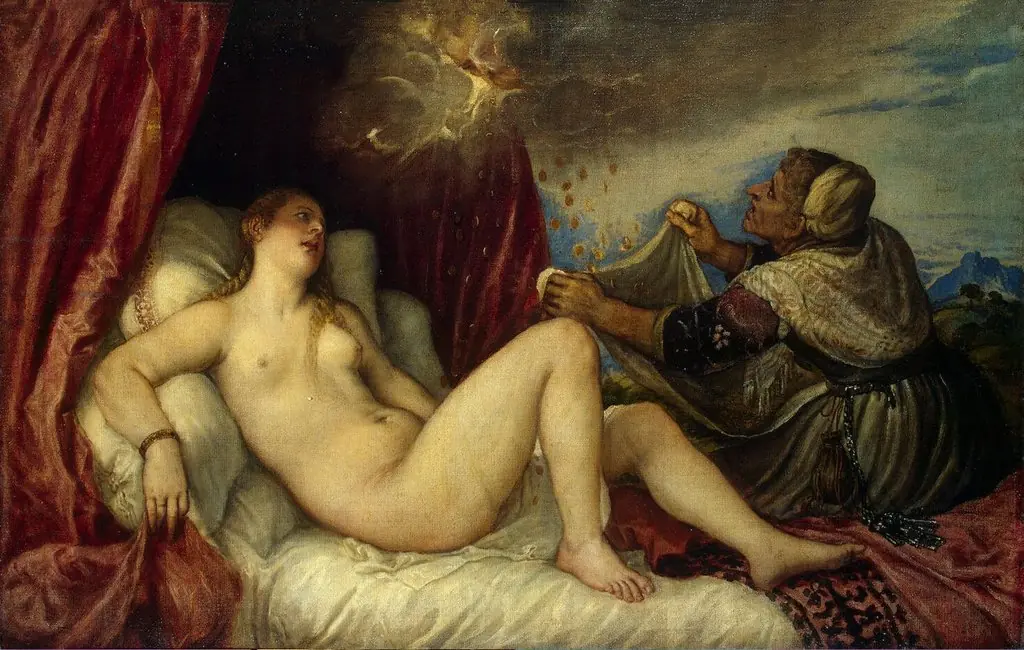
Scholarship emphasizes Gossaert's role in introducing Italian Renaissance architectural conventions into Northern painting while maintaining distinct regional sensibilities. Comparative analysis with Correggio's and Titian's versions of Danaë highlights Gossaert's unique portrayal of the nude figure as partially clothed yet sensually charged through exposed limbs and lighting. The painting's provenance includes possible ownership by Emperor Rudolf II before its documented presence in the Electorate of Bavaria's collection by 1748, eventually entering the Alte Pinakothek.
Contextual studies, such as Heringuez (2011), analyze the work's architectural elements as embodiments of Renaissance spatial theory adapted by Northern artists through direct exposure to Italian models during diplomatic or artistic sojourns.
Legacy
Danae has been recognized as a pivotal work in the evolution of Northern Renaissance depictions of mythological subjects, particularly for its synthesis of Italianate architectural perspective with Flemish naturalism. Art historians highlight its influence on later representations of mythological narratives in painting, especially in how it reimagined classical stories through a distinctly Renaissance lens. The painting's composition, featuring an idealized architectural setting inspired by Bramante and incorporating elements of the 'ideal city' motif, has been cited as a key example of cross-cultural artistic exchange between Northern Europe and Italy.
Its innovative treatment of light and texture, particularly the rendering of the golden rain and the tactile quality of the figure's skin, has been noted as a technical precursor to later Baroque interpretations of similar themes. The work's presence in the Alte Pinakothek since 1748 has cemented its role as a cornerstone in the museum's collection of Renaissance masterpieces, contributing to broader scholarly discourse on mythological art in the early 16th century.
Overview
Jan Gossaert, also known as Jan Mabuse, painted Danaë in 1527 with oil on canvas. The work shows a seated woman in a richly appointed interior, her blue robe slipped open to expose her breasts as she gazes upward toward a falling object. The composition is framed by large windows that open onto a cityscape, and the room is detailed with carved ceilings and columned windowsills.
Own this work as a print
Artist & collection
Artist
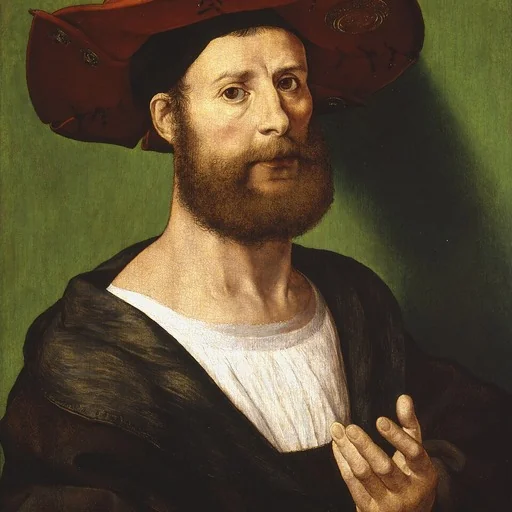
Jan Gossaert (c. 1478 – 1 October 1532) was a French-speaking painter from the Low Countries also known as Jan Mabuse (the name he adopted from his birthplace, Maubeuge) or Jennyn van Hennegouwe (Hainaut), as he called…

![Saint Jerome Penitent [right panel], by Jan Gossaert](https://artifactworldgallery.com/img/jan-gossaert--saint-jerome-penitent-right-panel--0d4ac14f44de87b1-w320.webp)
![Saint Jerome Penitent [left panel], by Jan Gossaert](https://artifactworldgallery.com/img/jan-gossaert--saint-jerome-penitent-left-panel--3d396afbb0f8e738-w320.webp)