Artwork
William Penn's Treaty with the Indians
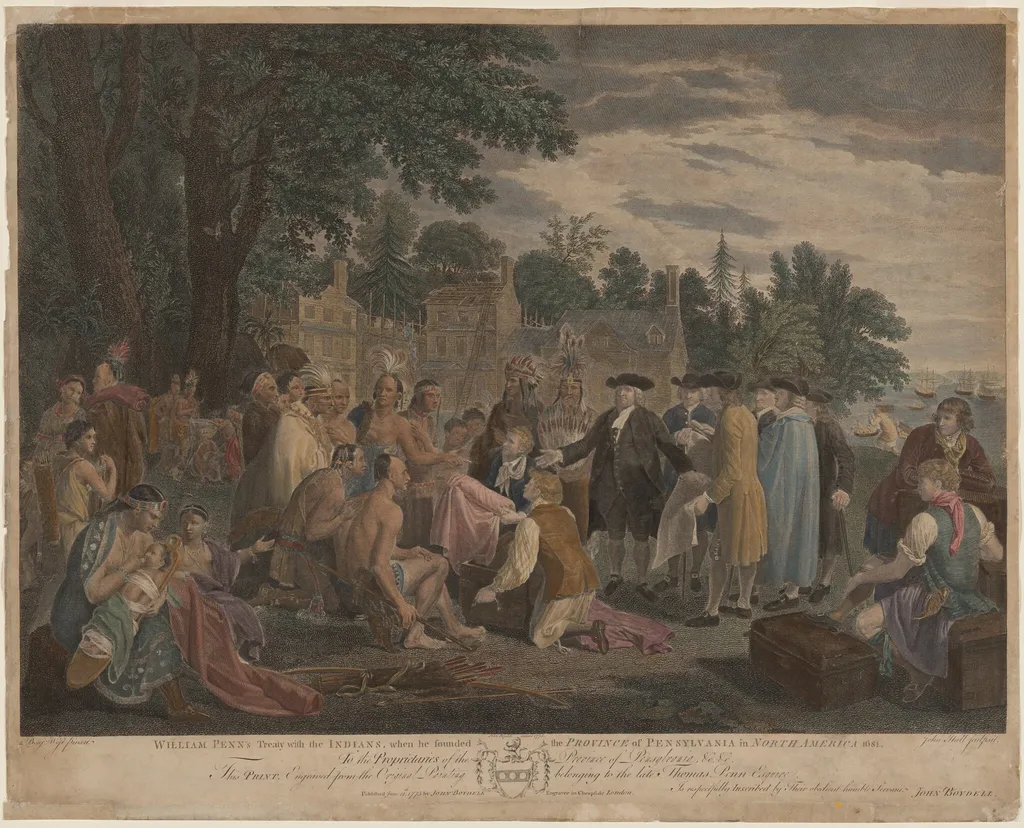
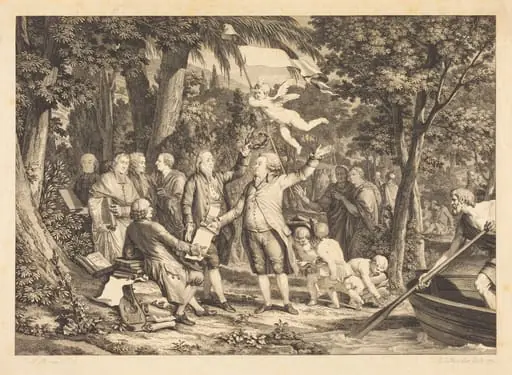
William Penn's Treaty with the Indians is a watercolor print by the Romanticist artist John Hall. It dates from 1775 and is held in the collection of the National Gallery of Art.
- Inscription
- Inscribed:lower left in plate: Benj West pinxit; lower right in plate: John Hall sculpsit; lower center in plate: John Boydell excudit 1775 / WILLIAM PENN'S Treaty with the INDIANS, when he founded the PROVINCE of PENSYLVANIA in NORTH AMERICA 1681. / To the Proprietaries of the Province of Pennsylvania, & c. &c. / This PRINT, Engraved from the Original Painting belonging to the late Thomass Penn Esquire. / Published June 12th by JOHN BOYDELL Engraver in Cheapside London
About this work
Overview
This 1775 engraving and etching with watercolor on laid paper, titled William Penn’s Treaty with the Indians, depicts a historical outdoor gathering between European colonists and Native Americans near a river.
Subject & Meaning
The scene illustrates a treaty meeting, contrasting the attire of the two groups: Europeans in wigs, coats, and hats, and Native Americans in loose, feather-adorned garments. The presence of children and varied postures suggests a serene, inclusive atmosphere.
Technique & Style
The artist employed engraving and etching techniques combined with watercolor to achieve depth. Notable is the use of shading and fine lines to create a sense of dimensionality, characteristic of layered glazing techniques.
History & Provenance
Created in 1775 by John Hall, the engraving's historical accuracy and original commission context are not detailed in available information.
Context
The work reflects 18th-century European depictions of colonial interactions, often idealizing harmony. The river and background structures provide a sense of place, though specifics on the location’s accuracy are unclear.
Legacy
As a print from the late 18th century, it serves as a visual record of perceived colonial relations. Its artistic and historical significance lies in representing a pivotal moment in American colonial history through the mediums of engraving and etching.
Own this work as a print
Artist & collection