Artwork
Still Life with Sweets and Pottery
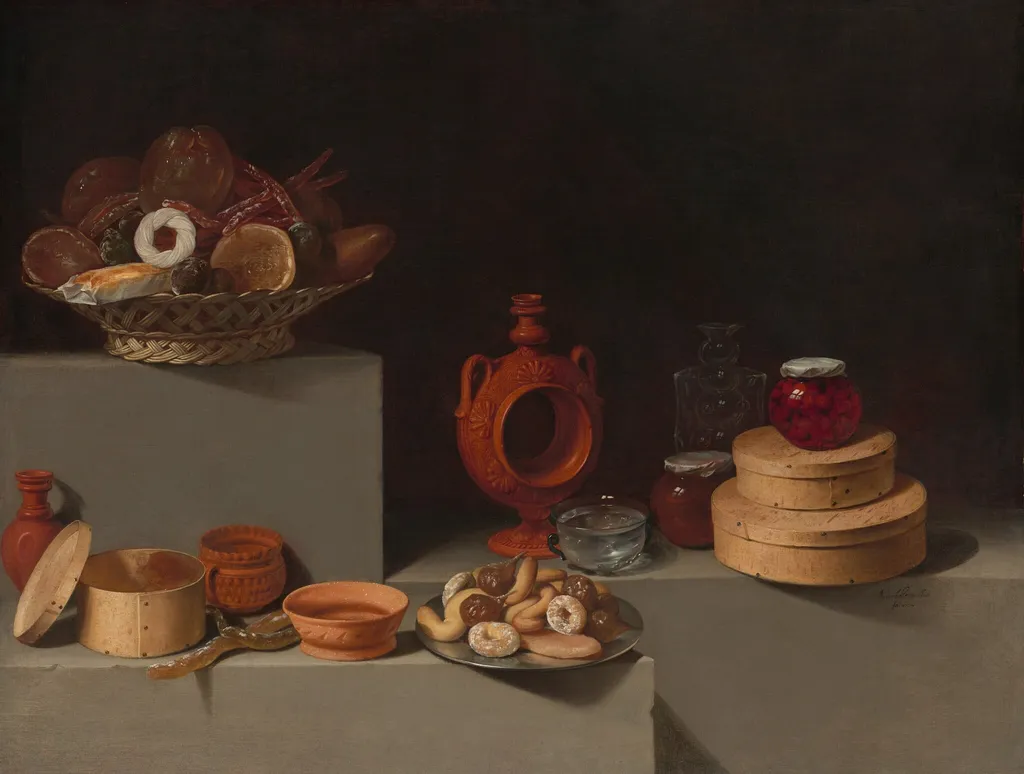
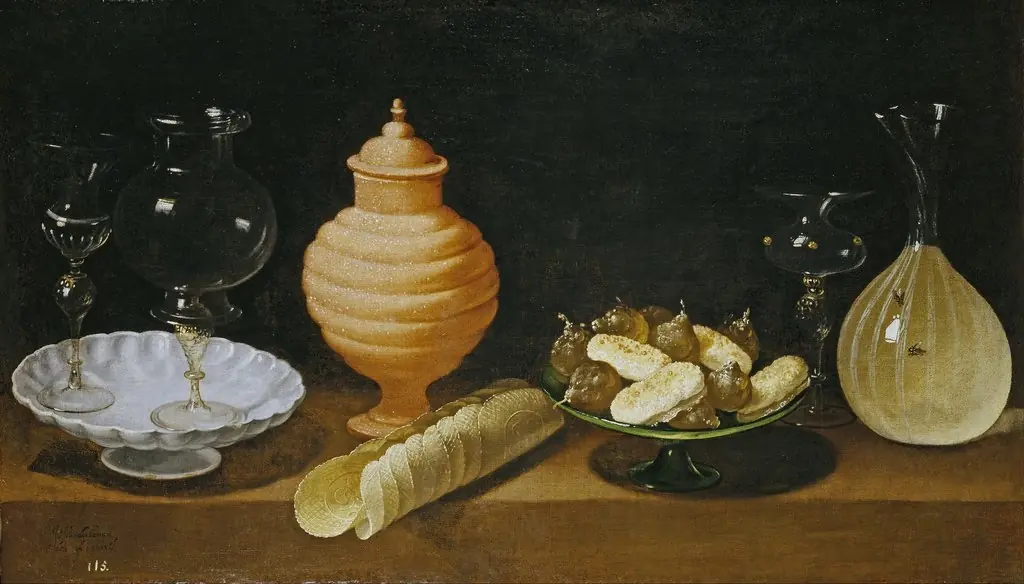
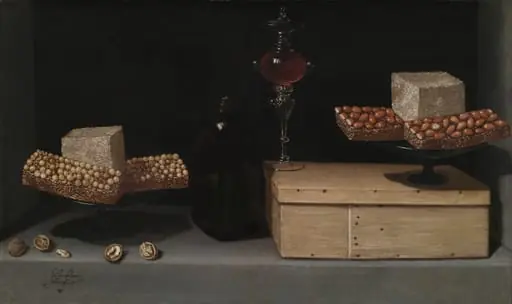
Still Life with Sweets and Pottery is an oil painting by the Baroque artist Juan van der Hamen. It dates from 1627 and is held in the collection of the National Gallery of Art.
- Inscription
- Inscribed:lower right: Juan vanderHamen i Leon / fat 1627
About this work
Technique & Style
The handling of the medium allows for a detailed representation of these objects, creating a banquet-like scene.
Executed in 1627, this work is an oil painting on canvas. The composition measures approximately 84.2 by 112.0 centimeters, though some records list the dimensions as 84.5 by 112.7 centimeters. As a still life, the piece features a formal arrangement typical of the Spanish Golden Age, depicting boxes of conserves, a basket containing varied sweets, and drinking cups.
The handling of the medium allows for a detailed representation of these objects, creating a banquet-like scene. Historical analysis suggests that while an inventory from 1655 described a similar work by the artist with significantly larger vertical dimensions, the existing canvas represents the authentic survival of this specific composition.
History & Provenance
The painting Still Life with Sweets and Pottery was created in 1627 by Juan van der Hamen y León as an oil on canvas work. Its early ownership is traced to Diego de Messía, marqués de Leganés, who possessed it at his death in 1655, according to documented inventories. The composition entered a private collection in Florence by 1950, passed through the Victor Spark gallery in New York between 1952 and 1954, and was later handled by the David M. Koetser Gallery in New York, London and Zurich.
Samuel H. Kress acquired it in 1955, and the National Gallery of Art received it as a gift in 1961. The work measures 84.5 × 112.7 cm.
Still Life with Sweets and Pottery is held by the National Gallery of Art in Washington, D.C., as part of the Samuel H. Kress Collection, with the accession number 1961.9.75. The painting entered the Kress Collection after being purchased by the Samuel H. Kress Foundation in 1955 from the David M. Koetser Gallery in New York, London, and Zurich; the foundation gifted it to the NGA in 1961. Earlier, it had passed through Victor Spark in New York (at least 1952 to 1954) and a private collection in Florence by 1950, where it was published by Roberto Longhi in 1950.
A possible earlier provenance links it to Diego de Messía Felípez de Guzmán, Marqués de Leganés, in Madrid, at his death in 1655, though William B. Jordan noted significant dimensional discrepancies with the inventory entry. The work was exhibited at the Musée de l'Orangerie in Paris in the 1952 show La nature morte de l'antiquité a nos jours.
Context
Scholarly attention to Still Life with Sweets and Pottery emerged significantly in the mid-20th century, notably through Roberto Longhi's 1950 essay which identified the work as a pivotal moment in the history of the still life genre. The painting's attribution and historical trajectory were further examined by William B. Jordan in 1985, who proposed a connection to a 1655 inventory of the Marquess de Leganés. Jordan noted a discrepancy between the documented dimensions of the inventory item and the current canvas, suggesting a potential scribal error in the original record while acknowledging the stylistic match to the artist's known banquet scenes.
This work stands as a key example of Juan van der Hamen y León's contribution to Spanish Golden Age still life, bridging the gap between early 17th-century traditions and later developments. Its inclusion in major exhibitions, such as the 1950s Paris survey La nature morte de l'antiquité a nos jours, underscores its recognized importance within the broader context of European still life painting.
Overview
Juan van der Hamen y León's "Still Life with Sweets and Pottery," painted in 1627, is an oil on canvas depicting a meticulously arranged collection of domestic items. The composition features various confections, ceramic vessels, and glass objects displayed on a surface, characteristic of the still life genre. This work exemplifies the artist's dedication to rendering everyday subjects with precision and clarity.
Subject & Meaning
The painting presents an array of culinary delights and household items. Sugar-coated fruits, pastries, and other sweets are arranged alongside diverse pottery and elegant glassware. A notable silver plate reflects light, adding to the visual richness.
Van der Hamen y León elevates these common objects, inviting viewers to appreciate their forms, textures, and the interplay of light on their surfaces.
Own this work as a print
Artist & collection
Artist
Juan van der Hamen y (Gómez de) León (baptized 8 April 1596 – 28 March 1631) was a Spanish painter, a master of still life paintings, also called bodegones.