Artwork
Still-Life of Glass, Pottery, and Sweets
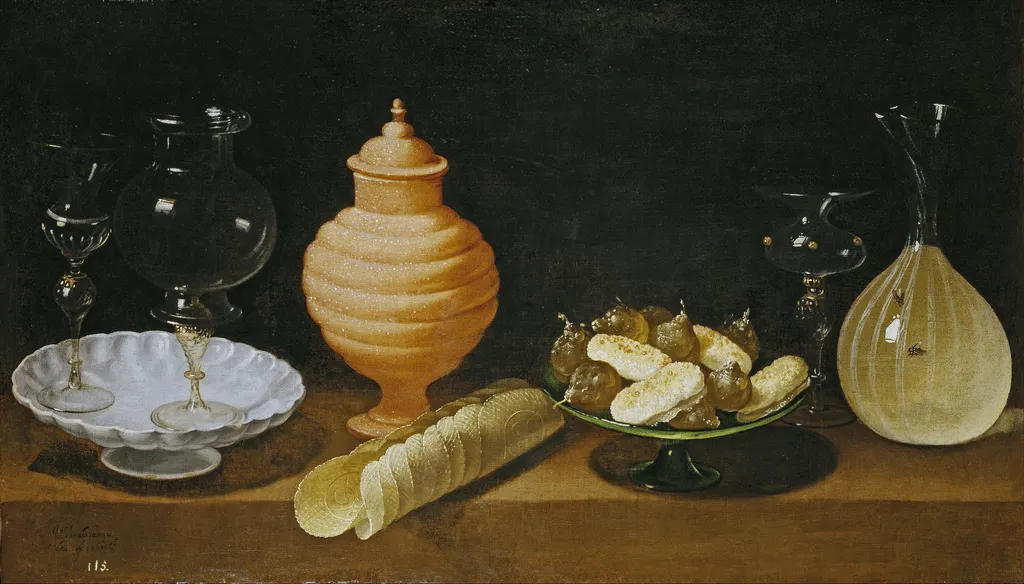
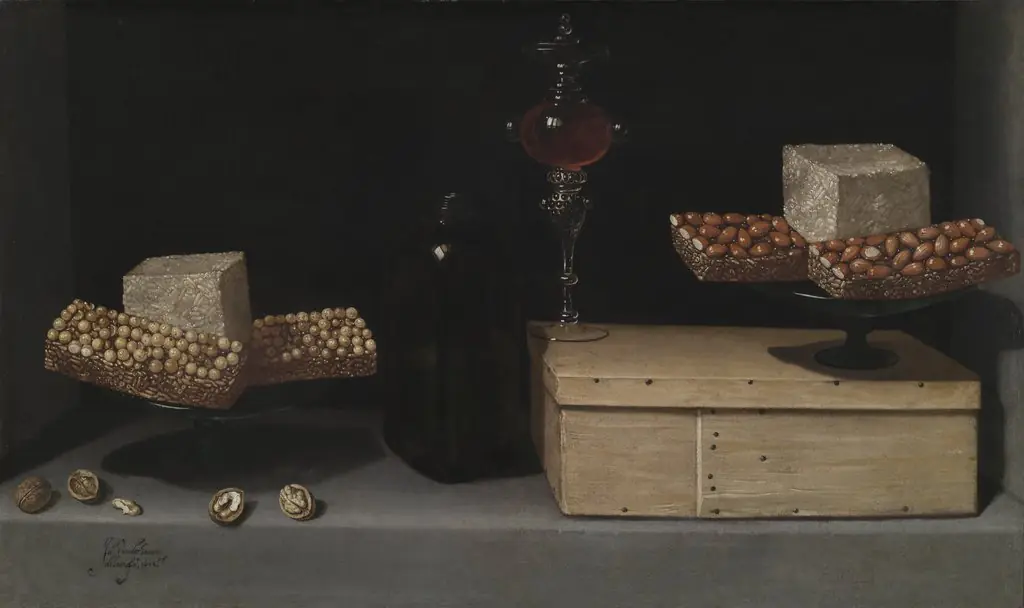
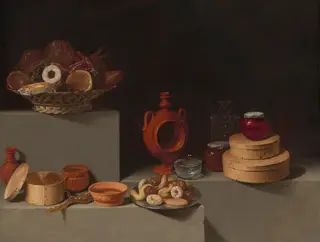
Still-Life of Glass, Pottery, and Sweets is an oil painting by the Dutch Golden Age artist Juan van der Hamen. It dates from 1622 and is held in the collection of the Museo del Prado.
About this work
Subject & Meaning
The painting centers on the refined consumption culture of Madrid’s early‑17th‑century elite, depicting an array of luxury goods and confections associated with the contemporary tea‑time ritual.
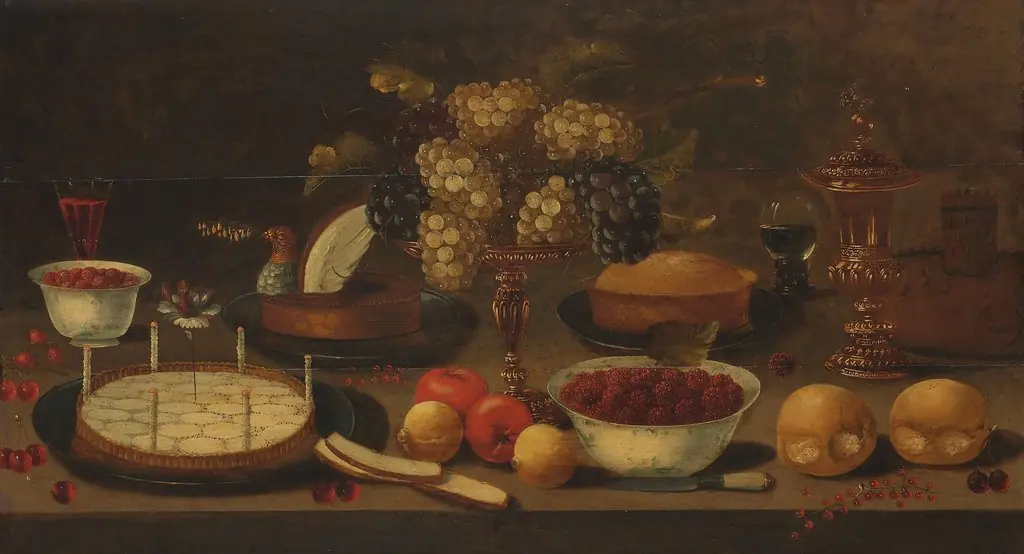
Van der Hamen arranges Venetian glassware, a terracotta honey pot, a white ceramic dish, and a green glass bowl filled with pastries and candied fruits in a shallow, zig‑zag composition on a narrow stone ledge. A Venetian glass flask containing aloja, a spiced honey‑water, occupies the right foreground, its surface attended by flies that signal the painted illusion’s lifelikeness. The inclusion of barquillos (rolled wafers) and candied fruits underscores the sweet‑oriented gastronomy prized by the aristocracy, while the Venetian glass alludes to the status of such imports at the royal court.
The work’s iconography reflects the period’s taste for costly novelties and the cultivated display of rarities, situating van der Hamen’s still life within the broader discourse of Spanish Golden Age luxury and visual seduction.
Technique & Style
Light is directed from a dark background to highlight reflections on crystal and the glaze of sweets, creating a subtle vibration across the surface.
The work is executed in oil on canvas, a medium confirmed by the artist’s catalogue entry (source1) and the Prado’s registration (source2). The support is a rectangular canvas measuring 52 × 88 cm (source2). Van der Hamen’s technique relies on a delicate chiaroscuro that models forms and accentuates the translucency of Venetian glass, as noted in contemporary descriptions (source3).
Light is directed from a dark background to highlight reflections on crystal and the glaze of sweets, creating a subtle vibration across the surface. The composition arranges objects in a shallow, zig‑zag plane on a stone ledge, emphasizing spatial depth while maintaining a restrained palette of toned hues (source3).
History & Provenance
Created in 1622, Juan van der Hamen's Still-Life of Glass, Pottery, and Sweets is signed and dated "Juº. Vanderhamen (y León?) fact 1622" in the lower left corner. The work's dimensions and composition suggest it was originally conceived as a supraporte, or over-door painting.
The provenance chain begins with its probable inclusion in the collection of Don Gaspar de Haro y Guzmán, Marqués de Eliche, by 1651. By 1702, the painting was recorded in the Spanish royal collection, specifically noted at the Buen Retiro Palace in 1701 and again in 1794. It currently resides in the Museo del Prado in Madrid.
The work is held in the permanent collection of the Museo del Prado, Madrid, inventoried as P001164. It was recorded in the Spanish royal collection by 1701 at the Palacio del Buen Retiro and appears in the 1794 Buen Retiro inventory as number 115.
Its exhibition history is limited in the sources; it is listed as part of the Prado’s holdings in the institution’s catalog but no specific temporary exhibitions are documented in the provided references.
Context
Created in 1622, this early still life by Juan van der Hamen y León demonstrates the artist's mastery of tenebrism and his debt to Sánchez Cotán, whose influence he likely absorbed in Granada. The work is distinguished by a subtle zigzag arrangement of objects on a narrow stone ledge, differing from the more geometric compositions of his later career. Art historians highlight the painting as a virtuosic exercise in rendering light, transparency, and reflection, particularly in the depiction of Venetian glassware, a luxury item at the Madrid court.
The inclusion of flies on a jar of spiced syrup serves as a clever allusion to the classical anecdote of Zeuxis, emphasizing the deceptive realism of the medium. Scholars suggest this refined piece may have inspired Francisco de Zurbarán's own still-life compositions and note its probable original function as an overdoor decoration.
Legacy
El bodegón de van der Hamen ha adquirido renombre como referencia temprana del género en la corte madrileña; su composición influyó en pintores posteriores, entre ellos Zurbarán, quien citó el modelo al elaborar su propio still‑life. La obra, conservada en el Museo del Prado, se estudia como ejemplo de la virtuosidad en la representación de vidrio y dulces, y como documento de la cultura de merienda del siglo XVII.
Overview
Juan van der Hamen's Still-Life of Glass, Pottery, and Sweets, painted in 1622, is an oil painting that exemplifies the artist's contribution to the genre. Active in early 17th-century Madrid, van der Hamen was instrumental in establishing still life as a popular subject, drawing on influences from the Dutch Golden Age. This work showcases his skill in arranging everyday objects into a compelling composition, reflecting the era's taste for detailed domestic scenes.
Artist & collection
Artist
Juan van der Hamen y (Gómez de) León (baptized 8 April 1596 – 28 March 1631) was a Spanish painter, a master of still life paintings, also called bodegones.