Movement
Spanish Golden Age
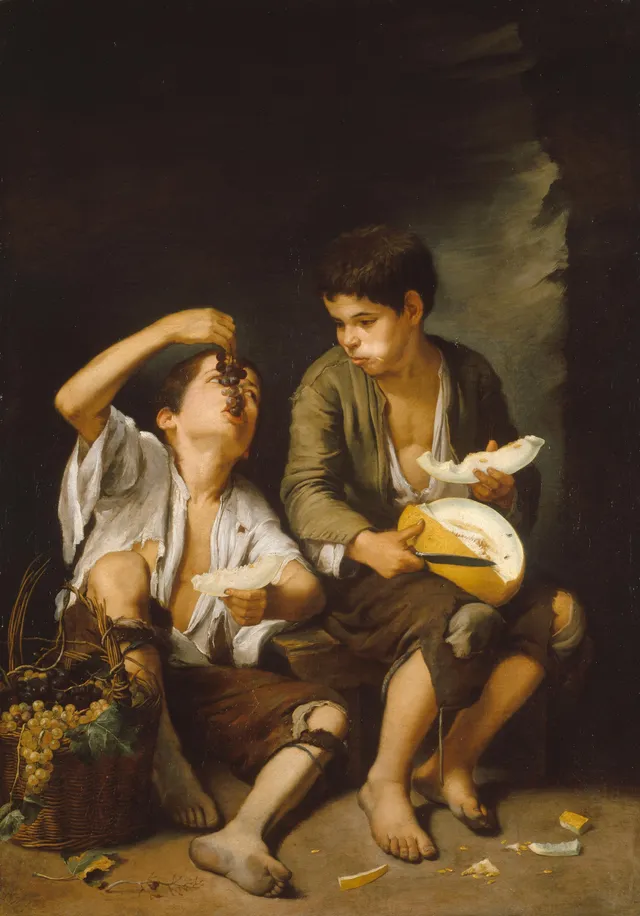
Spanish Golden Age is an art movement of the 1492–1681 period. The gallery holds 1 work in this movement. Browse Spanish Golden Age paintings, portraits, pictures and artworks from the world's public-domain museum collections.
The Spanish Golden Age, or Siglo de Oro, was the period of extraordinary cultural and literary flourishing that accompanied the rise of the Spanish Empire, stretching from the late sixteenth into the late seventeenth century. Funded by silver flowing in from the Americas and shaped by Habsburg power, the era's painting was driven by two great patrons: the royal court in Madrid and the Catholic Church. Spain stood at the heart of the Counter-Reformation, and art became an instrument of evangelization—a means to make sacred mysteries vivid, immediate, and emotionally persuasive to ordinary worshippers.
These aims produced a distinctive visual language rooted in naturalism and dramatic light. Many Spanish masters adopted tenebrism, the technique—borrowed from Caravaggio and his Italian followers—of isolating brightly lit faces, hands, and objects against deep, enveloping shadow to heighten psychological intensity. Spanish painters prized unflinching realism over idealized grace, whether rendering the ecstasy of a saint or the worn textures of everyday things. That same empirical eye gave rise to the bodegón, the austere still life of food and humble kitchen wares, and to genre scenes of street children and beggars observed with startling directness.
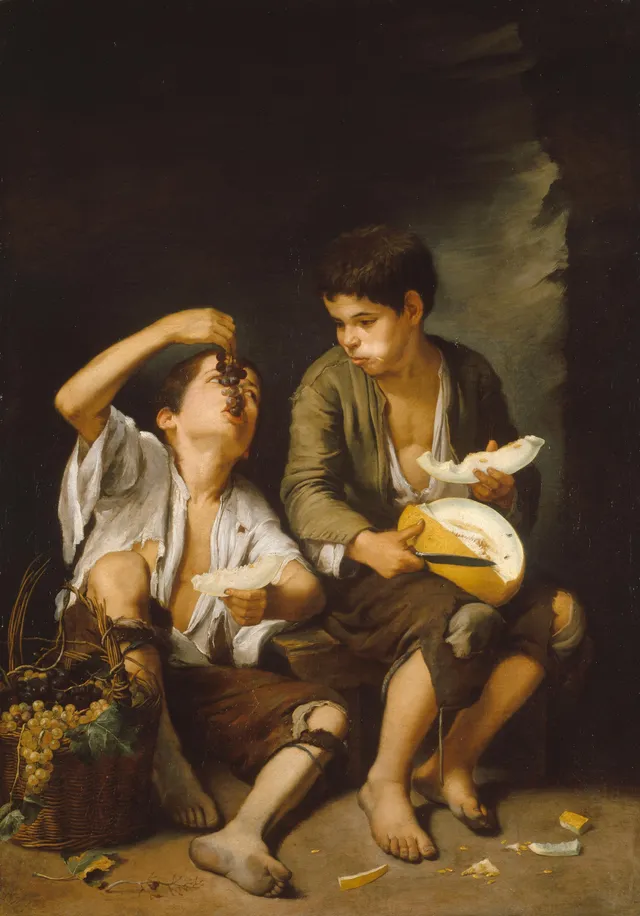
The movement's canonical figures span its arc. El Greco, working in Toledo, fused Byzantine and Mannerist sources into the elongated, visionary forms of The Burial of the Count of Orgaz (1586–1588). Jusepe de Ribera and Francisco de Zurbarán (1598–1664) brought monastic gravity and sculptural light to religious subjects. Above all stands Diego Velázquez (1599–1660), court painter to Philip IV, whose Las Meninas (1656) remains one of Western art's most analyzed paintings for its dissolving brushwork and its play between viewer, sitter, and mirrored king. Bartolomé Esteban Murillo (1617–1682) of Seville softened this tradition with warmth and tenderness; his Grape and Melon Eaters, held in this collection, exemplifies his ragged-children genre scenes, where the contrasts of light still echo Velázquez's early kitchen pictures.
Though sometimes labeled the Spanish Baroque, the Golden Age developed a markedly sober, devotional character distinct from the exuberance of its Italian and Flemish contemporaries. Its legacy proved enduring: Velázquez's loose, optical handling was claimed as a forebear by Goya, Manet, and the nineteenth-century realists and Impressionists, securing Spain a permanent place at the center of European painting.
Works
Frequently asked questions
What is Spanish Golden Age?
Spanish Golden Age is an art movement. Spain's cultural and artistic peak in the 16th and 17th centuries, concurrent with imperial power.
When did Spanish Golden Age take place?
Spanish Golden Age dates from 1492–1681.
Where can I see Spanish Golden Age works?
Spanish Golden Age works in the collection are held by Bavarian State Painting Collections.