Artwork
The King of Cochin
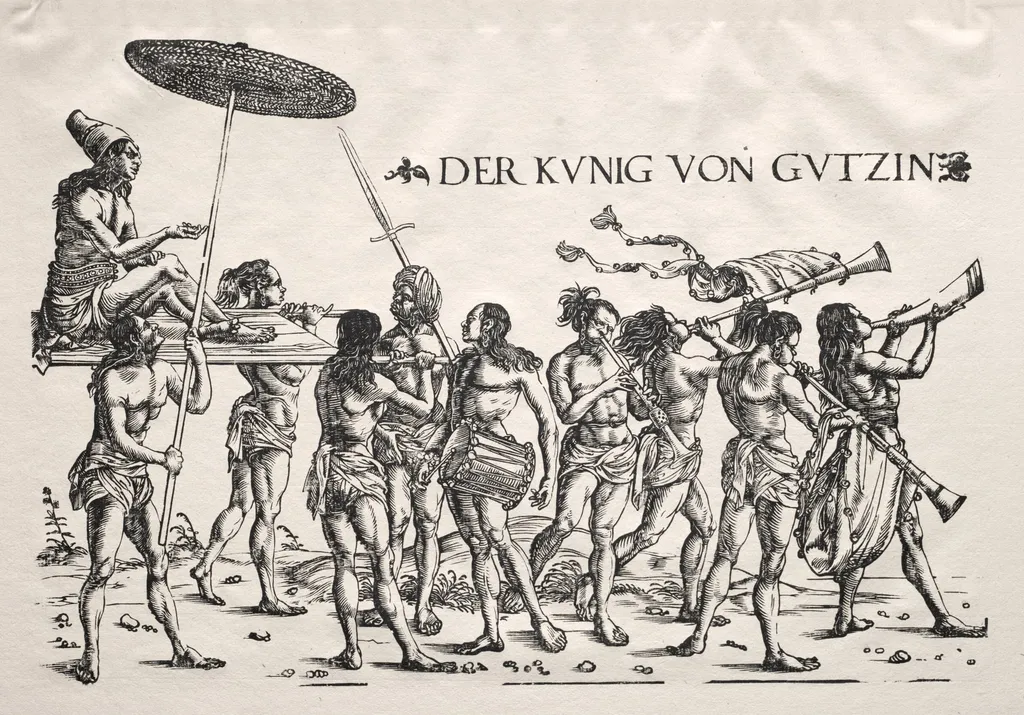
The King of Cochin is a print by Hans Burgkmair I. It dates from 1512 and is held in the collection of the Cleveland Museum of Art.
- Accession no.
- 1923.403
- Credit line
- Charles W. Harkness Endowment Fund
About this work
The overall mood of the image is one of energy and movement, with the men seeming to be engaged in some kind of activity or celebration.
The image depicts a group of men, some of whom are playing musical instruments or carrying objects. The men are dressed in loincloths and appear to be in motion, with some of them walking or running. In the background, there is a figure sitting on a platform, holding an umbrella.
The scene is rendered in a detailed and realistic style, with attention paid to the textures and folds of the men's clothing. The overall mood of the image is one of energy and movement, with the men seeming to be engaged in some kind of activity or celebration.
To learn more about the artist who created this image, look up Hans Burgkmair (German, 1473–1531).
Overview
Created around 1512, this woodcut by the German artist Hans Burgkmair is part of the collection at the Cleveland Museum of Art. The print portrays a lively gathering of men in motion, some playing instruments or bearing objects, while a seated figure on a platform holds an umbrella. The composition conveys a sense of festivity and activity.
Subject & Meaning
The scene shows several male figures clad in simple loincloths, engaged in what appears to be a celebratory or ritual procession. Musical performance, carrying of items, and the presence of an umbrella‑bearing figure suggest a communal event, possibly a courtly or ceremonial occasion linked to the titular King of Cochin.
Technique & Style
Burgkmair employs the detailed line work characteristic of early 16th‑century German printmaking. Fine hatching renders the texture of fabric folds and the musculature of the figures, while the composition balances dynamic movement with a clear spatial hierarchy. The realistic rendering of anatomy and clothing reflects the artist’s interest in naturalistic detail.
History & Provenance
The print was produced in the early Renaissance period, a time when Burgkmair was active in Augsburg and known for his innovations in woodcut design. It entered the Cleveland Museum of Art’s holdings through acquisition in the 20th century, where it remains a representative example of Burgkmair’s print output.
Own this work as a print
Artist & collection

 Marching Soldiers, in the Center a Standard Bearer
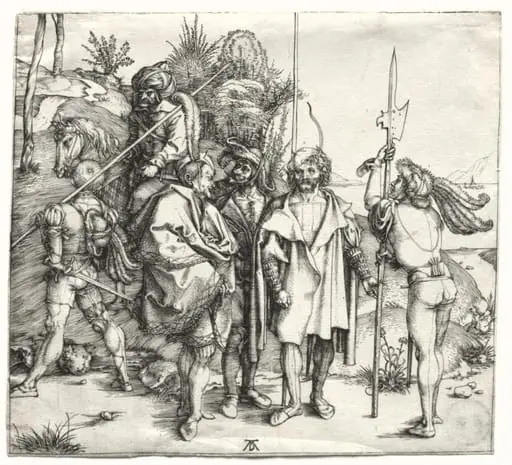 Five Soldiers and a Turk on Horseback
 Christ Tells His Disciples of the Last Judgment
 The Martyrdom of Saint James (?)
 Deacon Philip Baptising the Eunich
 The Men's Bath House
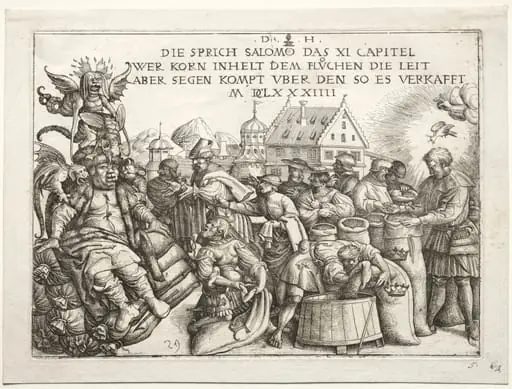 Illustration to proverbs XI (The Hoarders of Grain)
 Untitled
 Two Boats With Passengers and Guards
 drawing from Ionides Album
![Entry of Marie de Medici into Amsterdam [plate 6 of 6], by Pieter Nolpe](https://artifactworldgallery.com/img/pieter-nolpe--entry-of-marie-de-medici-into-amsterdam-plate-6-of-6--1180e5a1b81c4aa0-w320.webp) Entry of Marie de Medici into Amsterdam [plate 6 of 6]
Entry of Marie de Medici into Amsterdam [plate 6 of 6]- The King of Cochin