Artwork
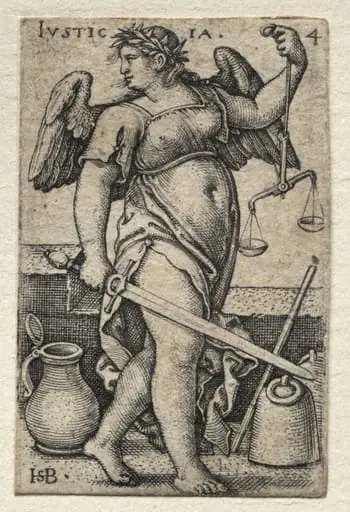
The Seven Virtues: Justice
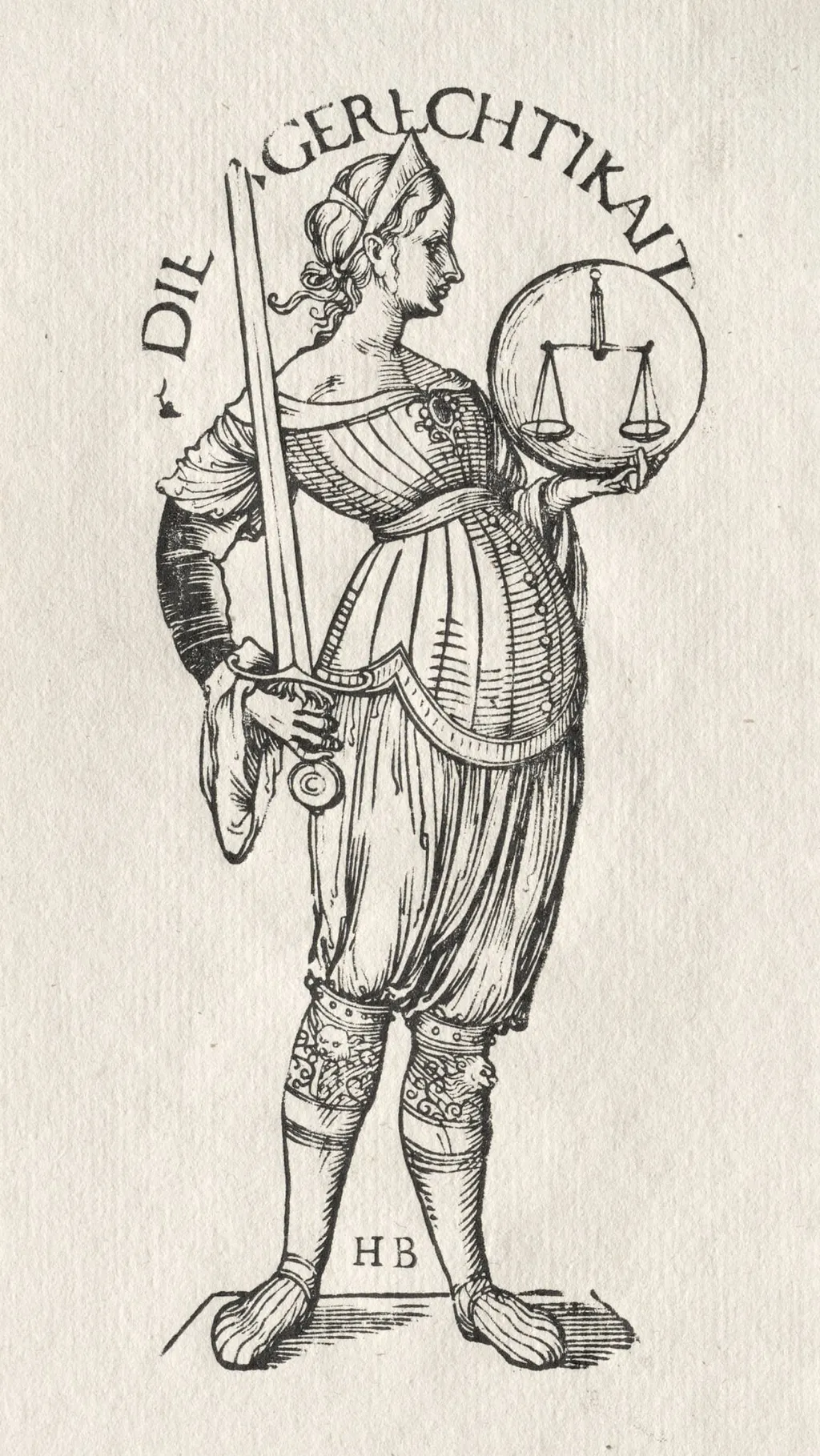
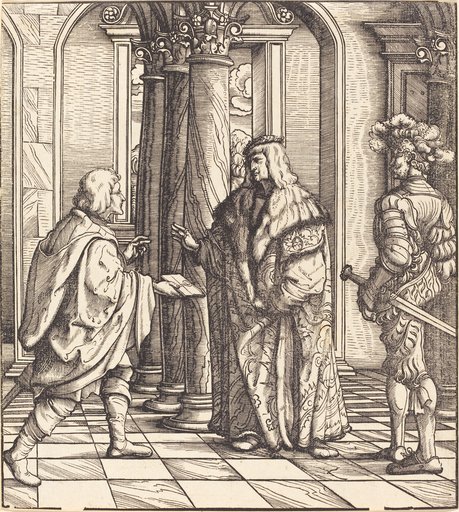
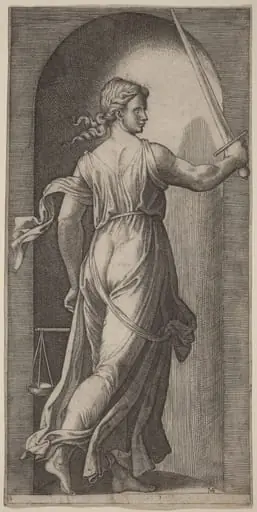
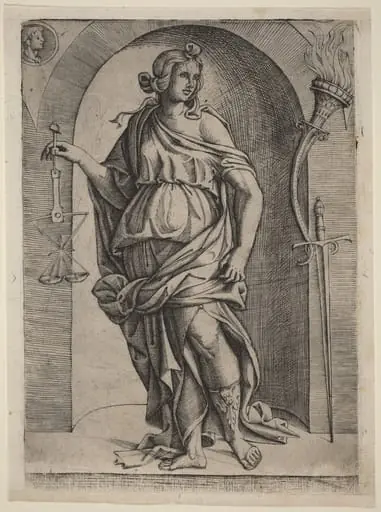
The Seven Virtues: Justice is a print by the Renaissance artist Hans Burgkmair I. It dates from 1510 and is held in the collection of the Cleveland Museum of Art.
- Accession no.
- 1923.408
- Credit line
- Charles W. Harkness Endowment Fund
About this work
Overview
The composition centers on a female figure clad in full plate armor, distinguished by a crown rather than a helmet, signifying her royal or divine authority.
Created in 1510 by the German artist Hans Burgkmair, this woodcut depicts the personification of Justice as part of a series illustrating the Seven Virtues. The composition centers on a female figure clad in full plate armor, distinguished by a crown rather than a helmet, signifying her royal or divine authority. She stands in a dynamic pose, gripping a sword in her right hand while holding a round shield in her left.
The shield prominently displays a set of scales, the traditional attribute of Justice, symbolizing the weighing of evidence and fairness. The figure is surrounded by a banderole containing the German inscription 'Die Gerichtskal,' an abbreviation for 'Die Gerechtigkeit' (Justice), which identifies the virtue. Executed with the bold lines and high contrast characteristic of Burgkmair's woodcut technique, the work reflects the Northern Renaissance interest in detailed armor and allegorical representation.
This print exemplifies Burgkmair's mastery of the medium during his mature period, blending classical iconography with contemporary German artistic sensibilities to convey moral instruction through visual clarity.
Subject & Meaning
The central figure is a female personification dressed in full armor, holding a sword and a round shield that bears a set of scales. The absence of a helmet, replaced by a crown, emphasizes her authority. An inscription encircles the image, reading “Die Gerichtskal,” a reference to the scale of judgment, underscoring the theme of fairness.
Technique & Style
Executed as a black‑and‑white drawing, the print relies on line work and hatching to render the intricate details of the armor and the delicate balance of the scales. Burgkmair’s approach reflects the Northern Renaissance interest in precise, symbolic representation, using contrast to highlight the figure’s dual role as warrior and arbiter.
History & Provenance
Created in the early sixteenth century, the print was produced during Burgkmair’s prolific period of moral and religious series. It entered the Cleveland Museum of Art’s holdings through acquisition in the twentieth century, where it remains a documented example of the artist’s engagement with allegorical subjects.
Artist & collection