Artwork
Still Life with Earthenware Jar, Fish and Fruit
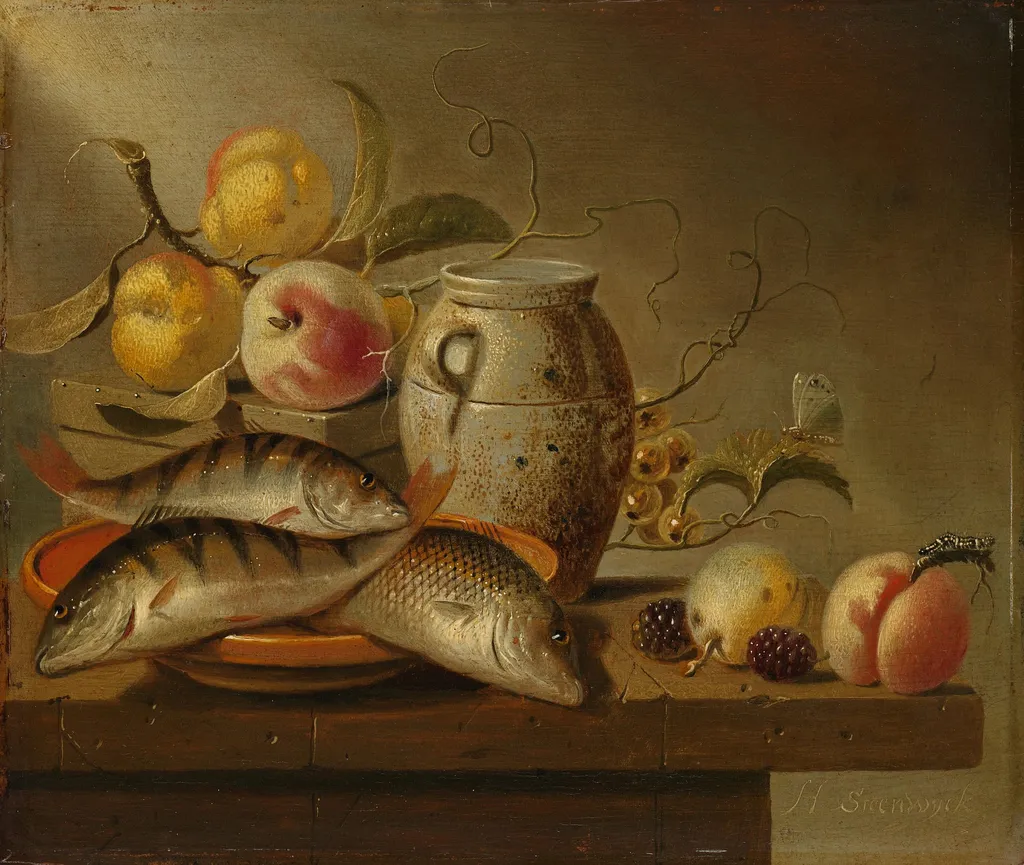
Still Life with Earthenware Jar, Fish and Fruit is an unspecified painting by the Dutch Golden Age artist Harmen Steenwijck. It dates from 1652 and is held in the collection of the Rijksmuseum.
About this work
Subject & Meaning
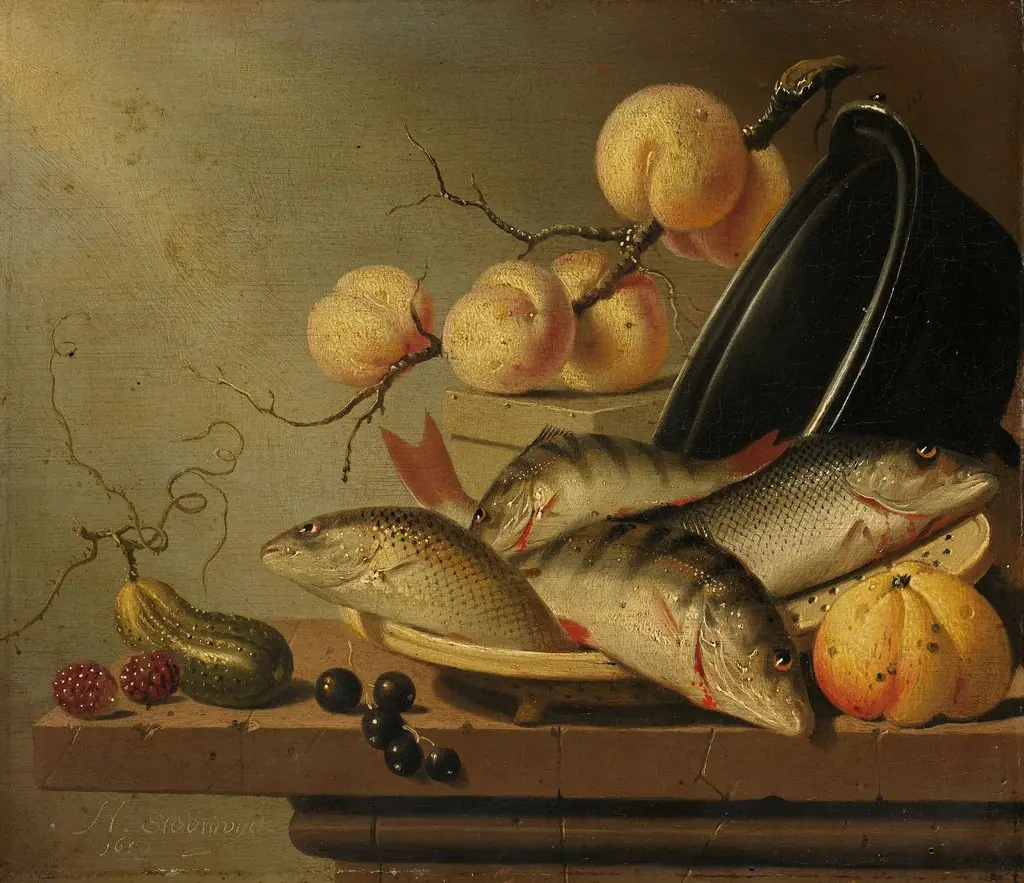
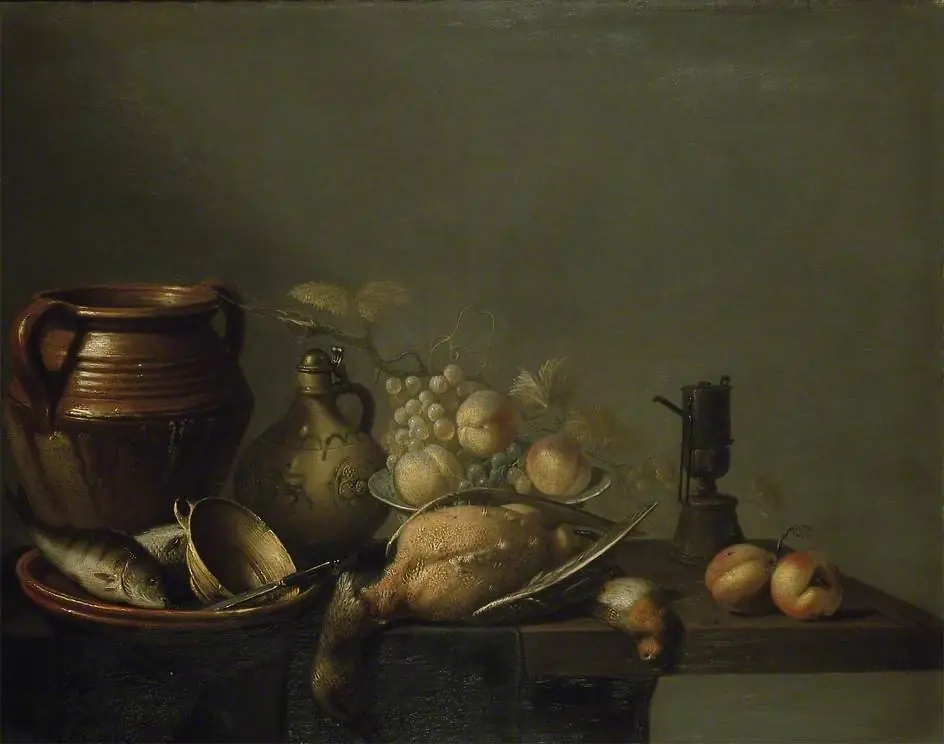
The painting Still Life with Earthenware Jar, Fish and Fruit (1652) depicts a modest arrangement of domestic objects, an earthenware jar, fish, and fruit, that together function as visual symbols of transience and material abundance. In the Dutch vanitas tradition, such still lifes juxtapose fresh produce and fish with the inevitability of decay, reminding viewers of the fleeting nature of wealth and life; the diagonal composition of the items heightens this moralizing message. The work is attributed to Harmen Steenwijck, a Dutch Golden Age specialist in vanitas subjects, and is catalogued in the Rijksmuseum Amsterdam collection where it is recorded as measuring 23 cm × 27 cm. Its iconography aligns with contemporary moralizing themes: the fish suggests the fleeting nature of flesh, the fruit hints at sensory pleasure, and the earthenware jar evokes everyday domestic stability, all combined to convey a meditation on the vanity of earthly existence.
Technique & Style
Formal qualities include a balanced triangular composition, muted earth tones, and symbolic elements such as the earthenware jar suggesting transience.
Harmen Steenwijck painted Still Life with Earthenware Jar, Fish and Fruit in 1652 using oil on wood. The work measures 23 cm by 27 cm and depicts a diagonal arrangement of a ceramic jar, fish, and fruit typical of Dutch vanitas still lifes. The painting is executed in a realistic style with careful attention to texture and lighting, characteristic of the Leiden school. It is part of the Rijksmuseum Amsterdam collection.
The technique employs oil medium on a wooden support, with fine brushwork that emphasizes the translucency of fish scales and the varied surfaces of fruit and pottery. Formal qualities include a balanced triangular composition, muted earth tones, and symbolic elements such as the earthenware jar suggesting transience. The handling of light creates depth while maintaining a flat pictorial space common in vanitas imagery.
Condition reports indicate the paint layer remains largely intact with minor craquelure across the wooden panel, consistent with its age. Stylistically, the work reflects Steenwijck's mature phase, combining detailed naturalism with allegorical symbolism inherited from his uncle David Bailly's vanitas tradition.
History & Provenance
The painting Still Life with Earthenware Jar, Fish and Fruit is dated 1652 by internal records, situating its creation late in Harmen Steenwijck’s career.
It entered the public record as part of the Rijksmuseum’s holdings, where it remains today. The museum lists the work as an oil on panel measuring 23 × 27 cm, consistent with Steenwijck’s small-scale still lifes of the 1650s.
Still Life with Earthenware Jar, Fish and Fruit is held by the Rijksmuseum Amsterdam, according to the German-language list of Steenwijck's selected works, which records the painting as oil on panel, dated 1652, measuring 23 cm × 27 cm. The source does not supply an inventory or accession number for the work.
No exhibition history is documented for this particular painting in the provided sources. The only exhibition-related reference to Steenwijck more broadly is the Metropolitan Museum of Art catalogue "Vermeer and The Delft School" (New York, 2001), which is cited as containing material on the artist but is not confirmed to have included this still life.
Context
Harmen Steenwijck was a Dutch Golden Age painter active in Leiden between 1628 and 1633, known for his vanitas still lifes that often arranged objects in diagonal or triangular compositions on tables. He specialized in works like Still Life with Earthenware Jar, Fish and Fruit (1652), a genre he helped shape alongside his brother Pieter and their teacher David Bailly. His artistic formula and thematic focus on transience align with documented practices in Dutch still life painting of the mid-17th century, as reflected in museum records and scholarly references to his output in Leiden and Delft. The work is part of a broader tradition of vanitas imagery that symbolized the fleeting nature of life, a motif central to Northern European art of the period.
The painting's provenance and scholarly attention are evidenced by its inclusion in major collections and exhibitions, including the National Gallery, London, and references in publications such as Walter Liedtke's catalog on the Delft School. It is cataloged in authoritative sources like the Rijksmuseum and RKD, confirming its attribution and historical context within Steenwijck's oeuvre and the evolution of Dutch still life.
Steenwijck's career intersected with key developments in Dutch art, including trade influences from his journey to the East Indies and documented activity in guilds like the Sint-Lucasgilde in Delft. His works, such as Still Life with Fish, Birch and Fruit in the Ashmolean Museum, exemplify the genre's technical and symbolic depth, securing his place in art historical narratives of 17th-century Northern Europe.
Own this work as a print
Artist & collection
Artist
Harmen Steenwijck or Harmen Steenwyck (c. 1612 – after 1656) was a Dutch Golden Age painter who specialised in still life painting, especially in the style of Dutch vanitas.