Artwork
The Shepherd Boy
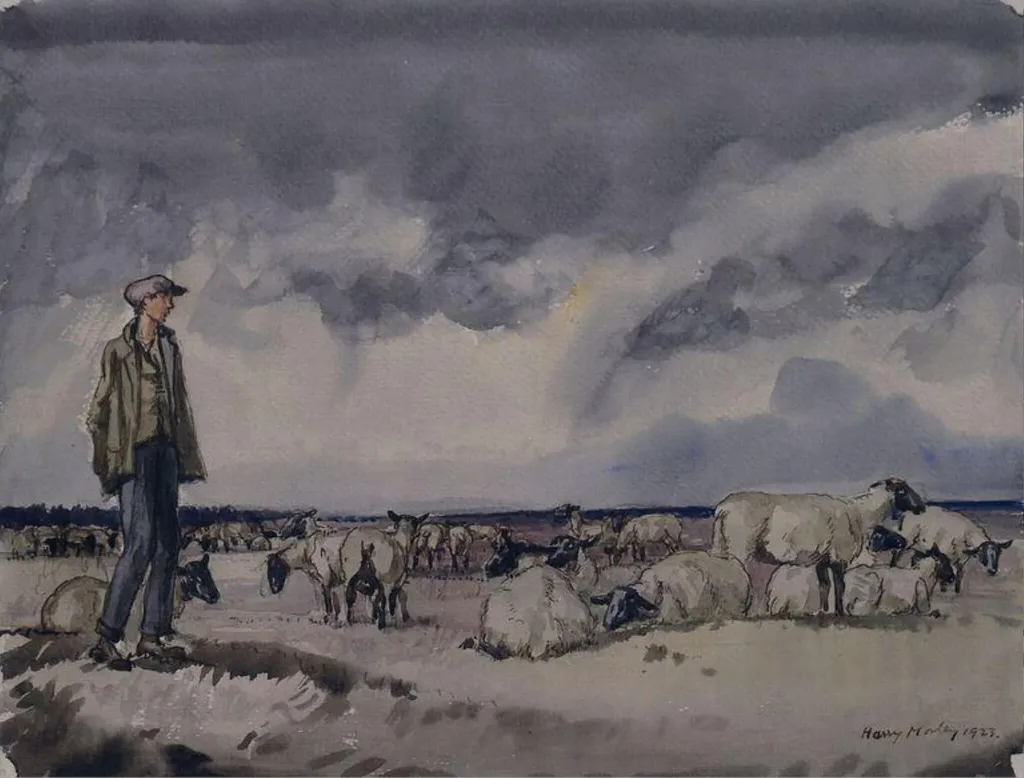
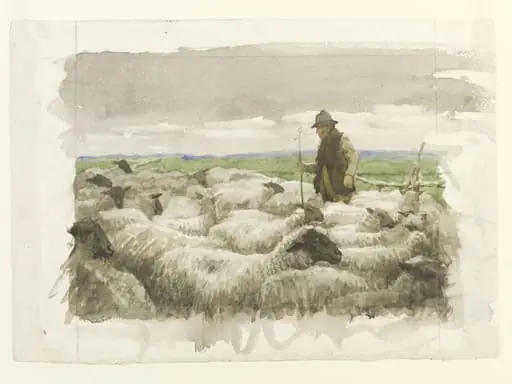
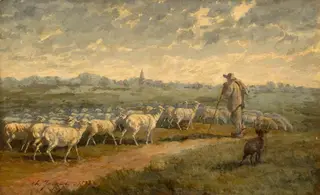
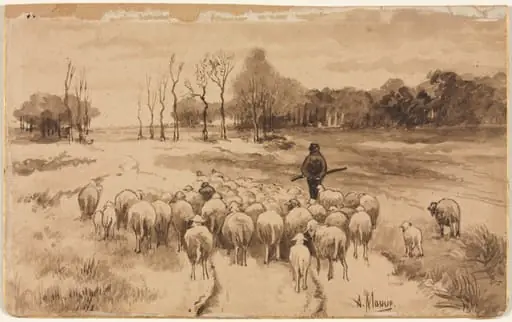
The Shepherd Boy is a watercolor work on paper by the Aestheticist artist Harry Morley. It dates from 1923 and is held in the collection of the Victoria and Albert Museum.
About this work
Overview
The work is signed and dated by the artist, confirming its origin and timing.
Created in 1923, The Shepherd Boy is a watercolour by Harry Morley, exhibited that same year at the Royal Society of British Artists under the alternative title A flock of black-faced ewes. The work is signed and dated by the artist, confirming its origin and timing. Executed on paper, it captures a quiet rural moment with restrained palette and fluid technique, characteristic of Morley’s approach to landscape and figure studies.
Subject & Meaning
The scene depicts a solitary shepherd standing on a windswept hillside, observing a group of sheep dispersed across the slope. The figure, dressed in simple rural attire, appears still and contemplative, contrasting with the scattered movement of the flock below. The composition suggests a quiet harmony between human and animal, emphasizing endurance and routine rather than narrative drama.
Technique & Style
Morley employed loose, rapid watercolour brushwork to suggest form and motion without detailed definition. The sky, rendered with layered washes, shows shifting light breaking through clouds, while the sheep are indicated by quick, textured strokes. The figure is simplified yet distinct, grounded by subtle shadows.
The medium’s transparency allows the paper’s whiteness to enhance luminosity, reinforcing the sense of open air and natural light.
History & Provenance
The work was first shown in 1923 at the Royal Society of British Artists, where it was listed under an alternate title referencing the flock rather than the shepherd. Its subsequent history is not widely documented, but it remains in private or institutional collections, likely preserved due to its association with Morley’s recognized body of watercolour work from the early 20th century.
Context
In the 1920s, British watercolourists often turned to rural themes as a counterpoint to industrial modernity. Morley’s work aligns with this trend, reflecting a broader interest in pastoral life and the quiet dignity of agricultural labor. His approach, neither romanticized nor idealized, resonated with contemporaries who valued sincerity and observational accuracy in landscape art.
Legacy
Though not among Morley’s most widely reproduced works, The Shepherd Boy exemplifies his commitment to capturing everyday rural scenes with sensitivity and technical restraint. It contributes to a broader understanding of early 20th-century British watercolour practice, where modest subjects were rendered with quiet authority through skilled handling of light and form.
Own this work as a print
Artist & collection
Artist
Harry Morley (5 April 1881 – 18 September 1943) was a British painter, etcher and engraver known for his classical and mythological compositions.