Artwork
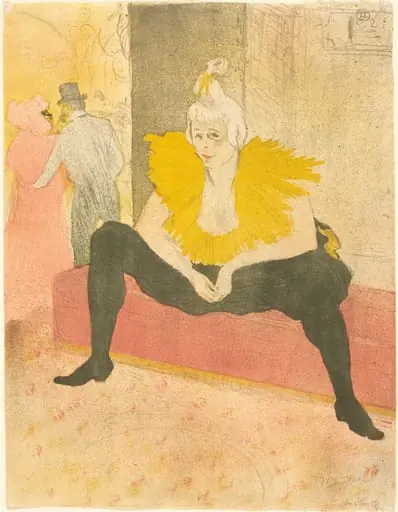
Elles: The Seated Clown, Mlle Cha-u-Ka-o
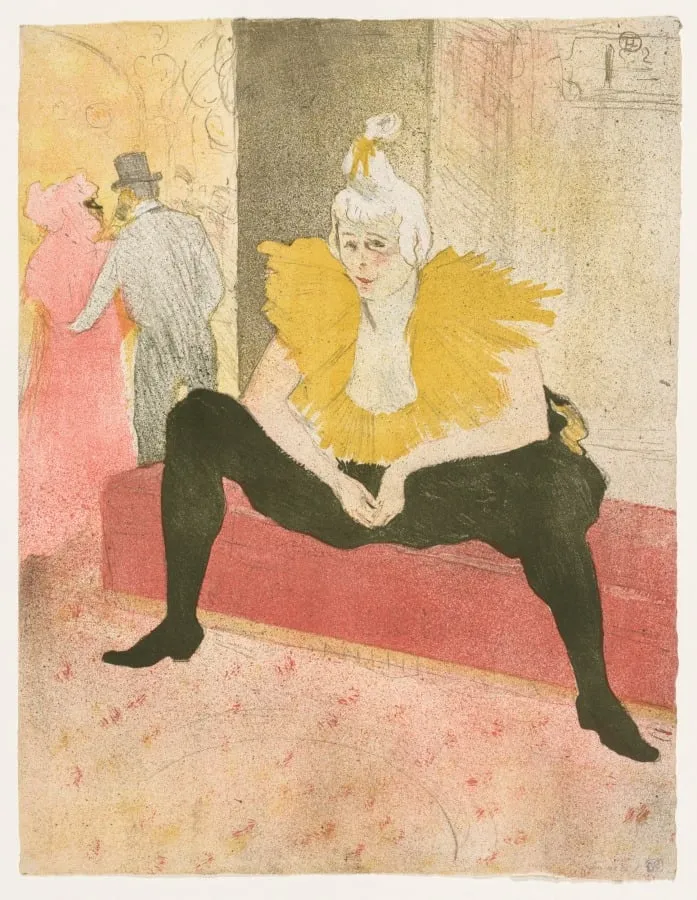
Elles: The Seated Clown, Mlle Cha-u-Ka-o is a print by the Impressionist artist Henri de Toulouse-Lautrec. It dates from 1896 and is held in the collection of the Cleveland Museum of Art.
- Accession no.
- 1925.1204.2
- Credit line
- Gift of Ralph King
About this work
Most artists showed prostitutes as either glamorous or tragic, he showed them as people, just sitting there.
A woman in a red-and-black clown suit sits on a chair, one leg crossed over the other. Her face is pale, her eyes tired. She looks straight at you.
Lautrec painted this in a Paris brothel, not for shock value, but because he liked these women. Most artists showed prostitutes as either glamorous or tragic, he showed them as people, just sitting there. The series flopped at first; buyers wanted titillation, not quiet moments.
Look up other works in the subject: france, 19th century.
Overview
Elles: The Seated Clown, Mlle Cha-u-Ka-o is a print from a series of lithographs created by Henri de Toulouse-Lautrec between 1892 and 1895. The work depicts a woman, identified as Mlle Cha-u-Ka-o, seated in a red-and-black clown suit, conveying a sense of weary introspection.
Subject & Meaning
This print focuses on the everyday life of a prostitute in a Parisian brothel, where Toulouse-Lautrec often resided. The subject's tired expression and relaxed pose underscore the artist's intention to portray these women with humanity and sympathy, rather than as erotic figures or tragic victims.
Technique & Style
Executed in color lithography, the piece showcases Toulouse-Lautrec's mastery of the medium through vibrant, yet subdued, coloring and expressive line work. The direct gaze of the subject, set against the simplicity of the composition, highlights the artist's ability to capture intimate, unguarded moments.
History & Provenance
Commissioned by publisher Gustave Pellet, the 'Elles' series was initially a commercial failure, likely due to its lack of eroticism. Toulouse-Lautrec's immersive approach, living among the brothel's inhabitants, informed the series' nuanced portrayal of their daily lives.
Context
Within late 19th-century French art, Toulouse-Lautrec's 'Elles' series was pioneering in its sympathetic, non-judgmental depiction of prostitutes. Unlike prevalent representations that sensationalized or romanticized them, his work offered a rare glimpse into their ordinary, private worlds.
Legacy
Despite its initial failure, 'Elles' is now recognized for its innovative approach to both subject matter and color lithography. It influences how artists represent marginalized communities with dignity and contributes significantly to Toulouse-Lautrec's reputation as a leading figure in late 19th-century French art.
Artist & collection
Artist
Comte Henri Marie Raymond de Toulouse-Lautrec-Montfa (24 November 1864 – 9 September 1901), known as Toulouse-Lautrec (French: ), was a French painter, printmaker, draughtsman, caricaturist, and illustrator.