Artwork
Rue des Moulins, 1894
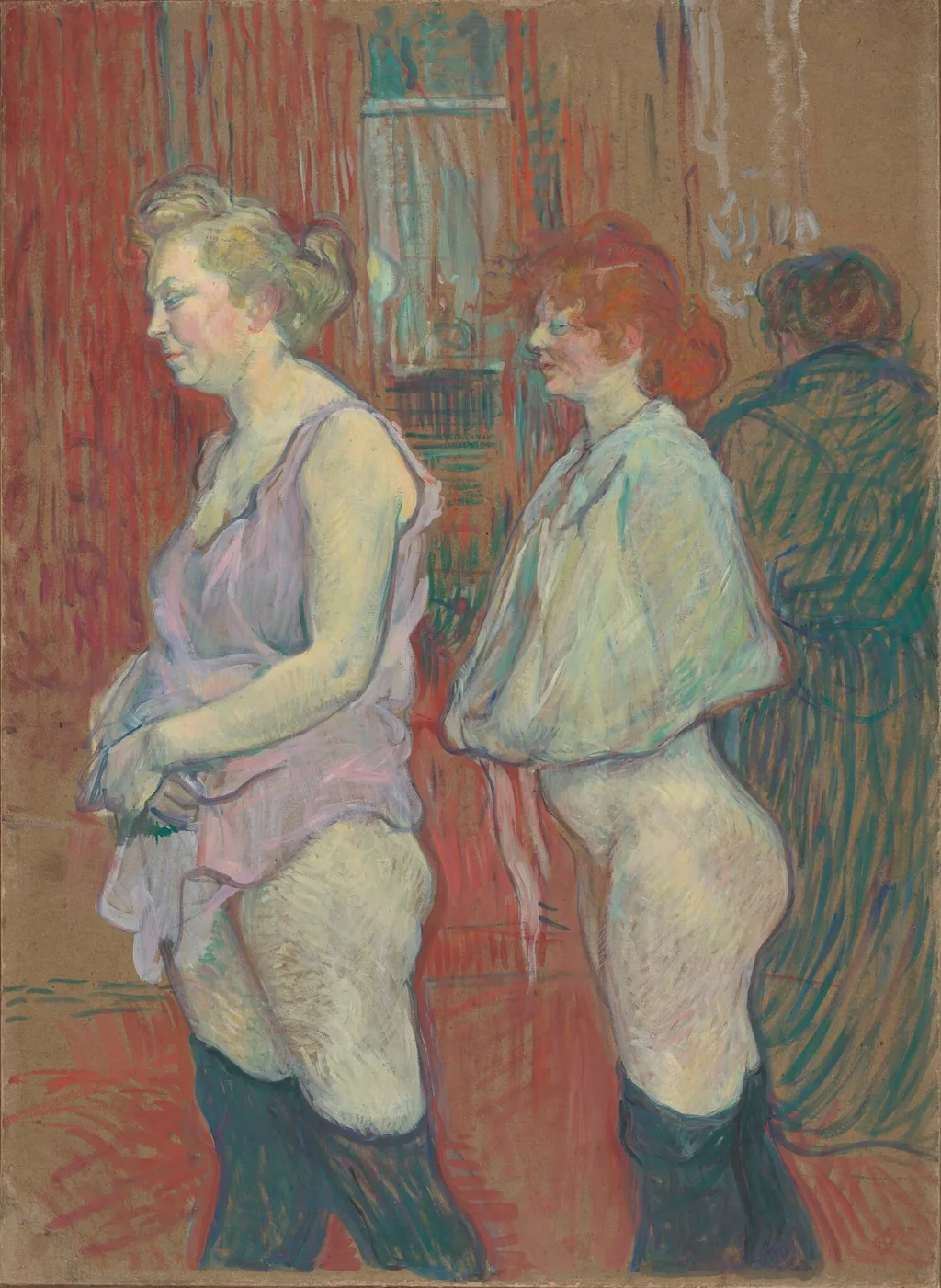
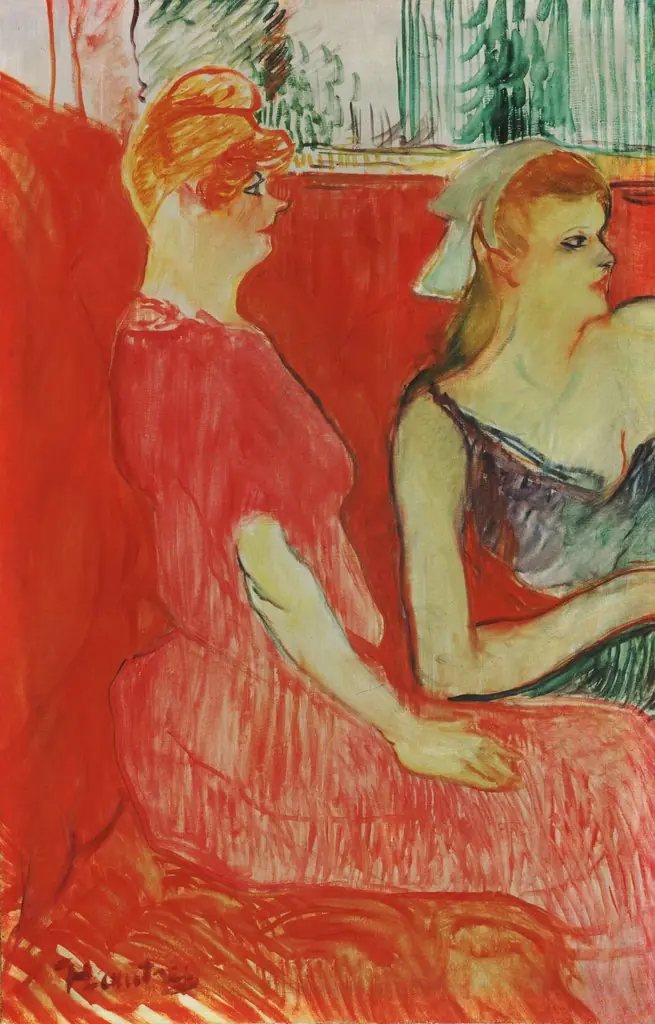
Rue des Moulins, 1894 is an oil painting by the Impressionist artist Henri de Toulouse-Lautrec. It dates from 1894 and is held in the collection of the National Gallery of Art.
- Inscription
- Inscribed:lower right atelier stamp in red: HTL (Lugt 1338)
About this work
Subject & Meaning
The work portrays two prostitutes awaiting a mandatory medical examination, a routine practice for women in regulated prostitution at the time.
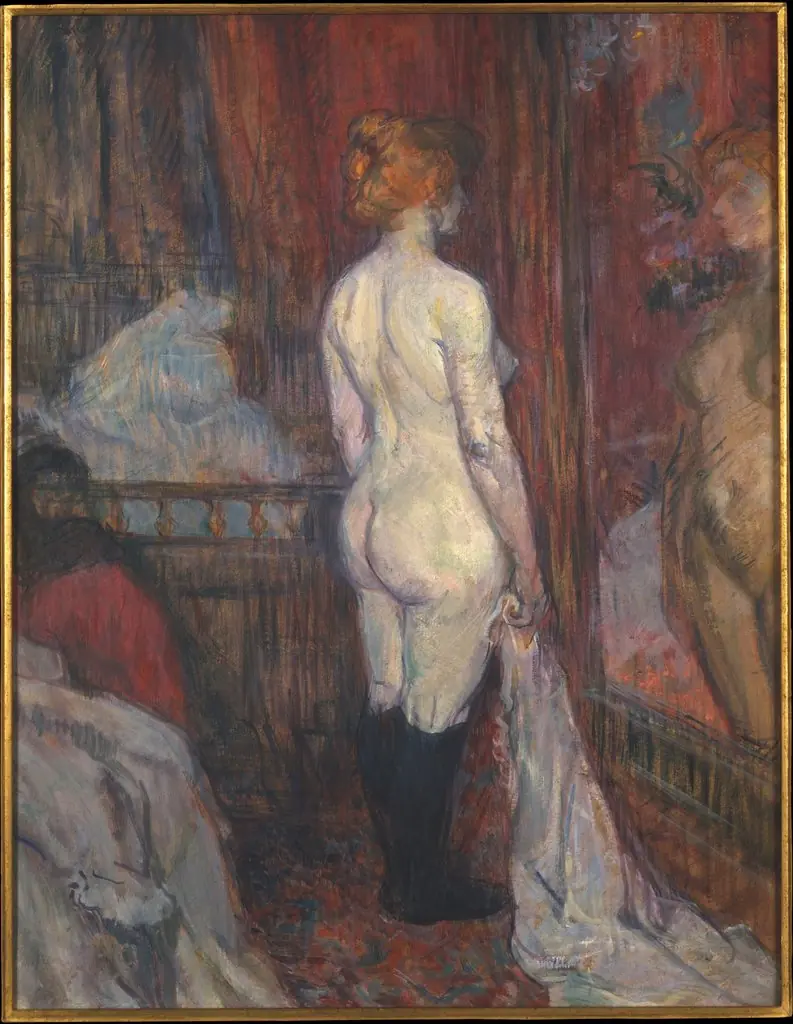
Henri de Toulouse-Lautrec's 1894 painting, Rue des Moulins (also titled La Visite médicale), depicts a specific genre scene within a Parisian brothel located on the Rue des Moulins. The work portrays two prostitutes awaiting a mandatory medical examination, a routine practice for women in regulated prostitution at the time. Visually, the figures are shown in profile from the left, standing and lifting the lower portions of their lilac and sea-green blouses to expose themselves for inspection.
The composition captures the clinical and impersonal nature of the gynecological check-up, emphasizing the waiting period and the objectification inherent in the system. Rather than romanticizing the subjects, the iconography presents a stark, documentary-style representation of the intersection between public health regulations and the sex trade in late 19th-century Paris.
Technique & Style
Rue des Moulins, 1894 is executed in oil on a cardboard support mounted on wood, a technique that combines a flexible support with the luminous handling typical of late-19th-century French painting. The work measures 83.5 cm in height by 61.4 cm in width, reflecting a vertical format noted in the National Gallery of Art catalogue. It depicts a genre scene of two prostitutes awaiting a medical examination, rendered with a profile view and distinctive garment colors, lilac for the blonde figure and sea-green for the red-haired figure, demonstrating Lautrec's interest in contemporary urban life and his precise, almost illustrative brushwork. The painting is part of the National Gallery of Art's collection.
History & Provenance
Rue des Moulins, 1894 is an oil on cardboard mounted on wood painted by Henri de Toulouse-Lautrec in 1894. The work originated as a genre scene depicting two prostitutes awaiting a medical examination in a Paris brothel on the rue des Moulins. It was first acquired directly from the artist by collector Paul Gallimard in Paris, and subsequently passed through the dealers Paul Cassirer and Étienne Bignou, who sold it in May 1930 to Chester Dale of New York.
Upon Dale's death, the piece was bequeathed in 1963 to the National Gallery of Art in Washington, D.C., where it remains in the permanent collection. The sources do not list specific past exhibition titles or dates beyond its inclusion in the gallery's holdings.
Context
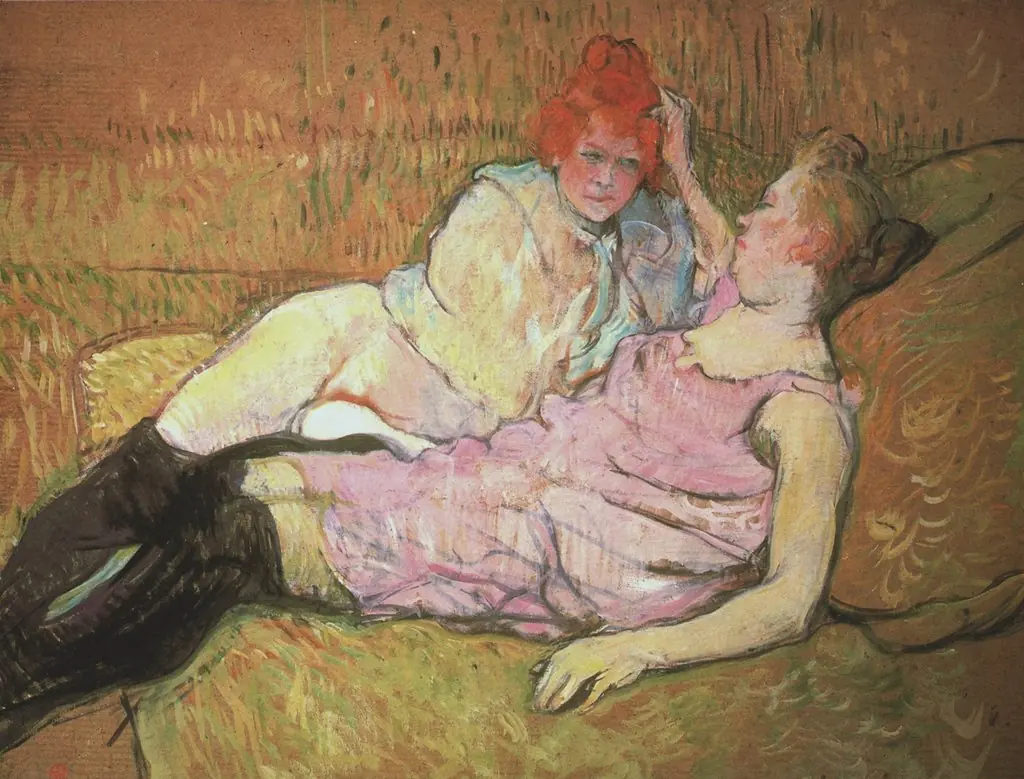
Rue des Moulins, 1894 occupies a distinct place in Toulouse-Lautrec's oeuvre as a socially engaged genre scene that documents Parisian sex-work under medical surveillance. Scholars have emphasized its alignment with contemporary public-health debates and the artist's sustained focus on marginalized urban life, positioning the work within fin-de-siècle visual culture that interrogated modernity's underbelly. The painting belongs to Lautrec's broader series of brothel scenes, where he exchanged moralizing for clinical observation, reflecting the medicalization and the temporal rhythms of waiting central to regulated prostitution.
Its later inclusion in the Chester Dale bequest at the National Gallery of Art, Washington, ensured its canonical presence in twentieth-century museum display.
Legacy
Rue des Moulins, 1894 continues to be exhibited and studied as a key example of Henri de Toulouse-Lautrec's genre scenes that merge eroticism with social commentary. After passing from the artist to dealer Paul Gallimard and later to Paul Cassirer and Étienne Bignou, the work was acquired by Chester Dale in 1930 and bequeathed to the National Gallery of Art in 1963, where it remains on public display. Its inclusion in a major American museum has ensured ongoing public and scholarly attention, particularly regarding the depiction of prostitution and medical examination in late-19th-century Paris.
The painting's provenance and subject matter contribute to its reputation as an important document of modern urban life.
Overview
Henri de Toulouse-Lautrec's 1894 painting, Rue des Moulins, captures a moment within a Parisian brothel. Executed in oil on cardboard mounted to wood, the work exemplifies the artist's engagement with the city's less visible social spheres. It reflects his distinctive Post-Impressionist approach to depicting figures and environments, offering a direct portrayal of daily life in these establishments.
Own this work as a print
Artist & collection
Artist
Comte Henri Marie Raymond de Toulouse-Lautrec-Montfa (24 November 1864 – 9 September 1901), known as Toulouse-Lautrec (French: ), was a French painter, printmaker, draughtsman, caricaturist, and illustrator.