Artwork
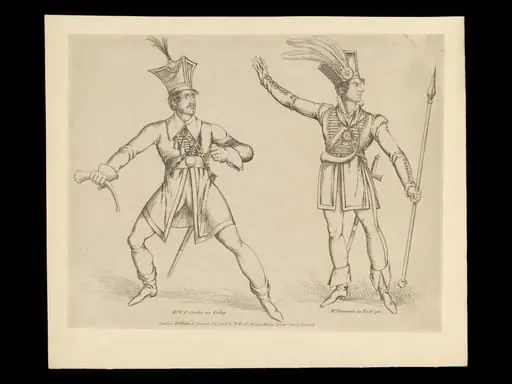
M. Deshayes et M. d'Egville, dans le Ballet Pantomime d'Achille et Deidamie
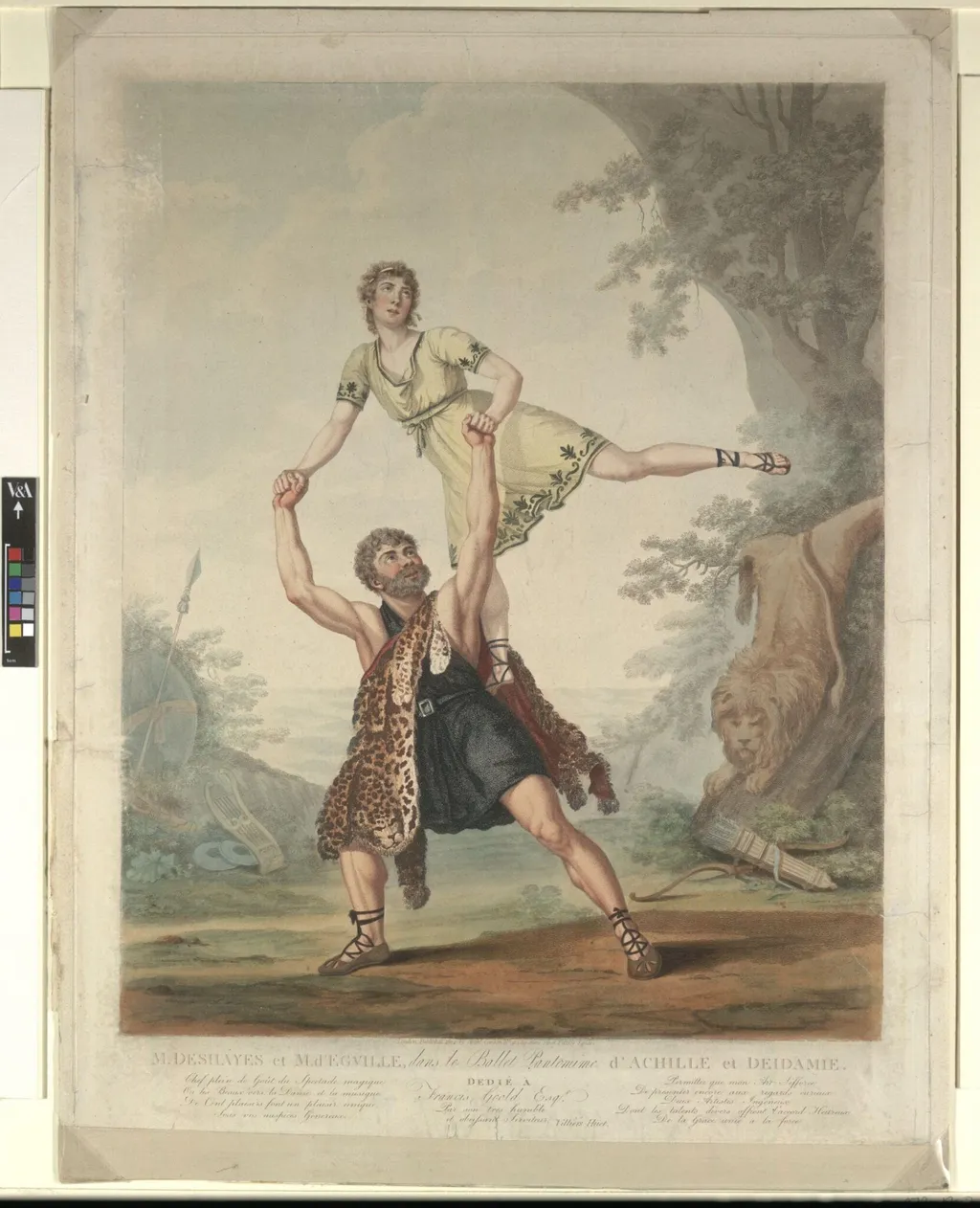
M. Deshayes et M. d'Egville, dans le Ballet Pantomime d'Achille et Deidamie is a print by the Romanticist artist Villiers Huët. It dates from 1804 and is held in the collection of the Victoria and Albert Museum.
About this work
The scene includes symbols of their roles: Achilles’s shield and Chiron’s bow.
This print shows two dancers in a ballet from 1804. André Deshayes and James D’Egville play Achilles and his tutor Chiron. The scene includes symbols of their roles: Achilles’s shield and Chiron’s bow.
The print marks a shift in dance style. Before this, dancers wore stiff costumes that kept them apart. New lighter clothes let them move closer and partner on stage.
Check out the Victoria and Albert Museum for more prints like this.
Overview
This 1804 print captures André Jean-Jacques Deshayes and James Harvey D'Egville in their roles from the ballet-pantomime Achille et Déidamie. Depicted mid-motion, the two male dancers embody Achilles and his mentor Chiron, surrounded by symbolic props: Achilles’s shield and Chiron’s bow. The image documents a transitional moment in dance, reflecting evolving stage practices after the French Revolution, as costumes and movement began to prioritize naturalism over rigid formality.
Subject & Meaning
The figures represent Achilles, the legendary Greek hero, and Chiron, the wise centaur who trained him. Their interaction conveys a pedagogical relationship, with Chiron guiding Achilles’s physical development. The inclusion of their signature weapons reinforces their mythological identities.
Though the ballet’s narrative centers on Achilles’s romance with Deidamie, this scene highlights the mentor’s role in shaping the hero’s strength and discipline, a theme resonant in post-revolutionary ideals of personal growth and civic virtue.
Technique & Style
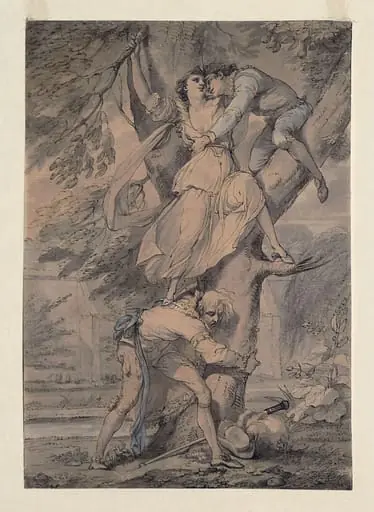
The composition suggests an early form of partnered movement, with one dancer seemingly supported by the other, an innovation made possible by the abandonment of stiff, hooped costumes. Though the print dramatizes the lift, making Achilles appear balanced on Chiron’s hip, a preparatory sketch reveals a more plausible stance: the foot resting on the thigh. This discrepancy reveals artistic license in service of visual impact, while still signaling the emerging vocabulary of lifts and dynamic partnering in ballet.
History & Provenance
The print was produced in 1804, shortly after the ballet’s premiere. A related pen-and-ink sketch, held by the Victoria and Albert Museum (S.1993-1996), serves as its direct precursor and offers insight into the artist’s process. The sketch corrects the final print’s exaggerated pose, indicating that the published version prioritized theatrical effect over anatomical accuracy.
This duality between study and finished work underscores the print’s role as both documentation and promotion of the performance.
Context
Prior to the French Revolution, male dancers wore the tonnelet, a stiff, skirt-like garment that restricted movement and kept performers at a distance. Post-revolutionary reforms introduced fitted jackets and breeches, enabling greater physical freedom and closer interaction on stage. This shift allowed for new choreographic possibilities, including lifts and synchronized motion.
Though the print shows two men, it reflects the broader trend toward partnered dancing that would soon define classical ballet’s male-female duets.
Legacy
The image stands as an early visual record of ballet’s transition from formalized court dance to a more expressive, physically dynamic art form. While the specific lift depicted was likely not performed as shown, the print captures the spirit of innovation in early 19th-century choreography. It contributes to the historical record of how costume reform enabled technical evolution, paving the way for the acrobatic partnering that became central to ballet’s development in the decades that followed.
Own this work as a print
Artist & collection
Artist
Villiers Huët made 1804 print portraits of M. Deshayes and M. d’Egville in costume, stiff-collared and posed mid-performance. Their stiff lace ruffs and powdered hair sit against a blank backdrop, the only lines the…