Artwork
Singerie: The Concert
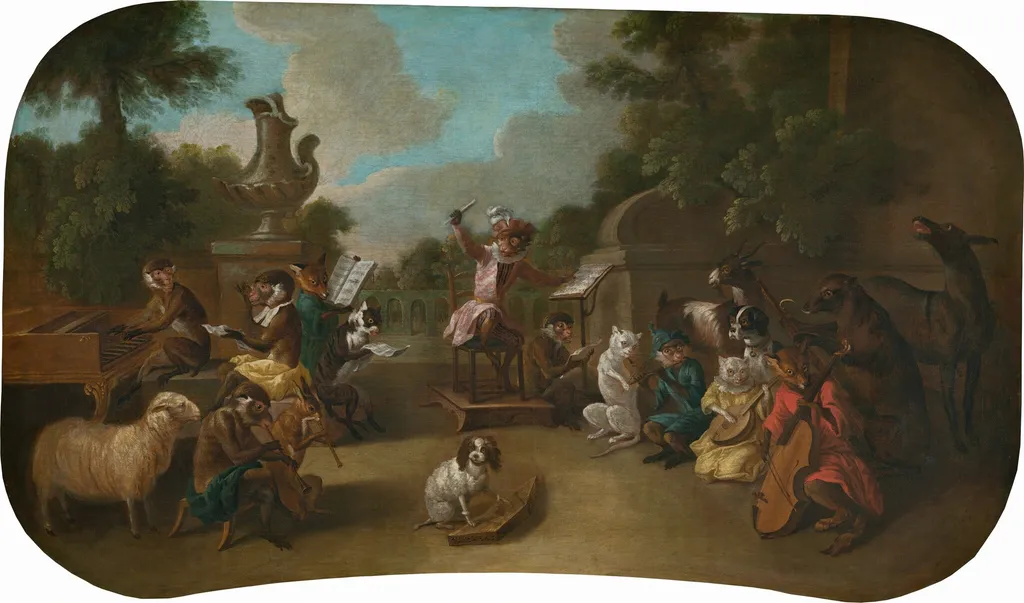
Singerie: The Concert is an oil painting by the Baroque artist Christophe Huet. It dates from 1739 and is held in the collection of the National Gallery of Art.
About this work
Technique & Style
The medium of oil on canvas allows for the detailed rendering of textures and expressions typical of this genre.
Christophe Huet's Singerie: The Concert is an oil painting executed on canvas in 1739. The work measures 89.1 cm in height and 150.9 cm in width, adhering to the standard dimensions for decorative panel paintings of the French Rococo period. As a singerie, the piece stylistically depicts monkeys engaged in human activities, specifically a musical gathering, reflecting the playful and whimsical formal qualities characteristic of Huet's series.
The medium of oil on canvas allows for the detailed rendering of textures and expressions typical of this genre.
History & Provenance
Christophe Huet executed this oil on canvas in 1739 as a commission for François Jules Duvaucel, intended to decorate a salon within the Château de La Norville in France. The work remained at the château through various owners until the early twentieth century, appearing with the Paris dealer Fauché by 1907. In 1922, Dr. Alexander Hamilton Rice and his wife, Eleanor Elkins Widener Rice, acquired the painting through the dealer André Carlhian for the dining room of their Fifth Avenue mansion in New York.
Following Dr. Rice's death in 1956, the piece passed by inheritance to Eleanor's children, George D. Widener, Jr., and Eleanor Widener Dixon. The siblings donated the artwork to the National Gallery of Art in Washington, D.C., in 1957.
Singerie: The Concert is held by the National Gallery of Art in Washington, D.C. Its accession occurred through a 1957 gift from Eleanor Elkins Widener Dixon and her brother George D. Widener Jr., who inherited the work from their mother Eleanor Rice after the death of Alexander Hamilton Rice in 1956. The painting was originally commissioned in 1739 by François Jules Duvaucel for the Château de La Norville in France and remained in the château until its sale by the Carlhian firm in Paris around 1901–1906. It entered the collection of Dr. Alexander Hamilton Rice and Eleanor Rice in 1922, passed by inheritance to the Widener heirs, and was donated to the National Gallery of Art in 1957.
The work measures 89.1 cm in height and 150.9 cm in width.
It has been exhibited at the National Gallery of Art as part of its permanent collection since 1957.
Overview
Christophe Huet’s oil on canvas, dated around 1739, presents a whimsical tableau titled Singerie: The Concert. In a landscaped garden setting, a troupe of primates, attired in contemporary dress, engage in a musical performance, while a sheep and a dog observe from the periphery. The composition balances detailed foliage with a prominent vase, framing the animated scene.
Subject & Meaning
The work belongs to the ‘singerie’ tradition, wherein monkeys mimic human activities to satirize social pretensions. Here, a conducting monkey leads companions playing harp, violin and other instruments, underscoring the folly of affectation. The inclusion of domestic animals as spectators amplifies the commentary, suggesting that even the simplest creatures can recognize the absurdity of human affectation.
Context
Singerie emerged in the French court as a lighthearted critique of aristocratic manners, often employed in interior decoration to amuse and instruct. Huet, active in the decorative arts of the period, contributed numerous such scenes to salons and garden pavilions, aligning his practice with the broader Rococo fascination with wit, nature, and theatricality.
Own this work as a print
Artist & collection