Artwork
Singerie: The Dance
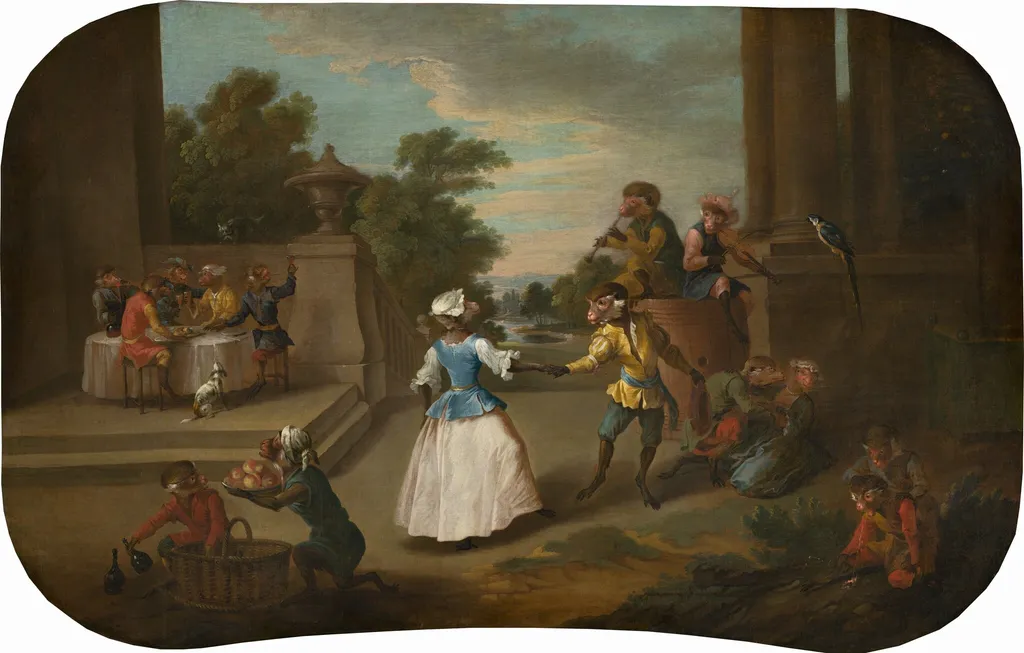
Singerie: The Dance is an oil painting by the Baroque artist Christophe Huet. It dates from 1739 and is held in the collection of the National Gallery of Art.
About this work
Subject & Meaning
Such scenes carry a broader satirical purpose, lampooning the social rituals of the aristocracy through the guise of animal performers.
The work depicts a troupe of monkeys engaged in a choreographed dance, a characteristic scene of the "singerie" genre that uses anthropomorphic animals to satirize human behavior. The composition centers on a ring of monkeys holding hands and stepping in unison, evoking courtly or theatrical performance. One figure plays a drum, another a violin, underscoring the parody of refined entertainments.
Such scenes carry a broader satirical purpose, lampooning the social rituals of the aristocracy through the guise of animal performers. The choice of monkeys, traditionally associated with mimicry, heightens the critique of pretension and social posturing.
Technique & Style
Christophe Huet painted Singerie: The Dance in 1739 using oil on canvas. The composition depicts monkeys engaged in human-like gestures within a stylized setting, reflecting the Rococo fascination with playful anthropomorphism and decorative singerie. Huet's delicate brushwork and nuanced gradations of tone produce a scene that is simultaneously whimsical and formally composed, characteristic of early 18th-century French decorative painting.
The canvas measures 92.1 cm in height and 144.4 cm in width, as recorded in the National Gallery of Art's collection data.
History & Provenance
Christophe Huet painted Singerie: The Dance in 1739 as an oil on canvas, originally made for the Château de La Norville in France. The work passed through several owners, and by 1907 was documented in the collection of Fauché in Paris. In 1922 it entered the ownership of Dr. Alexander Hamilton Rice and his wife Eleanor Elkins Widener Rice, who installed it in their New York Fifth Avenue residence.
After Eleanor's death in 1937 it passed to their children, George D. Widener Jr. and Eleanor Widener Dixon, who gifted it to the National Gallery of Art, Washington, D.C., in 1957.
Overview
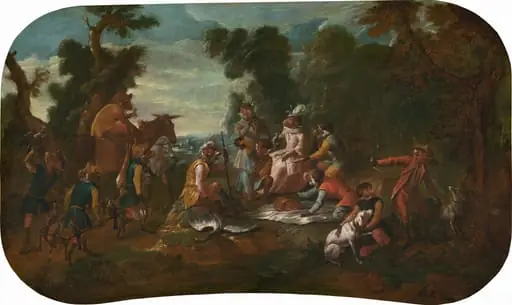
Christophe Huet’s oil on canvas, dated around 1739, presents a whimsical gathering of monkeys in a festive setting. The composition captures a moment of revelry, with the primates engaged in music, dance, and convivial dining. Rendered in the late Baroque period, the work combines vivid coloration with dynamic arrangement, guiding the eye across the bustling scene.
Context
Singerie enjoyed prominence in 18th‑century French art, often employed to entertain and subtly comment on social mores. Huet’s contribution aligns with contemporaneous works that used anthropomorphic animals to satirize courtly life, situating the painting within a broader trend of playful yet pointed visual allegory.
Own this work as a print
Artist & collection