Artwork
Hermit
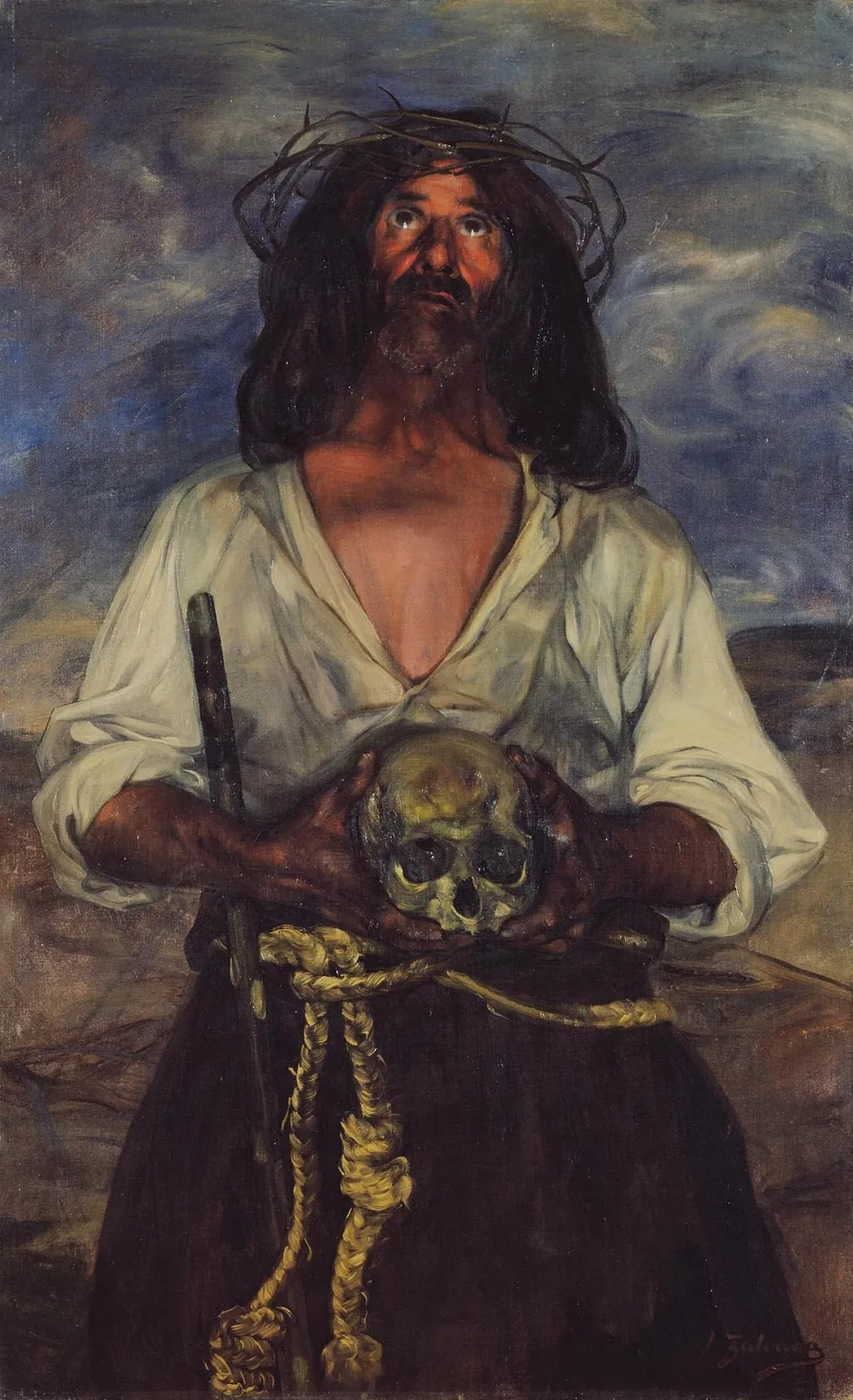
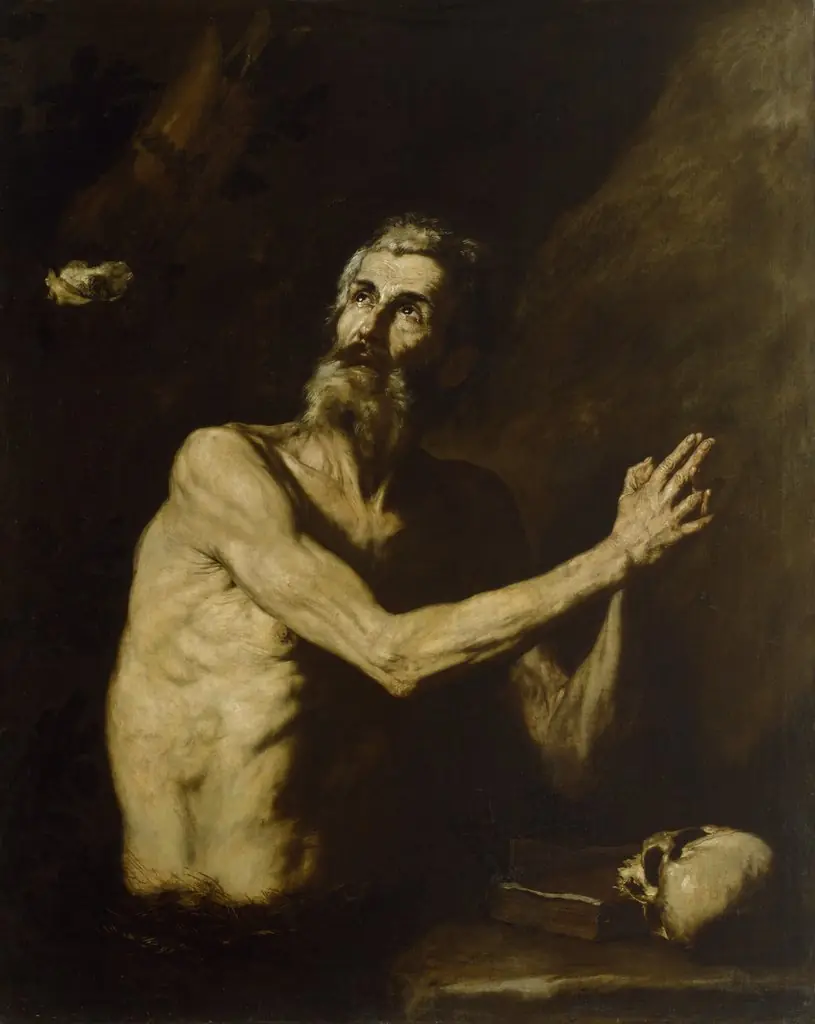
Hermit is an oil painting by the Post-Impressionist artist Ignacio Zuloaga. It dates from 1904 and is held in the collection of the Hermitage Museum.
About this work
Subject & Meaning
The work shows a middle-aged hermit kneeling in a barren landscape, his long dark hair and unkempt beard framing a face turned upward in prayer.
The work shows a middle-aged hermit kneeling in a barren landscape, his long dark hair and unkempt beard framing a face turned upward in prayer. He wears an open white shirt and dark trousers, a crown of thorns rests like a halo on his head, a skull is clasped in his hands while he leans on a staff, and a rough esparto rope binds his waist. These objects, skull, staff, rope and thorny crown, are traditional attributes of saints such as Jerome, Onofre and Francis and also allude to Christ's Passion, signalling penitence, monastic vows and a meditation on mortality.
Scholars note that Zuloaga's hermit type derives from the austere figures of Zurbarán and Ribera, yet the composition's monumentality and volumetric treatment connect it to the broader classical tradition of Velázquez and El Greco.
Technique & Style
Hermit is an oil painting on canvas, executed in 1904 by Ignacio Zuloaga and measuring 123 by 79 centimeters. The work depicts a kneeling middle-aged man with long dark brown hair and a short, unkempt greying beard, dressed in an open, rolled-up white shirt and dark brown trousers. A rough esparto rope is tied around his waist, and an oversized crown of thorns sits on his head almost like a halo.
Between his hands he holds a skull, supporting a staff with his elbow, while gazing upward in devotion with his mouth slightly open. The lower left corner contains the unfinished outline of a basket, and the artist's signature, I. Zuloaga, appears at the lower right.
Stylistically, the composition renews religious imagery while adhering to principles of monumentality and volumetric modeling of the figure, maintaining links to the classical Spanish school. The iconographic type of the hermit derives from the tradition of Spanish Baroque painters, and the handling reflects that lineage alongside El Greco and Velázquez.
History & Provenance
Ignacio Zuloaga painted Hermit in 1904 in Spain. It was first exhibited publicly in Düsseldorf in 1909, where it was likely acquired by the Russian collector Sergei Shchukin. After Shchukin's collection was nationalized following the October Revolution, the painting entered the State Museum of New Western Art in 1923 and was transferred to the Hermitage in 1931.
Owing to limited display space it remained in storage for long periods, appearing only occasionally in temporary exhibitions. Since 2017 it has been permanently displayed on the fourth floor of the General Staff Building, in the gallery devoted to late 19th- and early 20th-century Spanish painting. It is held by the State Hermitage Museum, Saint Petersburg; no accession number is given in the sources.
Context
Zuloaga's Hermit is regarded by Hermitage scholarship as a deliberate renewal of religious imagery. The critic N. B. Demina described it as a new type of religious composition that preserves monumental principles and the volumetric modeling of the figure while maintaining ties to the classical school. A. G. Kostenevich, chief researcher in the Hermitage's Department of Western European Fine Art, identified Francisco de Zurbarán and Jusepe de Ribera as the iconographic ancestors of Zuloaga's hermit type, while Demina also connected the work to Diego Velázquez and especially El Greco.
Legacy
Hermit has been read as an attempt to renew the language of religious painting while preserving ties to the Spanish classical tradition of Zurbarán, Ribera, Velázquez, and El Greco. Its public visibility has been shaped by its history: long kept in storage after entering the Hermitage in 1931, it has been on permanent display only since 2017, in the gallery of late 19th- and early 20th-century Spanish painting in the General Staff Building.
Overview
Created in 1904 by Spanish artist Ignacio Zuloaga, this oil painting portrays a solitary figure in a desolate landscape. The work is part of the State Hermitage Museum’s collection and exemplifies Zuloaga’s early engagement with themes of solitude and spirituality.
Artist & collection
Artist
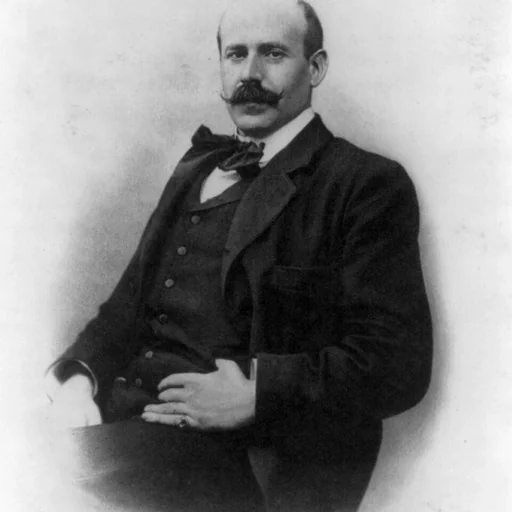
Ignacio Zuloaga y Zabaleta (July 26, 1870 – October 31, 1945) was a Spanish painter, born in Eibar, Guipuzcoa, near the monastery of Loyola.