Artwork
Marine
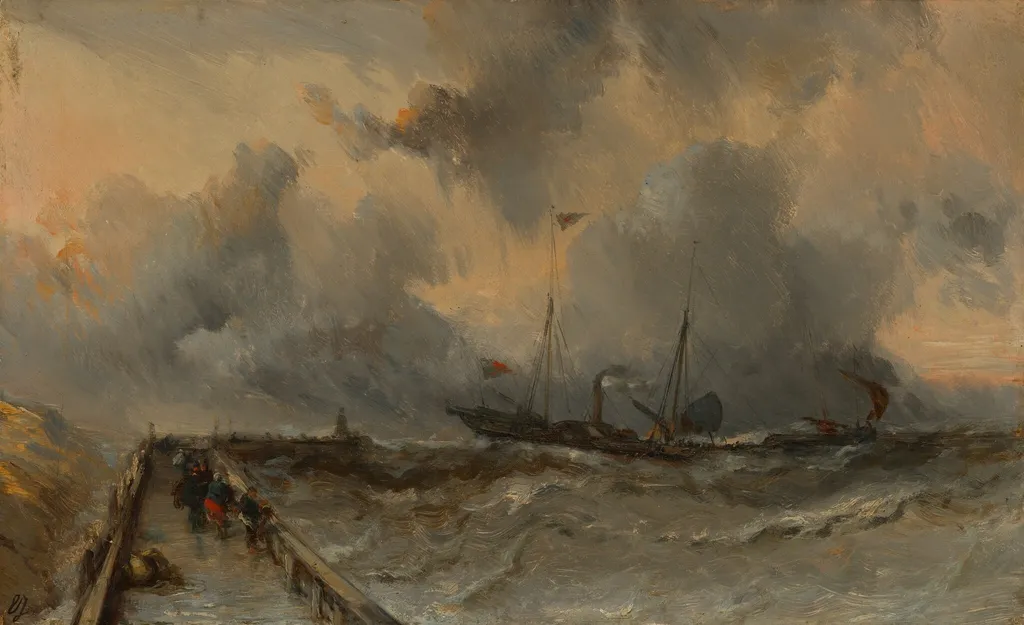
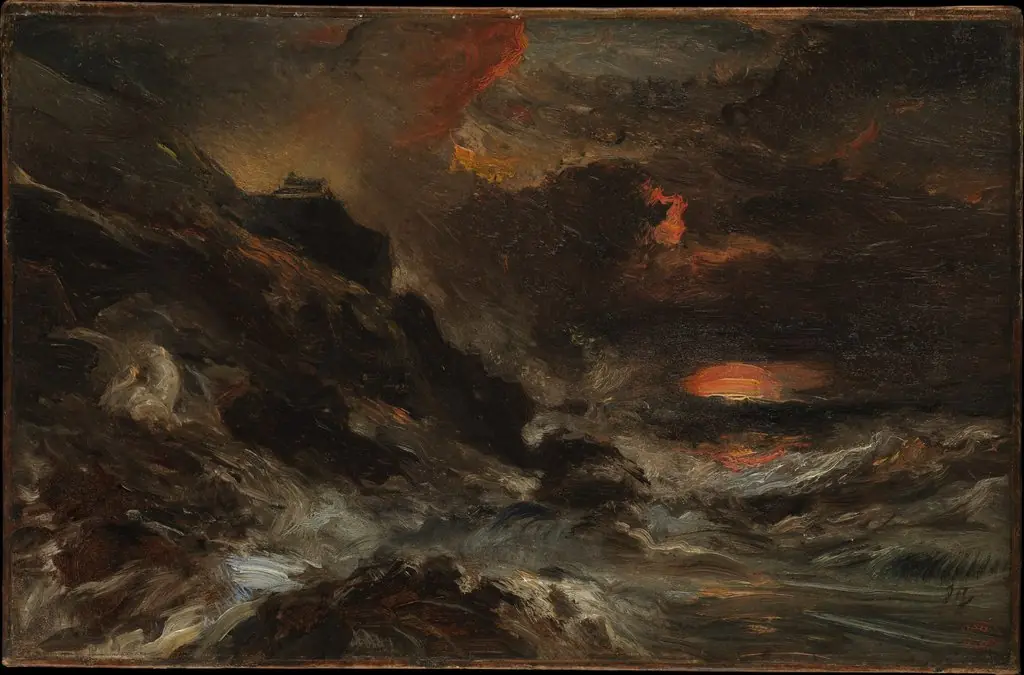
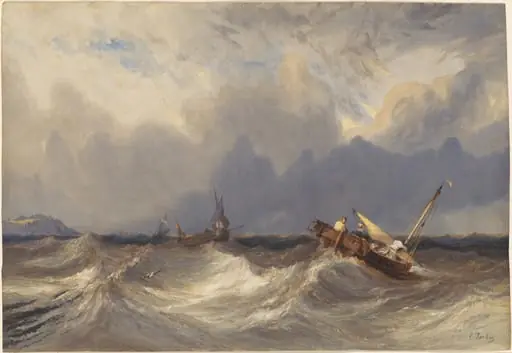
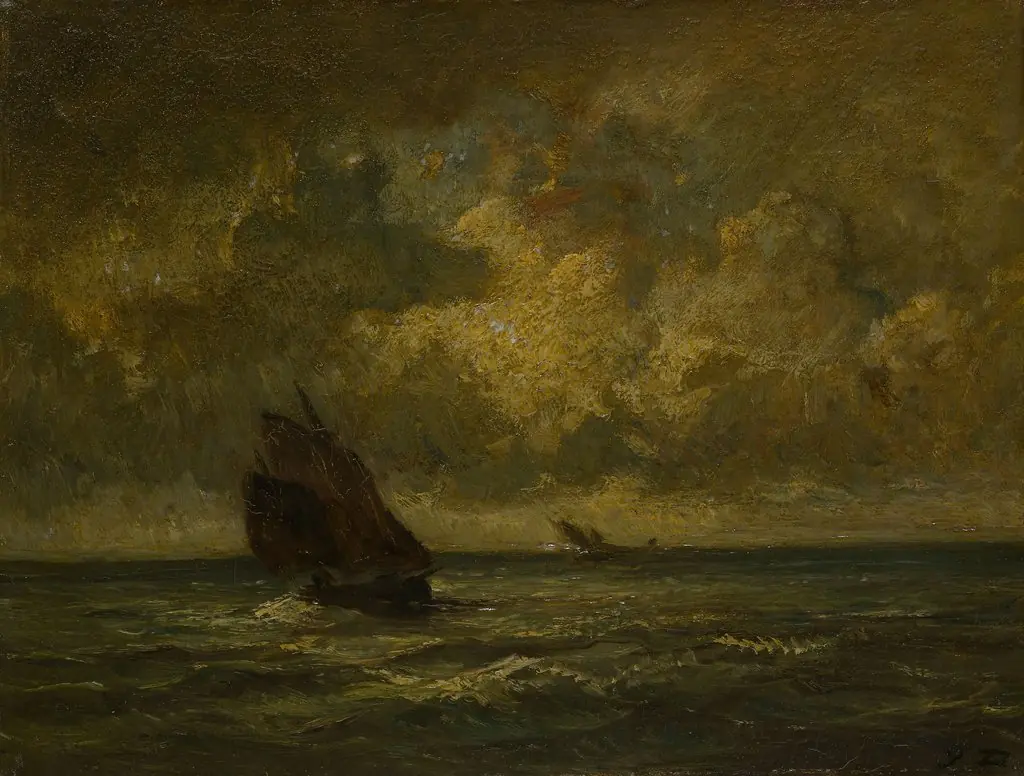
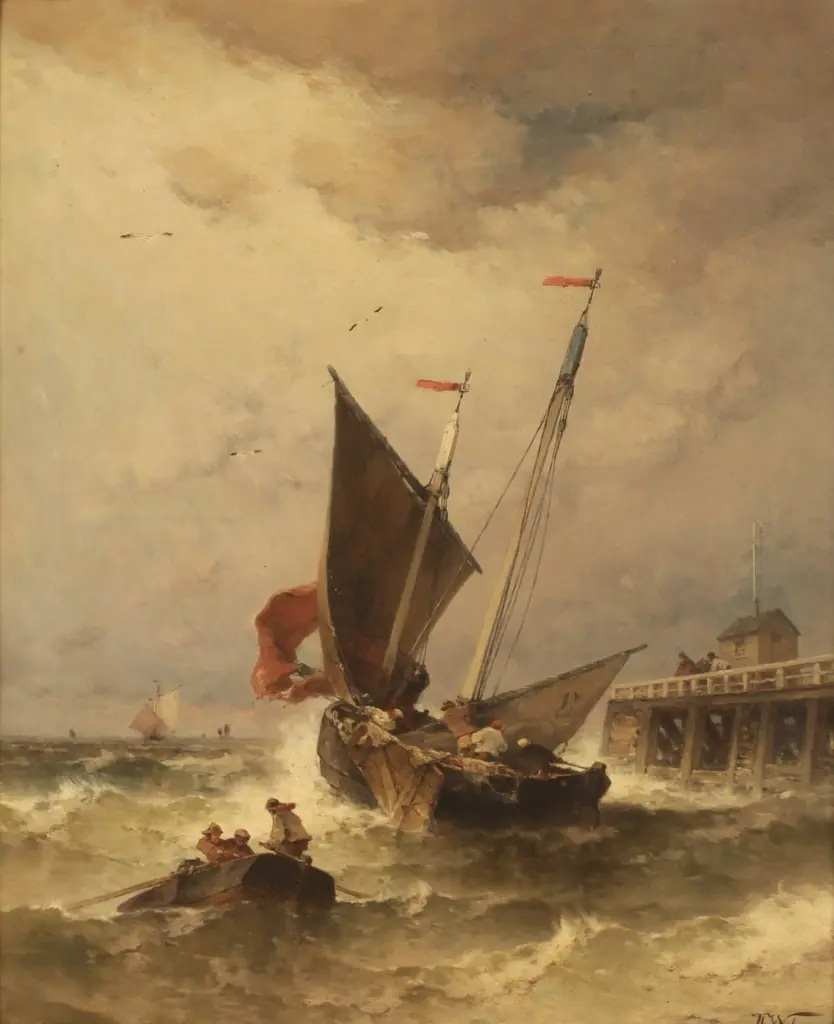
Marine is an oil painting by the Romanticist artist Eugène Isabey. It dates from 1830 and is held in the collection of the National Gallery of Art. Created circa 1830, this oil painting on wood portrays a turbulent seascape under a brooding sky.
- Inscription
- Inscribed:reverse: Port of Calais by E. Isabey / 3.901 - 402
About this work
Overview
47 centimeters, the small-scale work depicts a stormy seascape with sailing vessels and figures on a pier beneath a turbulent sky.
Marine is an oil-on-wood painting by the French marine painter Eugène Isabey, dated 1830. Measuring 23.5 by 37.47 centimeters, the small-scale work depicts a stormy seascape with sailing vessels and figures on a pier beneath a turbulent sky. The painting is held by the National Gallery of Art in Washington, D.C., under accession number 2015.19.64, having entered the collection in 2015 from the Corcoran Gallery of Art. Created at a pivotal moment in Isabey's early career, Marine exemplifies the Romantic-era fascination with nature's sublime power and the artist's emerging reputation as a specialist in dramatic coastal and maritime subjects.
Subject & Meaning
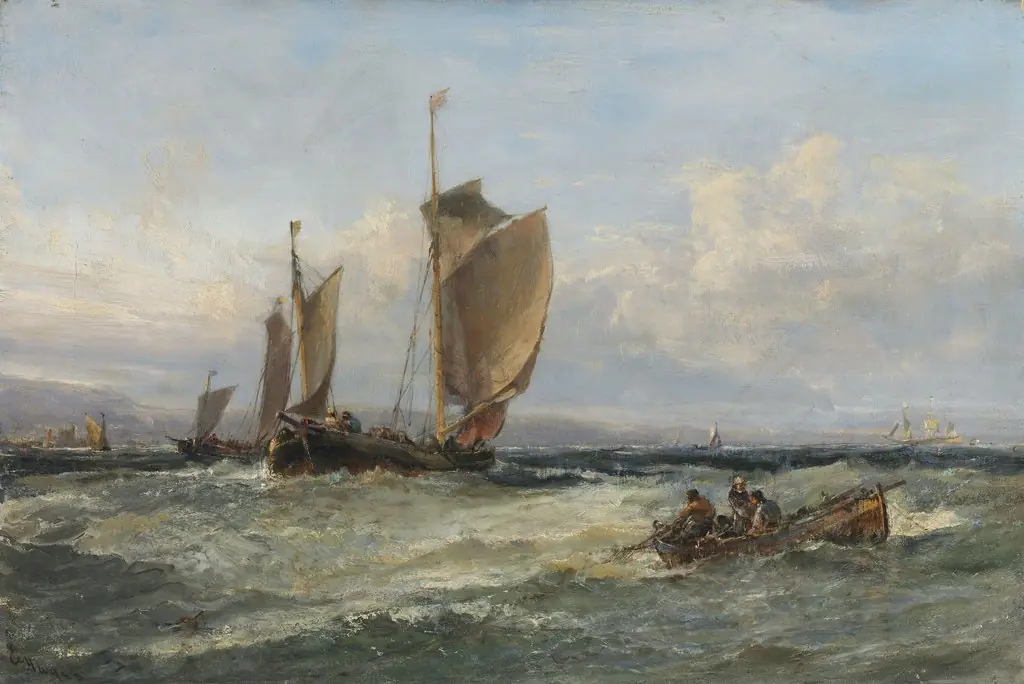
The painting presents a storm-tossed maritime scene dominated by a low horizon that thrusts the viewer's attention toward a roiling, overcast sky. Several sailing ships with masts and flags appear in the middle distance, their forms buffeted by choppy, dark waters. In the left foreground, a wooden pier or jetty extends into the sea, where small figures clad in dark and red clothing stand at the water's edge, seemingly confronting or observing the tempest. The iconography aligns with Romantic-era conventions of the marine sublime, where human figures are dwarfed by nature's overwhelming force. Touches of red on flags and clothing provide chromatic focal points against the prevailing muted grays, browns, and warm ochres. The diffuse light breaking through clouds in the upper left and right suggests neither full calamity nor complete respite, but rather the unstable, atmospheric conditions that Isabey made his specialty.
Technique & Style
Isabey executed Marine in oil on wood, a support that lent itself to the intimate scale and detailed handling of this 9 1/4 by 14 3/4 inch panel. The paint application is loose and textured, with heavy, swirling brushstrokes animating both sky and water to create a sense of movement and atmospheric instability. Visible strokes throughout suggest an almost sketch-like or unfinished quality, with forms dissolving into atmospheric haze and gestural marks rather than resolving into crisp detail. This handling reflects Isabey's early exposure to English watercolor practice and his status as one of the first French painters to work en plein air, directly from nature. The technique demonstrates the influence of J.M.W. Turner and the English watercolorists, whom Isabey studied during his 1825 visit to England, as well as the Romantic painterly freedom of Théodore Géricault and Eugène Delacroix.
History & Provenance
The painting's provenance traces from Edward C. (d. 1915) and Mary Griffin (1855-1937) Walker, who resided in Walkerville, Ontario, and Washington. Mary Griffin Walker bequeathed the work on 4 May 1937 to the Corcoran Gallery of Art in Washington, D.C., where it remained for nearly eight decades. The National Gallery of Art acquired it in 2015. An inscription on the reverse reads "Port of Calais by E. Isabey / 3.901 - 402," suggesting an early identification of the locale, though this attribution to Calais is not confirmed by other documentation. The work has been exhibited publicly on several occasions: in 1959 at the Museum of New Mexico in Santa Fe as part of "French Masterworks: A Loan Exhibition from the Corcoran Gallery of Art" (no. 14); in 1967 at the Fogg Art Museum in Cambridge, Massachusetts, for "Eugène Isabey: paintings, watercolors, drawings, lithographs" (no. 15); in 1976-1977 at Smith College Museum of Art and the Sterling and Francine Clark Art Institute for "Jongkind and the Pre-Impressionists: Painters of the École Saint-Siméon" (no. 78, reproduced); and in 1983-1984 at the Corcoran Gallery of Art for "Patrons of the Arts."
Context
Marine belongs to a critical period in Isabey's formation. The son of miniaturist Jean-Baptiste Isabey, Eugène debuted at the Paris Salon in 1824 and was building the reputation that would earn him first-class medals at the Salon and the Exposition Universelle, the Legion of Honor in 1832, and promotion to officer of that order in 1852. In 1830, the same year this painting was created, Isabey embarked on a diplomatic expedition to Algiers to record French naval activities for the king. His work along the Channel coast, including a period sharing a studio with Auguste-Xavier Leprince in Honfleur, positioned him as a bridge between Romantic landscape painting and the later developments that would influence the Impressionists. The painting's inclusion in the 1976-1977 exhibition "Jongkind and the Pre-Impressionists" explicitly connected Isabey's atmospheric coastal work to the lineage of plein-air painting that shaped Johan Jongkind and, subsequently, the Impressionist movement.
Legacy
Isabey's influence on subsequent generations of French landscape and marine painters proved substantial, particularly through his Normandy coastal scenes. His plein-air practice and atmospheric handling directly affected early Impressionists, notably Eugène Boudin and Johan Jongkind. Marine itself, though modest in scale, encapsulates the qualities that made Isabey's work consequential: the synthesis of observed meteorological effects with Romantic emotional intensity, achieved through a visibly modern handling of paint. The painting's trajectory from private Canadian-American ownership through the Corcoran Gallery of Art to the National Gallery of Art reflects the gradual recognition of Isabey's significance within American museum collections. Its exhibition history, particularly the 1976-1977 showing alongside works associated with the École Saint-Siméon, underscores its art-historical utility as a document of the pre-Impressionist landscape tradition.
Own this work as a print
Artist & collection
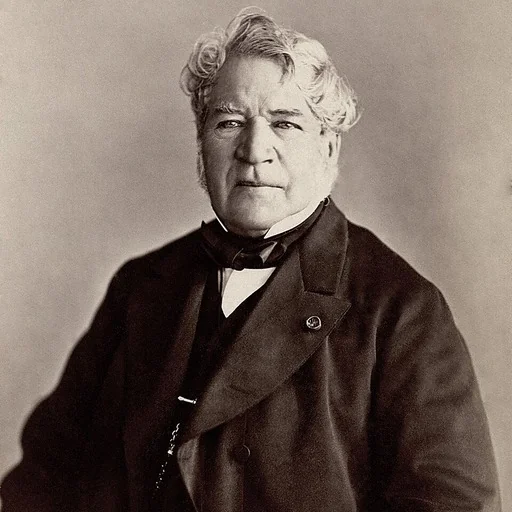
Artist
Eugène Louis Gabriel Isabey (French pronunciation:; 22 July 1803 – 25 April 1886) was a French painter, lithographer and watercolorist in the Romantic style.