Artwork
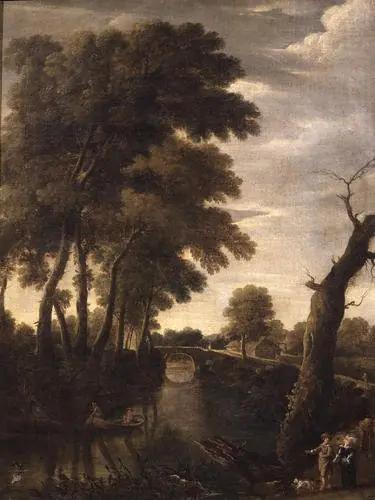
Travellers and shepherds at a crossroads near a dead tree
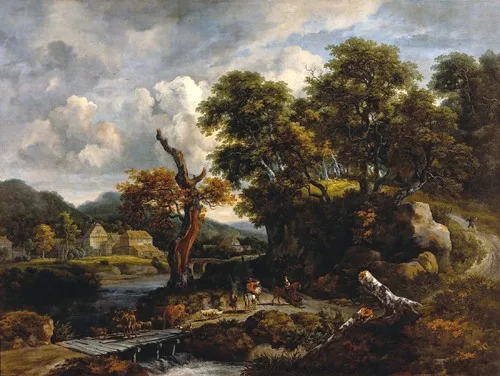
Travellers and shepherds at a crossroads near a dead tree is an oil painting by the Dutch Golden Age artist Jacob van Ruisdael. It dates from 1650 and is held in the collection of the Royal Museums of Fine Arts of Belgium.
About this work
Subject & Meaning
The composition draws on the tonal realism of Jacob van Ruisdael, emphasizing atmospheric depth and naturalistic detail to convey a contemplative mood.
The painting shows a group of travellers and shepherds gathered at a crossroads beside a dead tree, with a watercourse, forest, footbridge, house, road, people, and horse forming the surrounding landscape. This scene reflects typical 17th-century Dutch landscape symbolism where such crossroads and dead trees often signified the intersection of life paths and the transience of existence. The composition draws on the tonal realism of Jacob van Ruisdael, emphasizing atmospheric depth and naturalistic detail to convey a contemplative mood.
Technique & Style
Created in 1650, this landscape painting is executed in oil paint on a canvas support. The work measures 135 cm in height and 179 cm in width. It depicts a complex scene featuring travellers and shepherds navigating a crossroads near a dead tree, alongside elements such as a watercourse, forest, footbridge, and various structures.
The composition includes human figures and horses, characteristic of the artist's engagement with the natural world and daily life within the landscape genre.
Context
Jacob van Ruisdael painted this landscape in 1650 while working in Haarlem, depicting a crossroads scene with travelers and shepherds beneath a dead tree. The composition shows his mastery of atmospheric perspective and complex spatial depth, characteristic of Dutch Golden Age landscape painting. The work belongs to his mature period when he refined earlier influences from Haarlem school artists while developing his distinctive approach to naturalistic scenery.
Its subject matter reflects contemporary 17th century interest in rustic genre scenes within idealized landscapes, bridging the tradition of single-tree compositions with evolving Dutch landscape conventions.
Overview
Jacob van Ruisdael’s early landscape, dated around 1650, presents a tranquil woodland crossroads. The oil painting captures a narrow path that bends past a modest footbridge spanning a shallow stream, intersecting with a larger road where a few figures and horses pause. A gnarled, leaf‑stripped tree dominates the middle ground, anchoring the composition.
History & Provenance
Created in the mid‑17th century, the painting entered the collection of the Royal Museums of Fine Arts of Belgium, where it remains on display. Its acquisition reflects the museum’s focus on Dutch Golden Age landscapes and the artist’s significance within that tradition.
Legacy
The composition’s balanced arrangement of figures, architecture, and nature exemplifies Ruisdael’s influence on later landscape painters who sought to combine narrative elements with atmospheric realism.
Artist & collection
Artist
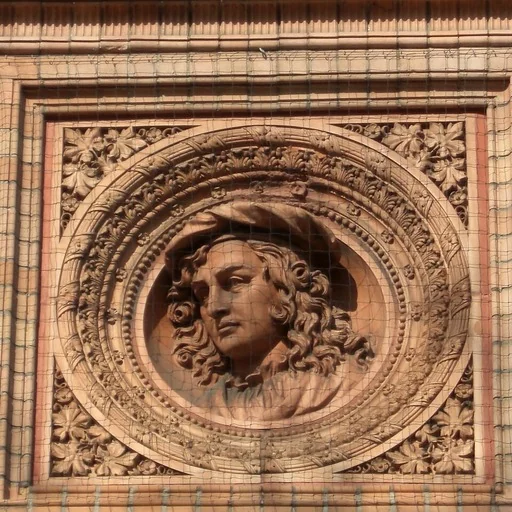
Jacob Isaackszoon van Ruisdael was a Dutch painter, draughtsman, and etcher. He is generally considered the pre-eminent landscape painter of the Dutch Golden Age, a period of great wealth and cultural achievement when…

Museum
Royal Museums of Fine Arts of Belgium
Continue through works from the same source collection.
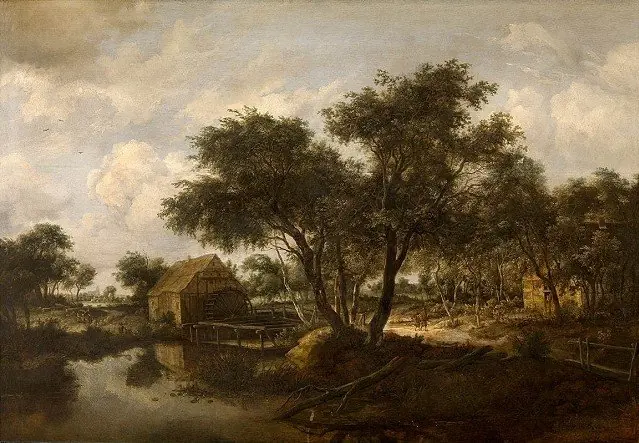
- The Watermill
 Eichenwald mit Jäger
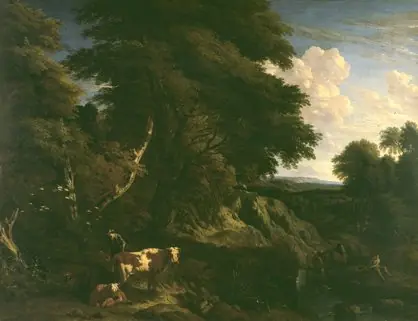 Landscape with animals
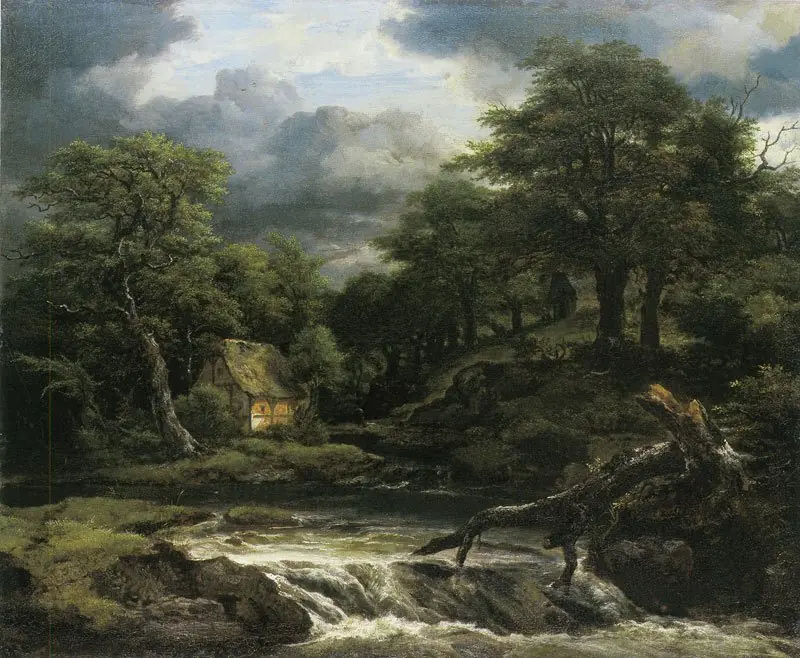 Hilly wooded landscape with a half-timbered house by a water fall
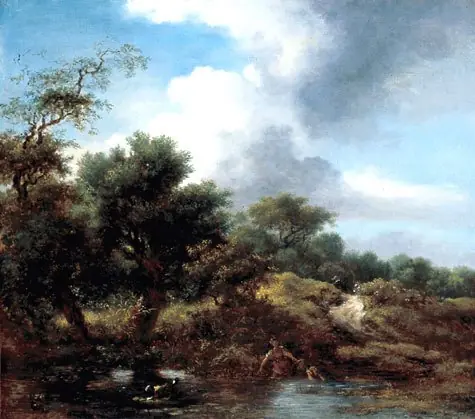 The Pond
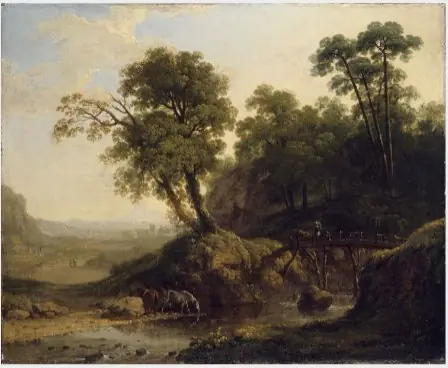 Landscape with a River and Horses by a Wooden Bridge
 A Wooded River Landscape with Figures and Horses at a Ford and Fallow Deer in a Clearing
 Boslandschap met rivier
 Landscape with a Rustic Bridge and Cattle
 Baumlandschaft mit Entenjagd
 Landscape with a river
 A View of Clonskeagh, County Dublin with Figures Bathing