Artwork
View of a City along a River
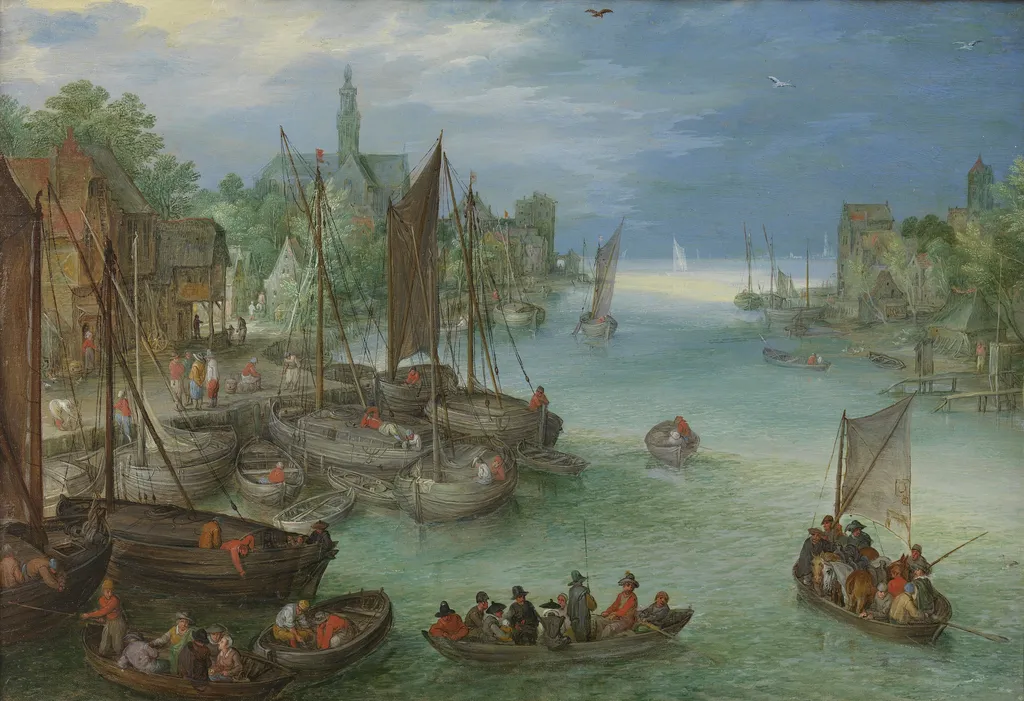
View of a City along a River is an oil painting by the Flemish Baroque painting artist Jan Brueghel, the elder. It is held in the collection of the Rijksmuseum.
About this work
Subject & Meaning
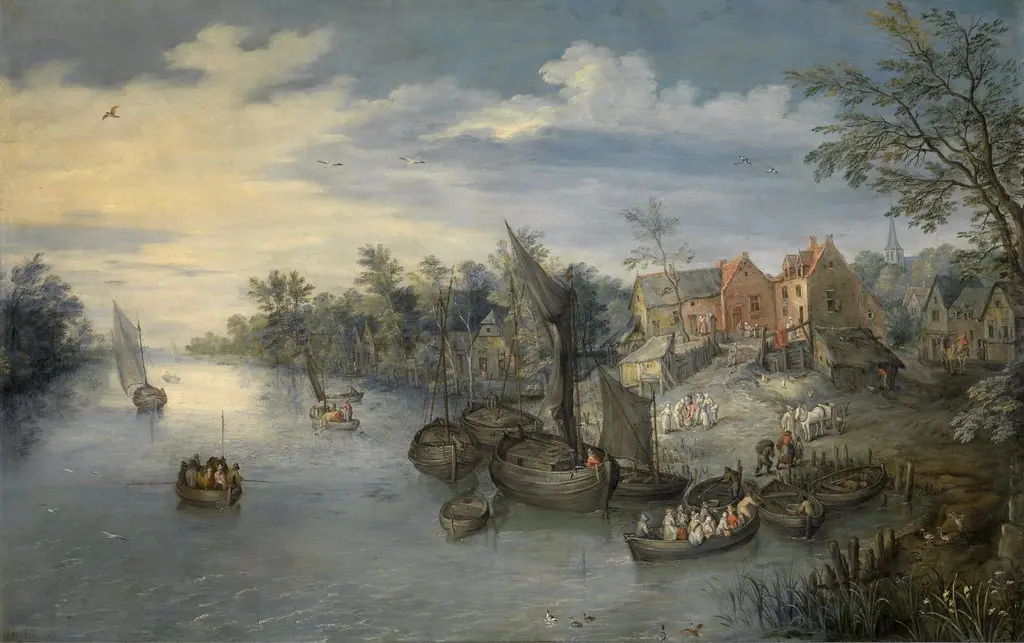
It was formerly considered a pendant to another river scene by the same artist, reflecting paired landscape works common in 17th‑century Dutch art.
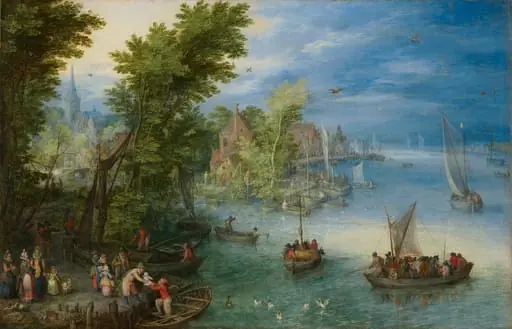
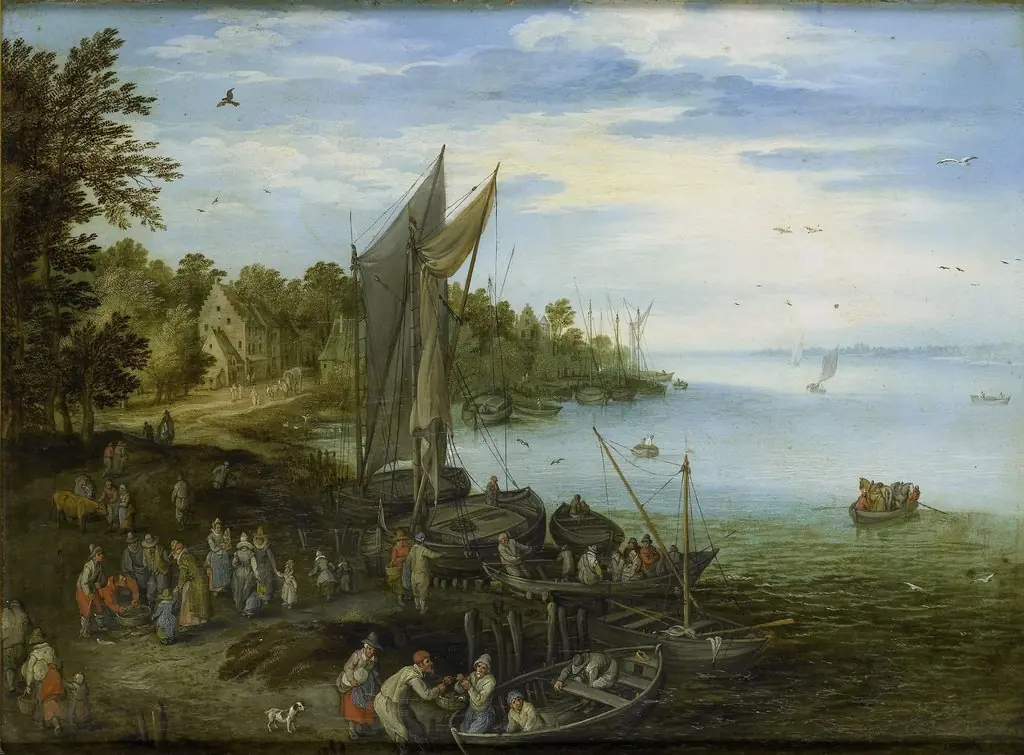
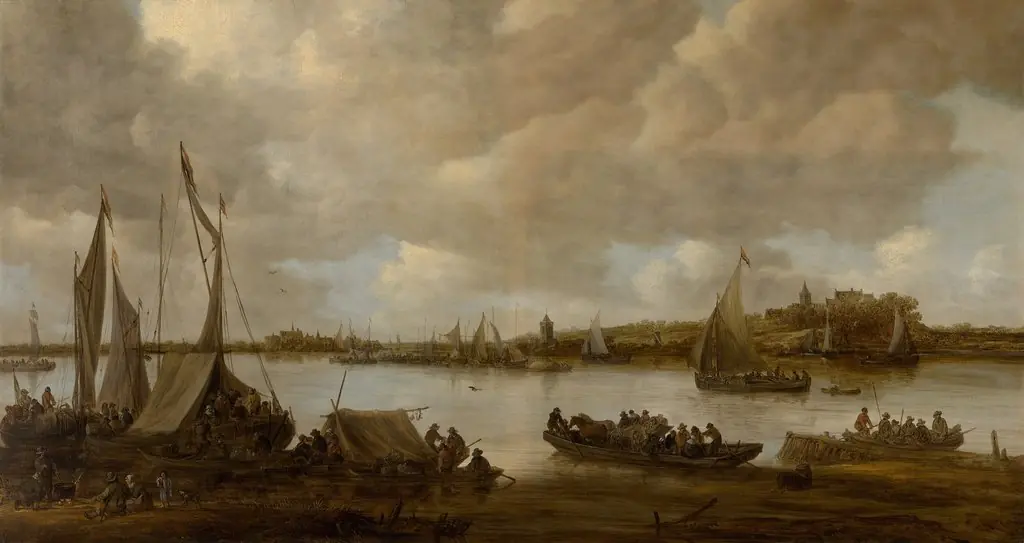
The painting depicts a riverside city with anchored fishing vessels and a ferry transporting people and animals, while distant ships sail on an open sea, suggesting trade and movement. The composition juxtaposes urban and rural elements, symbolizing the interconnectedness of commerce and nature. It was formerly considered a pendant to another river scene by the same artist, reflecting paired landscape works common in 17th‑century Dutch art.
Technique & Style
The painting is executed on a copper support using oil paint, a technique characteristic of Jan Brueghel the Elder’s mature period. The small, tightly framed riverine cityscape shows moored vessels, figures, and animals being ferried across the water, with distant ships on the open sea, reflecting a genre of Dutch landscape painting focused on quotidian riverine activity. The handling of figures exhibits a looser brushwork compared to the elder Brueghel, suggesting possible authorship by Jan Brueghel the Younger, whose style diverges from his father’s more precise rendering.
The work’s formal qualities include a compact composition, restrained palette, and meticulous detail in architectural and nautical elements, aligning with the tradition of 17th-century Flemish river vedute. Its condition is stable, with no recorded alterations to the original copper support or paint layer, preserving the integrity of the original execution.
History & Provenance
View of a City along a River is dated 1630 and painted in oil on copper, a small-scale landscape produced within the workshop milieu of Jan Brueghel the Elder, whose studio generated numerous variations of such river scenes for the open market. Dutch scholarship suggests the work was likely executed not by Brueghel the Elder himself but by his son, Jan Brueghel the Younger, whose looser handling and more sharply outlined figures distinguish his manner.
The painting first appears in records on 9 April 1783, when it was offered together with its pendant, View of a Village along a River, at an anonymous Amsterdam sale consigned by Cornelis Ploos van Amstel and conducted by auctioneer Philippus van der Schley. The pair was purchased for 300 guilders by the Rotterdam collector Gerrit van der Pot.
On 6 June 1808, the two works were again offered as a single lot at the Van der Pot estate sale in Rotterdam, where they were bought for 180 guilders by J.J. de Wit on behalf of the Koninklijk Museum, the predecessor of the Rijksmuseum in Amsterdam, where the painting remains.
The painting is held in the Rijksmuseum, Amsterdam, inventoried as SK-C-1944-151.
Its exhibition history begins with its first recorded appearance at the 1783 Amsterdam sale of Philippus van der Schley, where it was paired with its pendant View of a Village along a River and bought for 300 guilders by Rotterdam collector Gerrit van der Pot. Both works reappeared together at Van der Pot’s estate sale in Rotterdam on 6 June 1808, purchased for 180 guilders by J.J. de Wit for the Koninklijk Museum, predecessor of the Rijksmuseum.
Context
View of a City along a River (1630) is a small-scale landscape painting on copper that exemplifies the prolific output of the Brueghel workshop for the open market. While traditionally attributed to Jan Brueghel the Elder, modern scholarship often reassigns the work to his son, Jan Brueghel the Younger, citing a looser brushwork style and figures with hard outlines as distinguishing features. The painting was historically regarded as a pendant to another river scene, Gezicht op een dorp aan een rivier, reflecting the era's practice of creating paired compositions.
Its provenance traces back to the 1783 auction of Cornelis Ploos van Amstel, where it was acquired alongside its companion piece by the collector Gerrit van der Pot before entering the collection of the Rijksmuseum in Amsterdam in 1808. The work remains a significant example of the variations produced from a limited number of models within the family studio.
Overview
Created in 1630, this small-scale copper painting presents a bustling riverine vista populated by a variety of vessels and modest riverside structures. A solitary, mature tree rises amid the activity, while a distant church tower punctuates the skyline. The composition balances a lively foreground with a tranquil, cloud‑softened sky, offering a snapshot of everyday river traffic in a Flemish setting.
Own this work as a print
Artist & collection
Artist
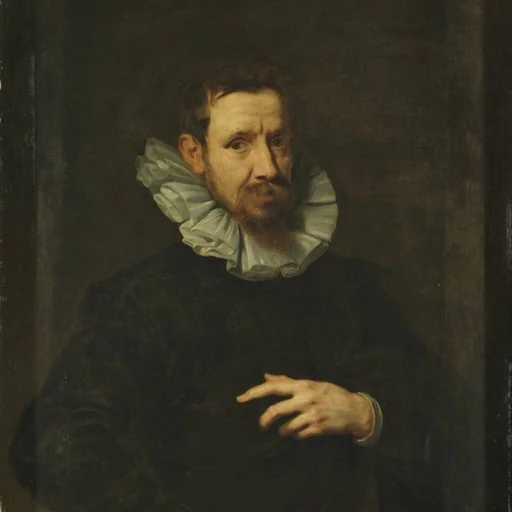
Jan Brueghel the Elder ( BROY-gəl, US also BROO-gəl; Dutch:; 1568 – 13 January 1625) was a Flemish painter and draughtsman.