Artwork
Latona and the Lycian Peasants
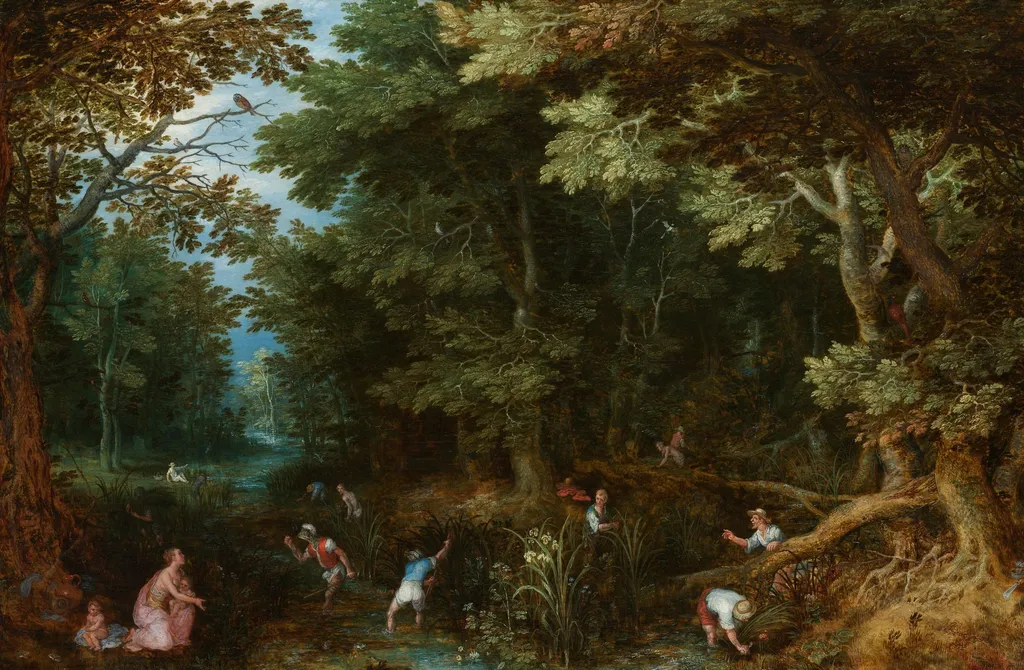
Latona and the Lycian Peasants is an unspecified painting by the Flemish Baroque painting artist Jan Brueghel, the elder. It dates from 1605 and is held in the collection of the Rijksmuseum.
About this work
Subject & Meaning
The composition showcases his skill in rendering fabrics and foliage, reinforcing the theme of sacred protection over the natural world.
The painting illustrates the classical myth of Latona, mother of Apollo and Artemis, confronting Lycian peasants who refused her water; the figures are arranged to emphasize divine rebuke and the transformation of the peasants into frogs, a motif of moral retribution. Brueghel's treatment combines precise naturalistic detail with allegorical symbolism, reflecting the Counter-Reformation emphasis on divine order and the moral consequences of impiety. The composition showcases his skill in rendering fabrics and foliage, reinforcing the theme of sacred protection over the natural world. This subject exemplifies his role as a pictor doctus who fused mythological narrative with moral instruction.
Context
Jan Brueghel the Elder occupies a pivotal position in early 17th-century Flemish Baroque art as a leading innovator alongside Peter Paul Rubens. Representing the pictor doctus, his work synthesizes Catholic Counter-Reformation ideals with the scientific revolution's drive for precise natural classification. He is credited with inventing distinct genres such as flower garland paintings, paradise landscapes, and gallery paintings, while also reworking his father Pieter Bruegel the Elder's peasant scenes.
Although he generally avoided painting large figures, his mastery of miniature techniques allowed for extraordinary detail in landscapes and mythological subjects. Often collaborating with artists like Rubens and Hans Rottenhammer, Brueghel served as court painter to Archdukes Albert and Isabella and maintained a lifelong patronage with Cardinal Federico Borromeo. His erudite approach and technical refinement earned him nicknames like "Velvet" and "Paradise" Brueghel, cementing his legacy as a master of small-scale, highly finished cabinet paintings.
Overview
This painting, "Latona and the Lycian Peasants," illustrates a dramatic episode from Ovid's Metamorphoses. It captures the moment the goddess Latona, weary and denied water by local farmers, enacts her divine retribution. The scene unfolds with Latona's raised arms initiating the curse, as some of the offending peasants already begin their irreversible metamorphosis into frogs, destined for the pond's muddy depths.
Technique & Style
The composition captures the climactic instant of divine punishment. Latona, draped in a flowing garment, stands by the water's edge with her arms uplifted, signifying her power. Below her, the peasants are rendered in various states of transition, some already possessing frog-like heads while still retaining human forms. The shimmering pond and an overcast sky contribute to the scene's unsettling atmosphere, emphasizing the irreversible change.
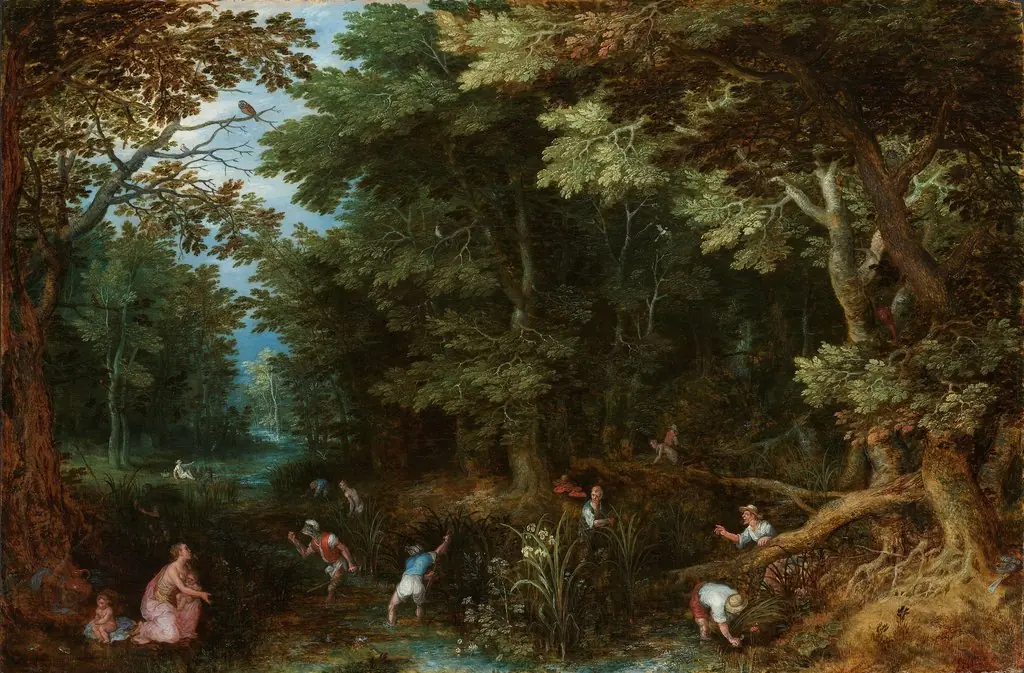
Own this work as a print
Artist & collection
Artist
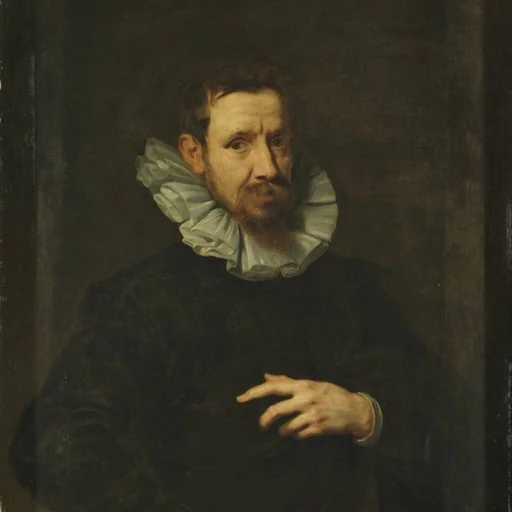
Jan Brueghel the Elder ( BROY-gəl, US also BROO-gəl; Dutch:; 1568 – 13 January 1625) was a Flemish painter and draughtsman.

 Wooded Landscape with Abraham and Isaac
 Landscape with the Flight into Egypt
 Waldinneres
 The four elements: Air
 Hunter and Horsemen on a Wooded Road, with a Village in a Valley beyond
 Gebirgslandschaft mit Reisenden
 Rest on the Flight into Egypt
 Landscape with Tobias and the Archangel Raphael
 Forest Scene with Hunters