Artwork
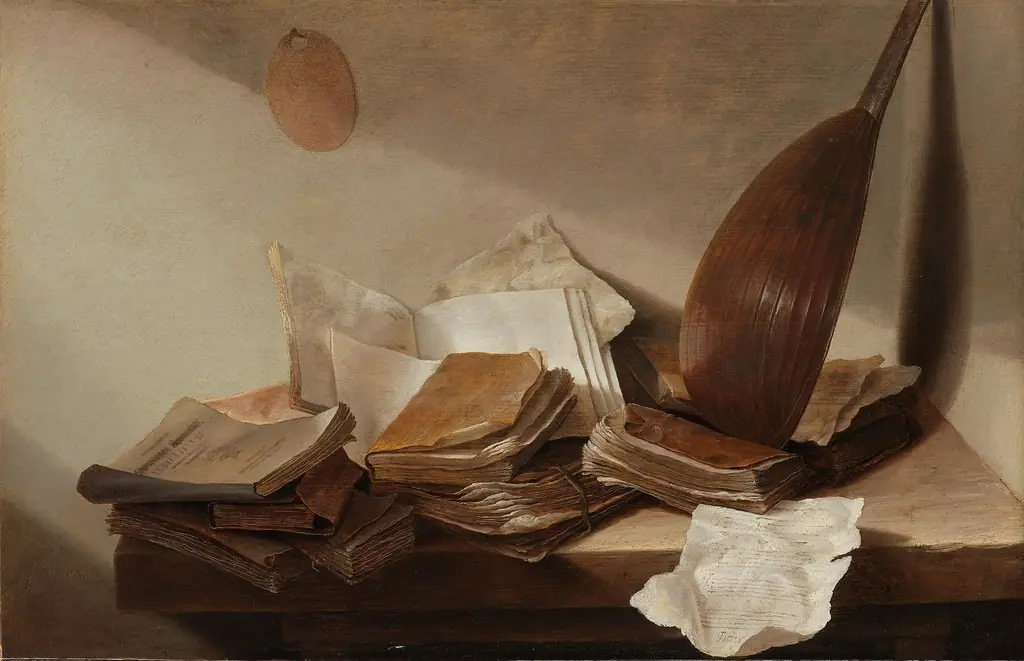
Still Life with Books
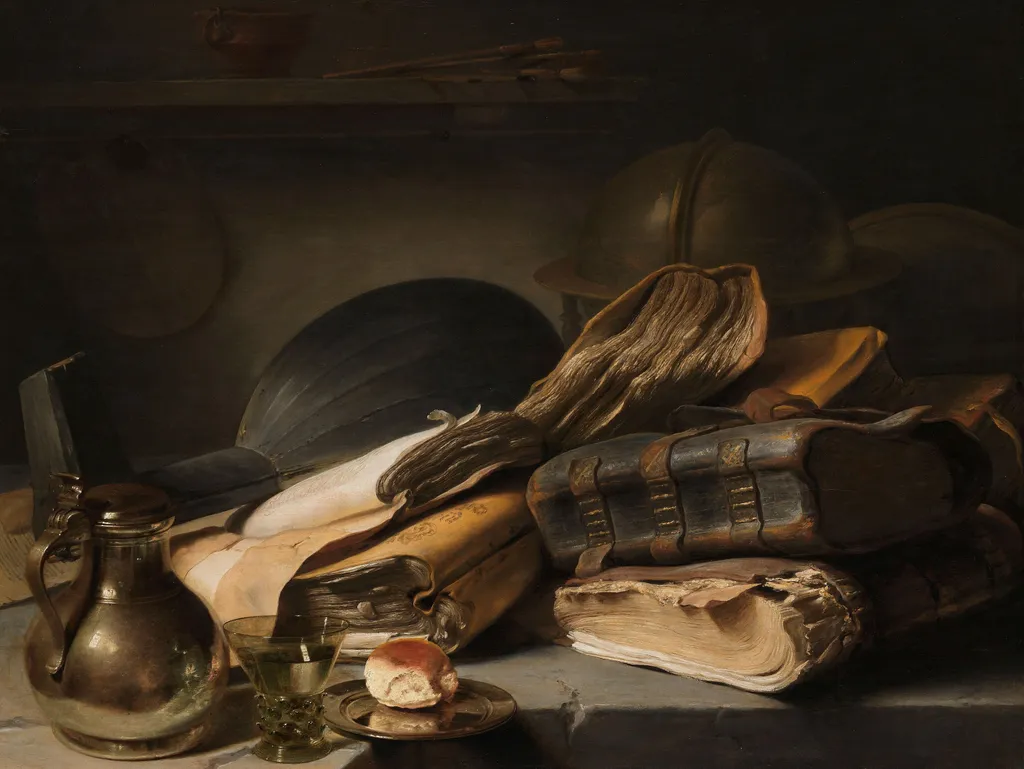
Still Life with Books is an oil painting by the Dutch Golden Age artist Jan Lievens. It dates from 1620 and is held in the collection of the Rijksmuseum.
About this work
Subject & Meaning
, propose the bread alludes to the Eucharist, introducing a spiritual dimension that complicates a purely secular vanitas reading.
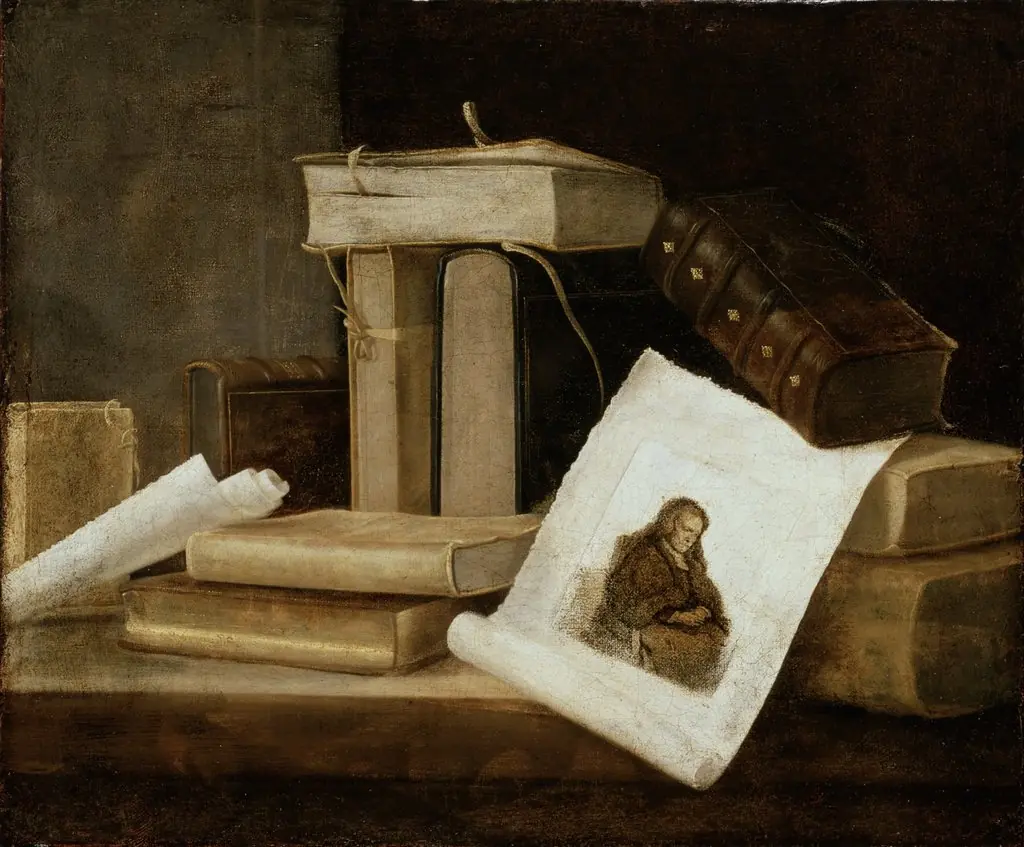
Still Life with Books is widely interpreted as a vanitas composition, a genre that uses symbolic objects to reflect on mortality and the transience of worldly possessions. The painting’s ledgers, empty bindings of worn leather or parchment, are central to this reading, their ruined state signaling the decay of knowledge and record-keeping over time. Art historian Pieter J.J. van Thiel further suggests these are not scholarly tomes but ledger files, linking them to professions such as moneychangers or tax collectors whose materials deteriorate, reinforcing the theme of moral and material decline.
The inclusion of a lute case, rather than a lute itself, is identified as an unusual feature; van Thiel notes that while lutes commonly appear in still lifes, their cases rarely do, adding an element of arrested potential. The juxtaposition of discarded items in the background with fresher elements like the bread roll in the foreground underscores the contrast between decay and fleeting vitality. Some scholars, including Arthur K. Wheelock Jr., propose the bread alludes to the Eucharist, introducing a spiritual dimension that complicates a purely secular vanitas reading.
Technique & Style
Created circa 1627–1628, Still Life with Books is an oil-on-panel painting measuring 91 cm by 120 cm. The work exemplifies Dutch realism and the vanitas genre, characterized by meticulous rendering of materials such as leather or parchment book bindings, pewter vessels, and a Berkemeyer glass. The composition contrasts fresh elements in the foreground with worn, discarded items in the background, utilizing a lighting scheme that fades toward the rear. Technical analysis via X-radiography revealed significant handling complexities; the central pitcher was painted over an incomplete book, while the bread roll, glass, jug, and plate appear to have been added after the initial completion, possibly as a late inspiration or by another hand.
The ledger bindings are depicted with specific structural details, including limp covers and laced supports, some showing signs of deterioration.
History & Provenance
The painting Still Life with Books was created by Jan Lievens circa 1627–1628 as an oil-on-panel work. For many years, the piece was misattributed to Rembrandt, likely due to the artists sharing a studio, until modern scholarship confirmed Lievens as the creator. Technical analysis via X-radiography revealed that the pitcher was painted over an incomplete book and that items on the left, including the bread roll and glass, were added after the initial completion, possibly as a late inspiration or by another hand.
The work remained in private ownership in England until the 20th century, passing through dealers Basil Wheeler and Han Jüngeling, and was sold to P. Potter by Montpellier Galleries in London. From 1960 to 1963, it was loaned to the Dordrechts Museum before being acquired by the Rijksmuseum in 1963. It was later exhibited at the Milwaukee Art Museum in 2009.
Still Life with Books has been held by the Rijksmuseum in Amsterdam since 1963, when the museum purchased the painting. It is also associated with the Dordrechts Museum, which received it on loan from 1960 to 1963 through the dealer Han Jüngeling of The Hague, who had acquired it on 28 April 1960. Before that, it passed through the London dealer Basil Wheeler, was sold to P. Potter by Montpellier Galleries, and had earlier been privately owned in England.
The painting's documented exhibition history includes a loan to the Milwaukee Art Museum from 6 February to 26 April 2009 for the show "Out of Rembrandt's Shadow," and it appears in the exhibition record associated with the Jan Lievens presentation referenced as "Jan Lievens: a Dutch master rediscovered."
Context
Still Life with Books (c. 1627–1628) is an oil‑on‑panel work by Jan Lievens, classified as a Dutch vanitas still life. For many years the painting was mistakenly attributed to Rembrandt, a misattribution resolved only after renewed study confirmed Lievens’ authorship.
The work entered the Rijksmuseum collection in 1963 and has since been exhibited internationally, including a 2009 showing at the Milwaukee Art Museum. Critics have described it as “complex and richly inconsistent” and as a “large and deceptively simple” example of Dutch realism, emphasizing its meticulous rendering of leather bindings and worn objects.
Scholarly analysis notes X‑ray evidence of later additions and debates over whether the ledger books function as symbols of mortality, situating the piece at the intersection of attribution history, Lievens‑Rembrandt collaboration, and 17th‑century vanitas traditions.
Legacy
The painting’s contested authorship shaped its reception for centuries. For decades after its creation, Still Life with Books was attributed to Rembrandt, a misattribution encouraged by Lievens’s early collaboration with the master in a shared studio. Technical examination in 2014 at the Rijksmuseum confirmed Lievens’s authorship, prompting a reevaluation of his oeuvre.
Its legacy rests on scholarly debates over meaning and method. Art historians describe the work as complex and deceptively simple, noting tensions between vanitas conventions and quotidian realism. Interpretations diverge: some emphasize mortality through subtle cues, while others read the ledgers as practical archives rather than symbolic books.
The painting’s layered composition, revealed by X-radiography, sparked discussion about later additions and the artist’s process, reinforcing its status as a touchstone for debates on Dutch still life.
Overview
Jan Lievens's Still Life with Books, painted around 1627
1628, is an oil-on-panel work that exemplifies key artistic trends of the Dutch Golden Age. This painting is recognized as a significant example of the vanitas genre, a type of still life that often incorporates symbolic objects to reflect on the transience of life and the futility of worldly pursuits. It also demonstrates the period's emphasis on detailed and naturalistic representation, characteristic of Dutch realism.
Own this work as a print
Artist & collection

Artist
Jan Lievens (24 October 1607 – 4 June 1674) was a Dutch Golden Age painter who was associated with his close contemporary Rembrandt, a year older, in the early parts of their careers.