Artwork
Hackensack Meadows
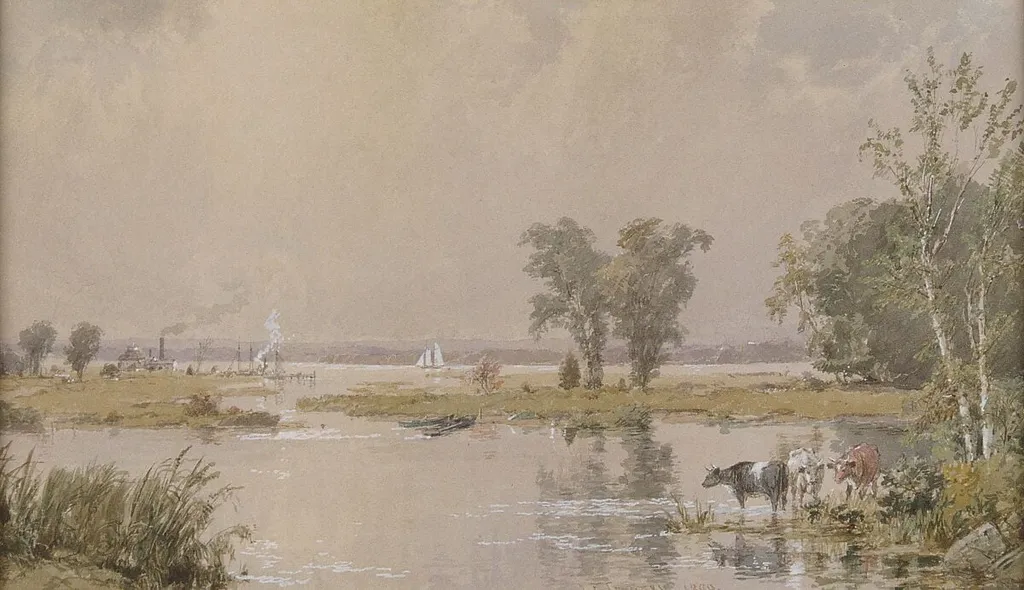
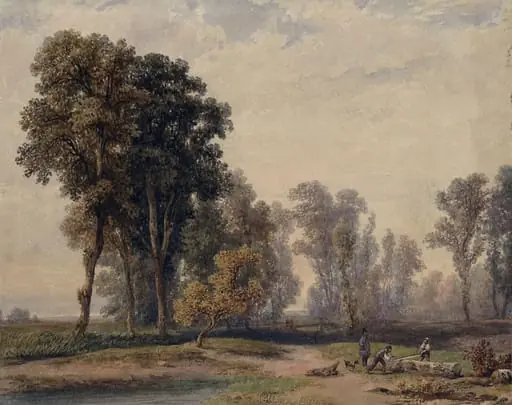
Hackensack Meadows is a gouache work on paper by the Hudson River School artist Jasper Francis Cropsey. It dates from 1890 and is held in the collection of the Metropolitan Museum of Art.
About this work
Subject & Meaning
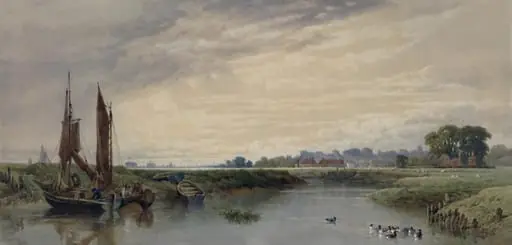
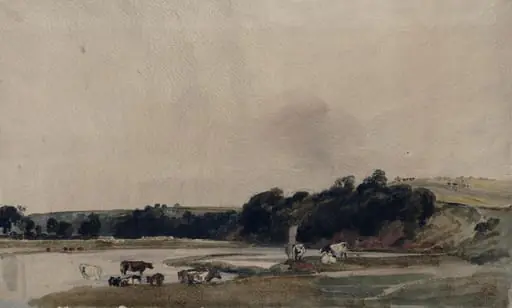
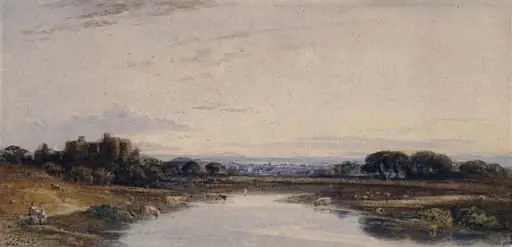
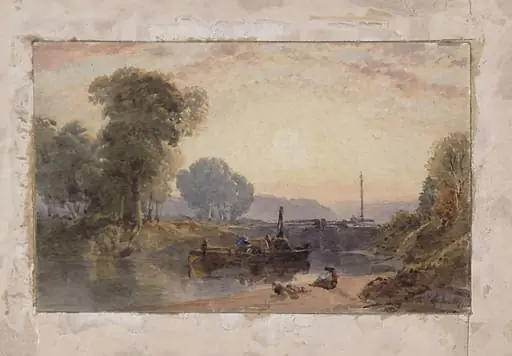
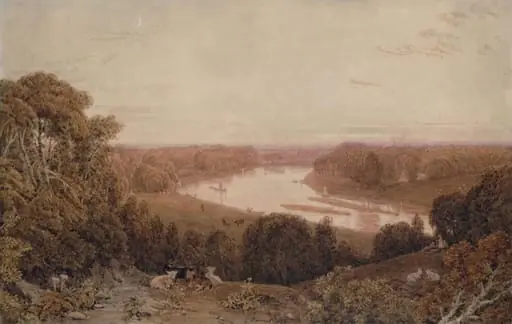
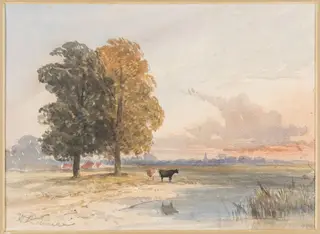
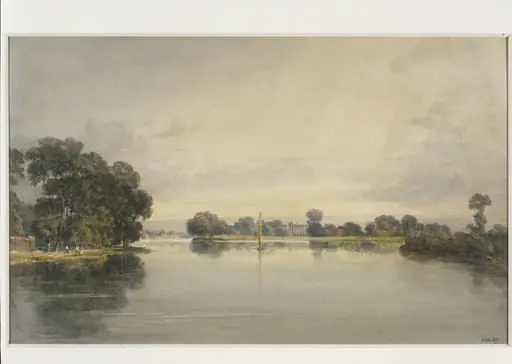
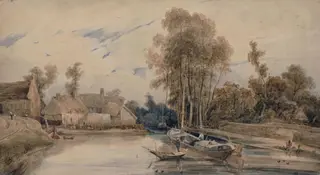
Created in 1890, this watercolor and gouache landscape by Jasper Francis Cropsey depicts the New Jersey Meadowlands, also known as the Hackensack Meadows.
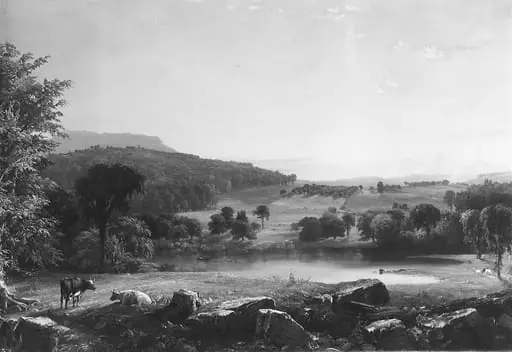
Created in 1890, this watercolor and gouache landscape by Jasper Francis Cropsey depicts the New Jersey Meadowlands, also known as the Hackensack Meadows. The composition features a naturalistic scene incorporating hills, trees, a river, and a lake under a sky filled with clouds. Human presence and industry are subtly integrated through the inclusion of cattle grazing, a sailboat on the water, and a chimney emitting smoke.
As a work within the American landscape genre, the piece documents the specific topography of the region while balancing rural agriculture with early signs of development. The iconography relies on these tangible elements to represent the character of the meadowlands during the late nineteenth century, capturing both the serene environment and the encroaching markers of settlement.
Technique & Style
The work Hackensack Meadows is executed in watercolor and gouache with graphite underdrawing on off-white wove paper, a support typical of Cropsey's late-19th-century landscape studies. The layered application of translucent washes creates a delicate atmospheric effect, while the graphite outlines define foliage and terrain features. Cropsey's handling of light emphasizes the sky and water, producing a luminous, almost photographic clarity within the composition.
The formal arrangement balances foreground vegetation with distant horizon, reinforcing the genre's realist emphasis on natural detail. Condition details are not recorded in the available documentation.
History & Provenance
The watercolor and gouache work Hackensack Meadows by Jasper Francis Cropsey is dated to 1890 based on internal records and the Metropolitan Museum of Art's collection documentation. It entered the museum's holdings as part of its American Wing collection, where it remains housed. The sheet's medium, watercolor, gouache, and graphite on off-white wove paper, aligns with Cropsey's late-career practice of combining transparent and opaque water-based pigments to render luminous, atmospheric landscapes.
The subject, the New Jersey Meadowlands, reflects Cropsey's sustained interest in documenting the Hudson River School's characteristic terrain during his final decade.
Overview
Jasper Francis Cropsey's 'Hackensack Meadows' (1890) is a late-career watercolor, gouache, and graphite work on off-white wove paper that captures the pastoral landscape of New Jersey. Executed when the artist was sixty-seven, the painting demonstrates his sustained commitment to the Hudson River School aesthetic, focusing on the specific topography of the Hackensack River valley. The composition features a winding river cutting through expansive green meadows, populated by grazing cattle under a luminous sky.
Cropsey employs a technique characteristic of his mature watercolors, utilizing fine, deliberate strokes to render individual blades of grass and foliage with meticulous detail. The application of watercolor allows light to penetrate the paper, creating a sense of atmospheric depth and vitality, while the addition of gouache provides opaque highlights and structural definition to the foreground elements. This work reflects Cropsey's enduring interest in the American landscape during the late 19th century, blending scientific observation of nature with a romanticized vision of rural tranquility.
It stands as a testament to his technical mastery in the watercolor medium, maintaining the precision and coloristic vibrancy for which he was renowned throughout his long career.
Artist & collection
Artist
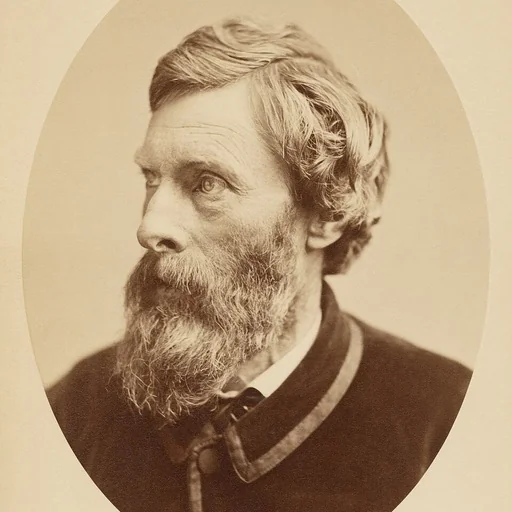
Jasper Francis Cropsey was an American architect and artist. He is best known for his Hudson River School landscape paintings.