Artwork
Portrait of Count Nikolay Guryev
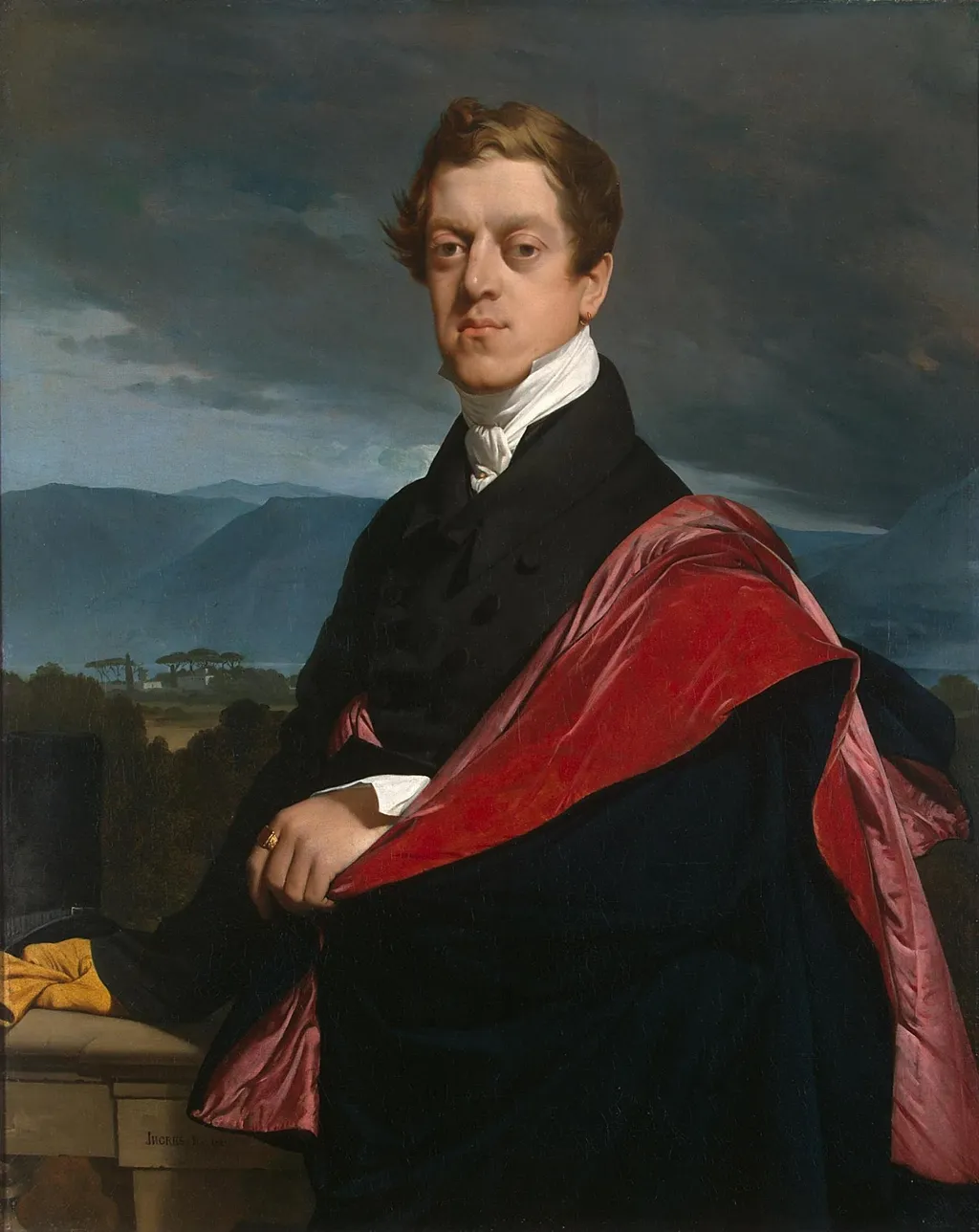
Portrait of Count Nikolay Guryev is an oil painting by the Neoclassicist artist Jean Auguste Dominique Ingres. It dates from 1821 and is held in the collection of the Hermitage Museum.
About this work
Subject & Meaning
These iconographic choices highlight the subject's stern demeanor and aristocratic status during his tenure as ambassador in Rome and Naples.
The work depicts Count Nikolay Dmitrievitch Gouriev, a Russian diplomat and former military officer, portrayed in a three-quarter view leaning against a balustrade. Set against an Italian landscape featuring stone pines and hills under a stormy sky, the composition emphasizes the subject's transition from military service to diplomacy. Visual elements such as the black jacket, crimson-lined overcoat, and pink scarf create a distinct barrier between the viewer and the sitter, according to art historian Robert Rosenblum.
The Count's expression, characterized by a determined chin and slight strabismus, combined with his high collar and white cravat, conveys an aura of rigidity and austerity. His right hand rests on the parapet holding a glove, while his left grips his coat, and a black top hat sits nearby. These iconographic choices highlight the subject's stern demeanor and aristocratic status during his tenure as ambassador in Rome and Naples.
Technique & Style
The portrait was executed in oil on canvas, a standard support for Ingres’s neoclassical practice. Technical examination notes the work’s dimensions of 107 × 86 cm and its creation in France, confirming the use of a stretched canvas. Ingres’s handling is evident in the delicate rendering of the sitter’s coat, the crisp delineation of the balustrade, and the subtle chiaroscuro that models the figure’s austere expression.
The composition features a three‑quarter view, a pink sash creating a visual barrier, and a signed inscription "Ingres Fl(orence) 1821" on the parapet. The painting remains well‑preserved, retaining its original palette and brushwork.
History & Provenance
The portrait was executed in 1821 in Florence, commissioned by Count Nikolai Dmitrievich Guryev, a Russian diplomat who had previously served as aide‑de‑camp to Emperor Alexander I (date and commission reflected in. Ingres signed it “Ingres Fl(orence) 1821” on the parapet. After the sitter’s death in 1849 the work remained in his family, passing to his widow, then to E. D. Narychkina (until 1871) and A. N. Narychkina (until 1922) (provenance chain in. The Hermitage Museum acquired the canvas in 1922 (inventory 5678). The painting measures 107 × 86 cm and was created amid Ingres’s Florentine period, a time marked by financial strain and rivalry with François‑Xavier Fabre, whose pendant portrait of the countess was rejected.
Since 1922, the portrait has been held in the collection of the Hermitage Museum, where it is registered under inventory number 5678. Prior to this acquisition, the work remained in private hands following its commission by the sitter, Count Nikolay Guryev, who retained it until his death in 1849. Ownership subsequently passed to his descendants, including his widow until 1871, followed by E.D. Narychkina until 1889, and A.N. Narychkina until the museum purchased it in 1922.
While the painting is documented in major scholarly catalogs and was featured in the 1999 Metropolitan Museum of Art exhibition 'Portraits by Ingres: Image of an Epoch,' specific records regarding other public exhibitions are not detailed in the available sources.
Context
Created during Ingres’s Florentine period (1820–1824), the Portrait of Count Nikolay Guryev (1821) exemplifies the artist’s Neoclassical approach to portraiture within a broader European context marked by shifting aesthetic hierarchies after David. The work’s restrained composition and psychological intensity reflect Ingres’s engagement with Renaissance prototypes and his evolving dialogue with Romantic currents, as seen in the stormy Italianate backdrop and the sitter’s averted gaze. Scholarly assessments emphasize the painting’s significance as a counterpoint to François-Xavier Fabre’s contemporaneous rejected portrait of the countess, underscoring Ingres’s competitive positioning within Florence’s expatriate art scene.
Critics such as Robert Rosenblum highlight the deliberate barrier created by the sitter’s crimson-lined coat and pink sash, framing the work as a study in aristocratic reserve. The portrait’s acquisition by the Hermitage in 1922 further situated it within Soviet-era museological narratives of French neoclassicism, consolidating its place in the canon of Ingres’s mature oeuvre.
Legacy
The portrait of Count Nikolay Guryev remains in the Hermitage Museum’s collection (inventory 5678) and has been featured in major Ingres retrospectives, most notably the 1999 exhibition at the Metropolitan Museum of Art, which highlighted its significance within the artist’s later oeuvre. Scholars such as Robert Rosenblum have emphasized its psychological depth and compositional rigor, influencing subsequent studies of Neoclassical portraiture. The work’s continued presence in academic catalogues and museum displays underscores its lasting reputation among historians of 19th‑century art.
Overview
This oil painting, Portrait of Count Nikolay Guryev, was completed by the French artist Jean Auguste Dominique Ingres in 1821. It captures the likeness of Count Nikolay Guryev, a prominent figure of the era. The work exemplifies Ingres's Neoclassical approach to portraiture and is currently housed in the collection of the State Hermitage Museum.
Own this work as a print
Artist & collection

Artist
Jean-Auguste-Dominique Ingres was a French Neoclassical painter. Ingres was profoundly influenced by past artistic traditions and aspired to become the guardian of academic orthodoxy against the ascendant Romantic…

- Portrait of Andrei Mikhailovich Bolotov
 Dr. Connell
 Edward Parry
 Industrimanden og politikeren I.C. Drewsen
 Portrait of Jonas Daniel Meijer, Lawyer
 Andrew Spottiswoode
 John Myers
 David Sears, Jr.
 Portrait of Jonas Daniel Meijer (1780-1834)
 Portrait of Pavel Masyukov, the Cavalry Captain of the Life-Guards Hussar Regiment
 Industrimanden og politikeren I.C. Drewsen