Artwork
Charon and the Souls of the Dead
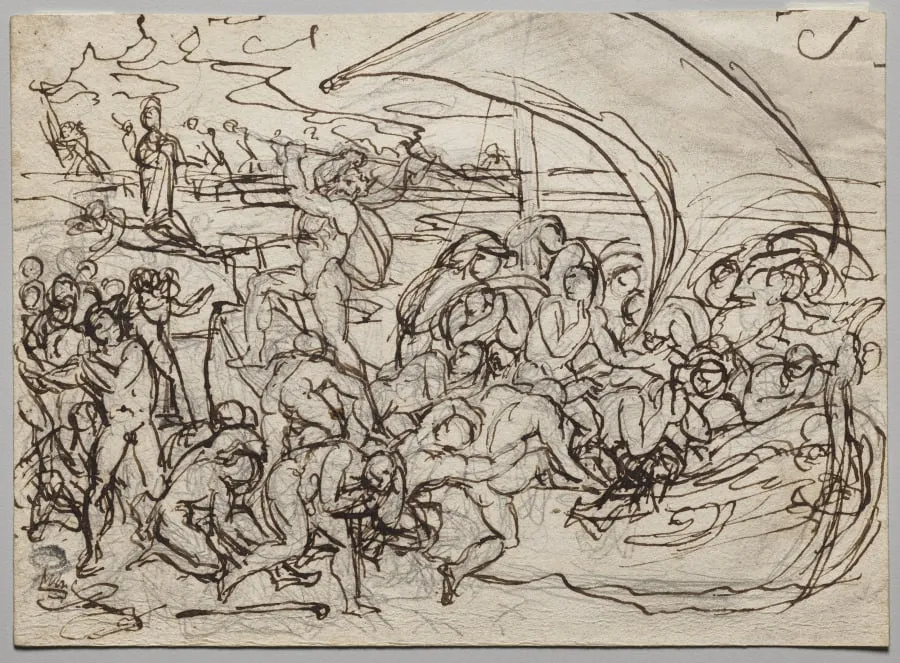
Charon and the Souls of the Dead is a drawing by the Impressionist artist Jean-Baptiste Carpeaux. It dates from 1858 and is held in the collection of the Cleveland Museum of Art.
- Accession no.
- 2019.251
- Credit line
- Bequest of Muriel Butkin
About this work
Overview
This ink and wash drawing by Jean-Baptiste Carpeaux depicts Charon, the mythological ferryman, guiding a throng of naked souls across the underworld river. Executed during his stay in Rome, it served as a preparatory study for an unfinished painting. The composition’s dense, agitated forms suggest a moment frozen in transition, revealing Carpeaux’s engagement with monumental human expression.
Subject & Meaning
Charon, cloaked and silent, steers a vessel overloaded with the dead, bodies contorted in anguish, desperation, or resignation. The scene draws from classical mythology, where the ferryman transports souls to Hades. Carpeaux emphasizes the weight of mortality through physical compression, rendering the afterlife not as serene passage but as a burdened, chaotic transit.
Technique & Style
Carpeaux employed rapid, expressive ink lines and layered washes to model forms with dramatic contrast. The figures are stacked and interlocked, echoing Michelangelo’s torsioned musculature and dynamic groupings. The lack of clear spatial depth and the emphasis on overlapping bodies create a sense of claustrophobic motion, characteristic of his preparatory studies for larger works.
History & Provenance
Created during Carpeaux’s tenure at the French Academy in Rome, the drawing reflects his intensive study of Renaissance and classical sculpture. Though the intended painting was never completed, this sketch survived as a standalone work. Its survival suggests its value as a document of his creative process, capturing a moment of artistic exploration before the project was abandoned.
Context
In mid-19th-century France, mythological themes remained central to academic training, even as realism gained traction. Carpeaux’s focus on Charon aligns with contemporary interest in dramatic, emotional narratives drawn from antiquity. His Rome years exposed him to Michelangelo’s legacy, which informed his approach to the human form as a vessel for psychological intensity.
Legacy
Though the painting never materialized, this drawing endures as a powerful example of Carpeaux’s ability to convey emotional gravity through movement and mass. It illustrates how preparatory works can outlive their intended outcomes, offering insight into an artist’s process and the unresolved tensions within ambitious projects.
Artist & collection

Artist
Jean-Baptiste Carpeaux (French pronunciation: ; 11 May 1827 – 12 October 1875) was a French sculptor and painter during the Second Empire under Napoleon III.

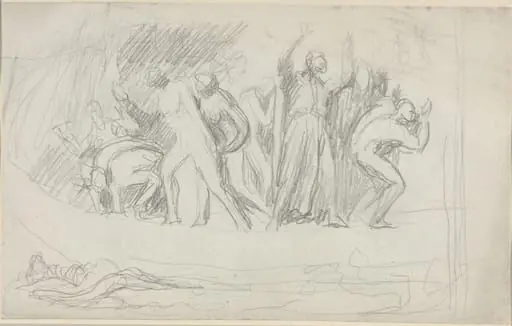
- Study for "The Deluge"
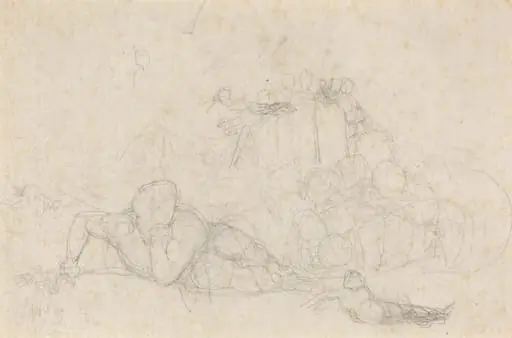 Sheet of Studies
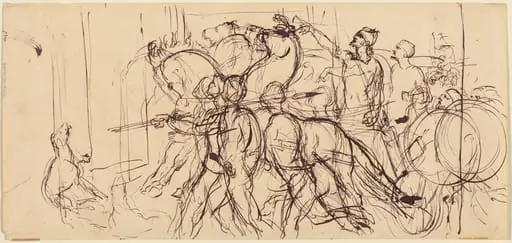 Charioteers
![Xenophon and the Greeks Sighting the Sea [recto], by Benjamin Robert Haydon](https://artifactworldgallery.com/img/benjamin-robert-haydon--xenophon-and-the-greeks-sighting-the-sea-recto--0775cd64b855201c-w320.webp) Xenophon and the Greeks Sighting the Sea [recto]
Xenophon and the Greeks Sighting the Sea [recto]![Sheet of Studies [recto and verso], by John Flaxman](https://artifactworldgallery.com/img/john-flaxman--sheet-of-studies-recto-and-verso--5d19d38e20f446c0-w320.webp) Sheet of Studies [recto and verso]
Sheet of Studies [recto and verso]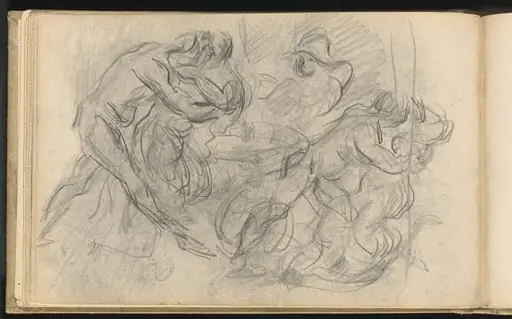 Carnival Scene
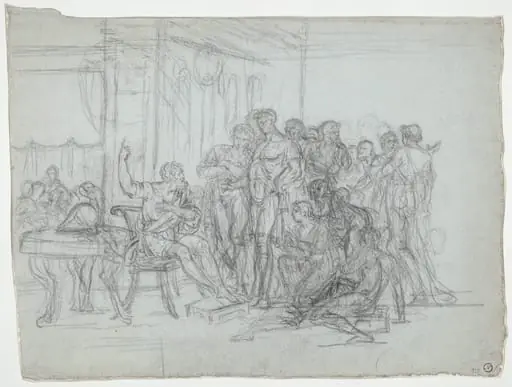 Timoleon Thanked by the Citizens of Syracuse
 Sheet of Studies
 Two sketches of groups of Chinese figures
 Study of Neptune and Sea Creatures (?)
 Rats
Rats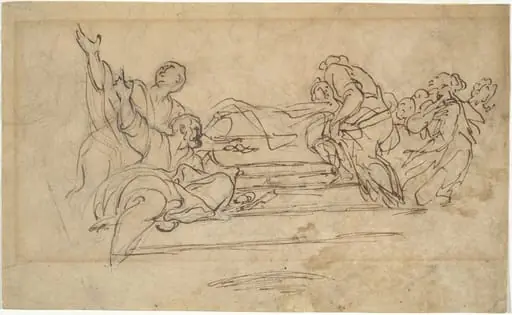 Figures on Steps (Studies for an Assumption of the Virgin)