Artwork
Party of Armenians Playing Cards
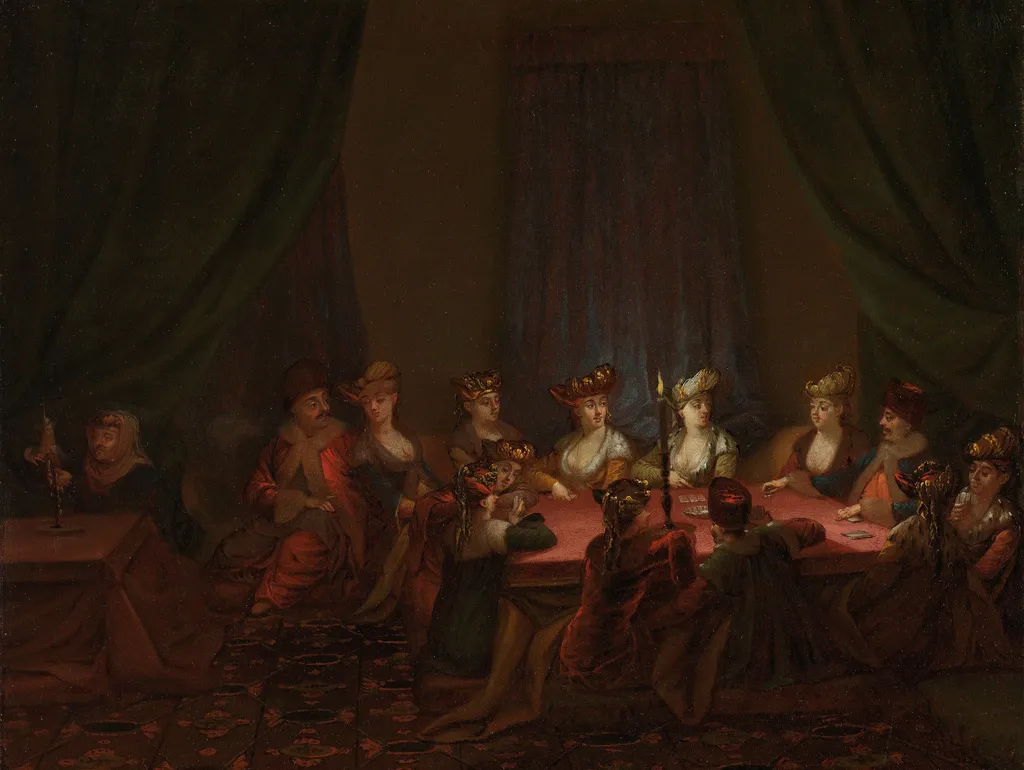
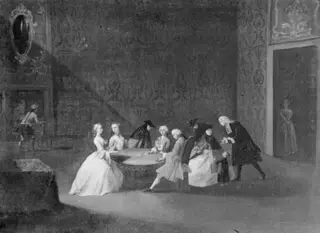
Party of Armenians Playing Cards is an oil painting by the Rococo painting artist Jean Baptiste Vanmour. It dates from 1728 and is held in the collection of the Rijksmuseum.
About this work
Subject & Meaning
The scene likely reflects European curiosity about Armenian life in Ottoman or Levantine contexts, framed through the lens of sociability and domestic routine.
The painting depicts a group of Armenians engaged in a card game, an everyday social activity rendered in a genre-scene format. The work centers on male figures seated around a draped table, their postures and expressions conveying conversation and leisure rather than conflict or solemnity. The composition emphasizes the act of play as a shared cultural practice, situating it within the broader visual tradition of 18th-century European depictions of non-Western social customs.
The scene likely reflects European curiosity about Armenian life in Ottoman or Levantine contexts, framed through the lens of sociability and domestic routine. Such images served to document cultural difference while domesticating it within the conventions of European genre painting.
Technique & Style
Created in 1728, this genre scene is executed in oil paint on a canvas support. The work measures 44.5 cm in height and 58.5 cm in width. Stylistically, the composition focuses on a group of Armenians engaged in a card game, reflecting the artist's detailed approach to depicting social interactions within specific cultural contexts.
The application of oil allows for the rendering of textures and figures characteristic of the period's genre painting.
History & Provenance
The painting Party of Armenians Playing Cards was created in 1728 by Jean Baptiste Vanmour as an oil on canvas work measuring 44.5 cm by 58.5 cm. It entered the collection of Cornelis Calkoen and later passed to his relative Nicolaas Calkoen. The work was acquired by the Rijksmuseum, where it remains in the institution's holdings. Its subject depicts a card game, reflecting genre scene practices of the period.
The painting is part of the Rijksmuseum's Directie van de Levantse handel en de Navigatie op de Middellandse Zee, Koninklijk Kabinet van Zeldzaamheden, Nederlandsch Museum voor Geschiedenis en Kunst collection.
Party of Armenians Playing Cards, painted by Jean Baptiste Vanmour in 1728, is held in the collection of the Rijksmuseum. According to the work's provenance record, it was formerly owned by Cornelis Calkoen and Nicolaas Calkoen, and passed through the collections of the Directie van de Levantse handel en de Navigatie op de Middellandse Zee, the Koninklijk Kabinet van Zeldzaamheden, and the Nederlandsch Museum voor Geschiedenis en Kunst before reaching the Rijksmuseum. No specific inventory or accession number is recorded in the available sources, and no exhibition history is documented.
Overview
Jean Baptiste Vanmour’s 1728 oil painting, Party of Armenians Playing Cards, captures a convivial gathering within a dim interior. Rendered in the light‑filled palette of the Rococo, the work presents a group of Armenian figures around a table, their richly dressed forms illuminated against a darker backdrop. The composition balances activity and restraint, offering a snapshot of social interaction in the early eighteenth‑century Ottoman world.
Own this work as a print
Artist & collection
Artist
Jean Baptiste Vanmour or Van Mour (9 January 1671 – 22 January 1737) was a Flemish-French painter, remembered for his detailed portrayal of life in the Ottoman Empire during the Tulip Era and the rule of Sultan Ahmed III.